
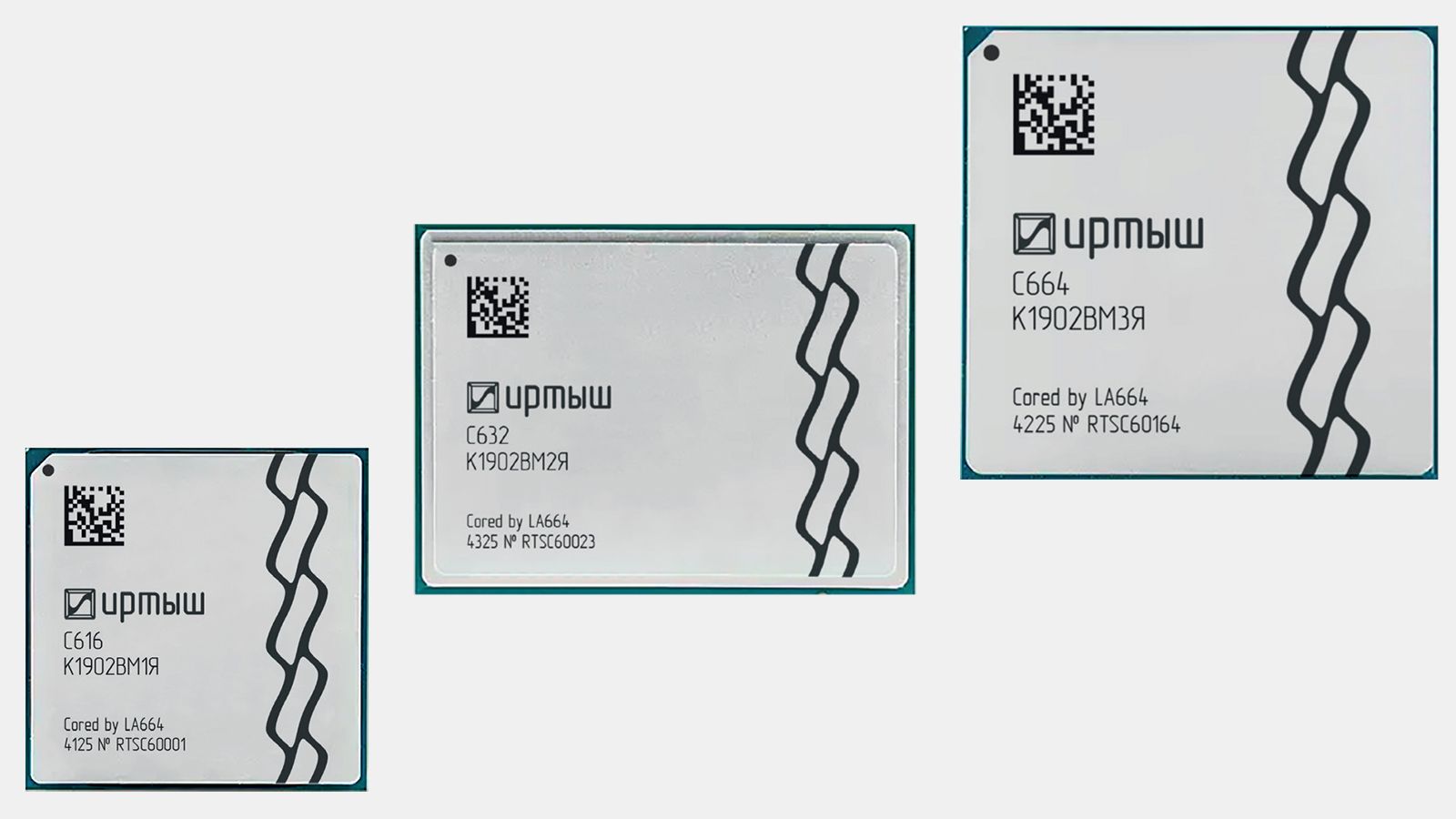
Tramplin Electronics claims that it has obtained its 16-core Irtysh C616 and 32-core Irtysh C632 processors for sovereign data centers and HPC applications. Notably, Russian firms cannot rely on industry-standard x86 CPUs from AMD and Intel because they are sanctioned by the US and cannot be legally obtained from nearby countries. You can see the Russian chips in the flesh by expanding the tweet below.
Сибирская компания Трамплин получила свои первые инженерные образцы процессоров Иртыш с системой команд и архитектурой ЛонгАрч, лицензированной у Китая и доработанной в РоссииС616 на 16 ядерС632 на 32 ядраЭто аналоги Intel Xeon Gold 6338 и AMD Zen 3#RuChip #InnoRu #PureRu pic.twitter.com/XhfYRRZe9N March 12, 2026
The company's product catalogue also includes the 64-core Irtysh C664. The CPUs are based on the LA664 microarchitecture that features a 6-way out-of-order execution and simultaneous multi-threading (SMT) technology, as well as support 128-bit vector processing extension instructions (LSX) and 256-bit advanced vector processing extension instructions (LASX) for the new CPUs. Loongson and its Russian ally Tramplin claim that LA664-based CPUs are competitive against AMD's Zen 3 and Intel's Ice Lake-based offerings .
You may like China-made Loongson 12-core chip is approximately three times slower than six-core Ryzen 5 9600X Intel keeps socket LGA 1700 alive with new P-core-only CPUs Nvidia's Chinese competitor Moore Threads launches new "MTT AI Book" laptop featuring custom 12-core Arm chip Among the advantages of the Irtysh processors, Vasily Vorobushkov, director of development at Tramplin Electronics, cited a proprietary boot environment, high energy efficiency, stable production, and uninterrupted supply. Development is said to be handled by the company's own team of engineers and designers, along with partner companies that build complete hardware-software solutions. The company is also said to operate its own design center focused on developing domestic IP blocks and maintains a broad ecosystem, though Vorobushkov did not elaborate on which blocks and elements of the ecosystem have been developed by Tramplin so far.
The specifications of Tramplin's 16-core Irtysh C616 (2.20 GHz, 32MB L3, quad-channel DDR4-3200 memory, 844.8 GFLOPS, 100W – 120W TDP) and 32-core Irtysh C632 processors (2.10 GHz, 64MB L3, octa-channel DDR4-3200 memory, 1612.8 GFLOPS, 180W – 200W TDP) are identical to those of Loongson's 16-core LS3C6000/S and 32-core LS3C6000/D CPUs down to a single number, which isn't something that happens usually unless we are dealing with the very same silicon.
Indeed, Tramplin Electronics was first registered on April 4, 2025 , so the company is less than a year old. It is impossible to develop a processor from scratch (even based on a known/licensed ISA), find a production partner, build its physical design, tape it out, and get samples in this short of a time frame. In fact, a year is barely enough to bring up a new CPU based on an existing platform (this may easily take a couple of years for a company of AMD's or Intel's size), not to mention developing one from scratch. That said, even though the processors were made in the third week of 2026, it looks like these are regular Loongson LS3C6000 CPUs that carry Cyrillic inscriptions.
Now that Russia-based entities cannot legally obtain high-performance CPUs from companies like AMD or Intel, the only way for the country to retain access to more or less contemporary processors is to buy them illegally in nearby countries, or get Chinese processors from the People's Republic. Apparently, we are dealing with the second option here, albeit with an attempt to disguise Chinese processors as those developed in Russia. Interestingly, the source of the river Irtysh — after which the CPUs are named — is in China.
Get Tom's Hardware's best news and in-depth reviews, straight to your inbox.
Key considerations
- Investor positioning can change fast
- Volatility remains possible near catalysts
- Macro rates and liquidity can dominate flows
Reference reading
- https://www.tomshardware.com/pc-components/cpus/SPONSORED_LINK_URL
- https://www.tomshardware.com/pc-components/cpus/11-month-old-russian-outfit-claims-it-has-developed-16-core-and-32-core-processors-flaunts-cyrillic-badged-processors-chips-appear-to-be-sanctions-swerving-rebadged-chinese-loongson-processors#main
- https://www.tomshardware.com
- Shopper scores $1,000 in PC hardware for just $86 in a shocking pricing glitch — Newegg shrugs off massive loss and responds with a thumbs-up emoji
- 11-month old Russian outfit claims it has developed 16-core and 32-core chips, flaunts Cyrillic-badged processors — chips appear to be sanctions-swerving rebadg
- Microsoft confirms next-gen Xbox, codenamed Project Helix, will be powered by custom AMD SoC and feature 'FSR Diamond' — 'Xbox Mode' is also coming to Windows 1
- Save $800 on this MSI desktop with RTX 5070, 2TB SSD, and 32GB of RAM — get an Intel Core Ultra 265K gaming rig for just $1,899
- 11-month old Russian outfit claims it has developed 16-core and 32-core chips, flaunts Cyrillic-badged processors — chips appear to be sanctions-swerving rebadg
Informational only. No financial advice. Do your own research.