
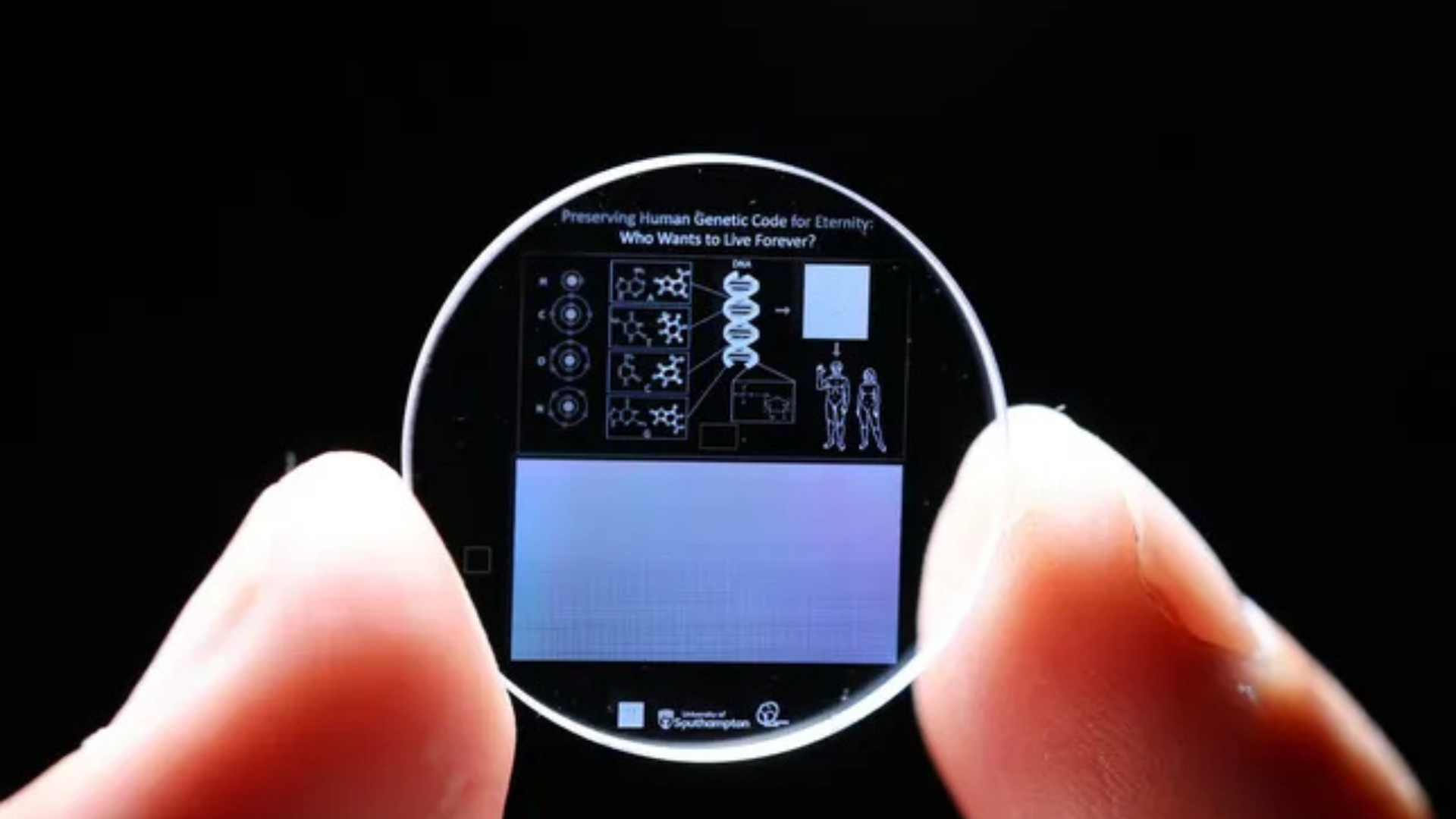
A startup called SPhotonix says its fused-silica 'memory crystal' has reached a deployment-ready milestone for cold data.
When you purchase through links on our site, we may earn an affiliate commission. Here’s how it works .
(Image credit: SPhotonix) Share Share by: Copy link Facebook X Whatsapp Reddit Flipboard Share this article Join the conversation Follow us Add us as a preferred source on Google SPhotonix says it has moved its so-called 5D Memory Crystal technology out of the lab and closer to real-world deployment, outlining plans to pilot glass-based cold storage systems in data centers over the next two years, according to remarks made during an interview with The Register . The UK start-up, spun out of research at the University of Southampton and founded in 2024, made the announcement alongside details of its first round of external funding.
The company’s storage medium is a fused silica glass platter, written using a femtosecond laser that encodes data in nanoscale structures. Information is stored across five dimensions: three spatial coordinates (x, y, z), plus the orientation and intensity of the nanostructures, which are read back optically using polarized light. SPhotonix claims a single 5-inch glass disc can hold up to 360TB of data, with the media designed to be stable for 13.8 billion years — the estimated age of the universe — assuming there are no external mishaps along the way.
According to SPhotonix, its current prototypes achieve write speeds of around 4 MBps and read speeds of roughly 30 MBps. Those figures place the technology well below existing archival systems today, but the company has published a roadmap targeting sustained read and write speeds of 500 MBps within three to four years.
'World's first scalable DNA data storage offering' announced offering a staggering ‘60PB in 60 cubic inches,’ enough to hold 660,000 4K movies
Toshiba touts industry-first 12-disk HDD stacking technology, will pair with microwave-based recording tech
Photonic latch memory could enable optical processor caches that run up to 60 GHz, twenty times faster than standard caches
The company estimates early system costs at approximately $30,000 for a writer and $6,000 for a reader, with a field-deployable reader expected in about 18 months. SPhotonix says it has raised $4.5 million to date and is now working to move from Technology Readiness Level (TRL) 5 to TRL 6, which typically involves validation in relevant operational environments rather than controlled laboratory settings.
In terms of its lifetime longevity, the company describes the media as inherently air gapped, requiring no power to retain data, and suitable for archives where access latencies of 10 seconds or more are acceptable.
SPhotonix is not alone in pursuing non-magnetic cold storage. Microsoft has publicly tested glass media under its Project Silica program , while other startups such as Cerabyte are promoting ceramic-based alternatives aimed at robotic library systems. What differentiates SPhotonix’s approach is its focus on licensing the media and optical platform into existing data center architectures rather than building an end-to-end storage service.
Whether SPhotonix’s 5D glass can transition from impressive density demonstrations to competitive system-level performance will determine if it becomes a niche archival medium or a viable storage solution in modern data centers.
Get Tom's Hardware's best news and in-depth reviews, straight to your inbox.
Key considerations
- Investor positioning can change fast
- Volatility remains possible near catalysts
- Macro rates and liquidity can dominate flows
Reference reading
- https://www.tomshardware.com/pc-components/storage/SPONSORED_LINK_URL
- https://www.tomshardware.com/pc-components/storage/sphotonix-pushes-5d-glass-storage-toward-data-center-pilots#main
- https://www.tomshardware.com
- The Ultimate Black Friday Deal Is Here
- Experiment to train rats to play Doom reaches a new level; rats can now shoot enemies — wraparound AMOLED screen provides virtual environment for neuroengineers
- 2,800 RGB drones turned into the world's largest-ever game of Tetris — Red Bull Tetris world final lights up Dubai night sky
- First truly 3D chip fabbed at US foundry, features carbon nanotube transistors and RAM on a single die — future devices could have up to 1000x improvement in en
- Experiment to train rats to play Doom reaches a new level; rats can now shoot enemies — wraparound AMOLED screen provides virtual environment for neuroengineers
Informational only. No financial advice. Do your own research.