
(Image credit: Tom's Hardware) (Image credit: Tom's Hardware) (Image credit: Tom's Hardware) (Image credit: Tom's Hardware) In the Geekbench CPU test, the Acer posted middling scores, delivering 2,789 points in the single-core portion, to practically tie the Dell but trailing the Zenbook (3,031) and particularly the MacBook (3,780). Its 15,926-point multi-core showing slotted towards the bottom of the group, surprisingly ahead of the MacBook (14,924) but trailing the Zenbook and Dell by a sizable margin.
In our 25GB file transfer test, Acer rebounded with a leading score of 1,745 MBps, outdoing the Dell (1,531 MBps) and leaving the Apple and last-place Asus well behind.
Finally, the Acer demonstrated middling performance in our 4K-to-1080p Handbrake transcoding test, completing the render in 4 minutes and 25 seconds. The Zenbook was within seconds (4:22) while the Dell proved the quickest (3:50) and the Macbook was the slowest (4:52).
We stress test ultrabooks by running Cinebench 2024 ten times sequentially to simulate extended CPU load. The Swift 16 started with 948 points, dipped to 762 points on the second run, but then stabilized around the 900-point mark for the remaining runs, suggesting no obvious performance throttling once the fans spin up.
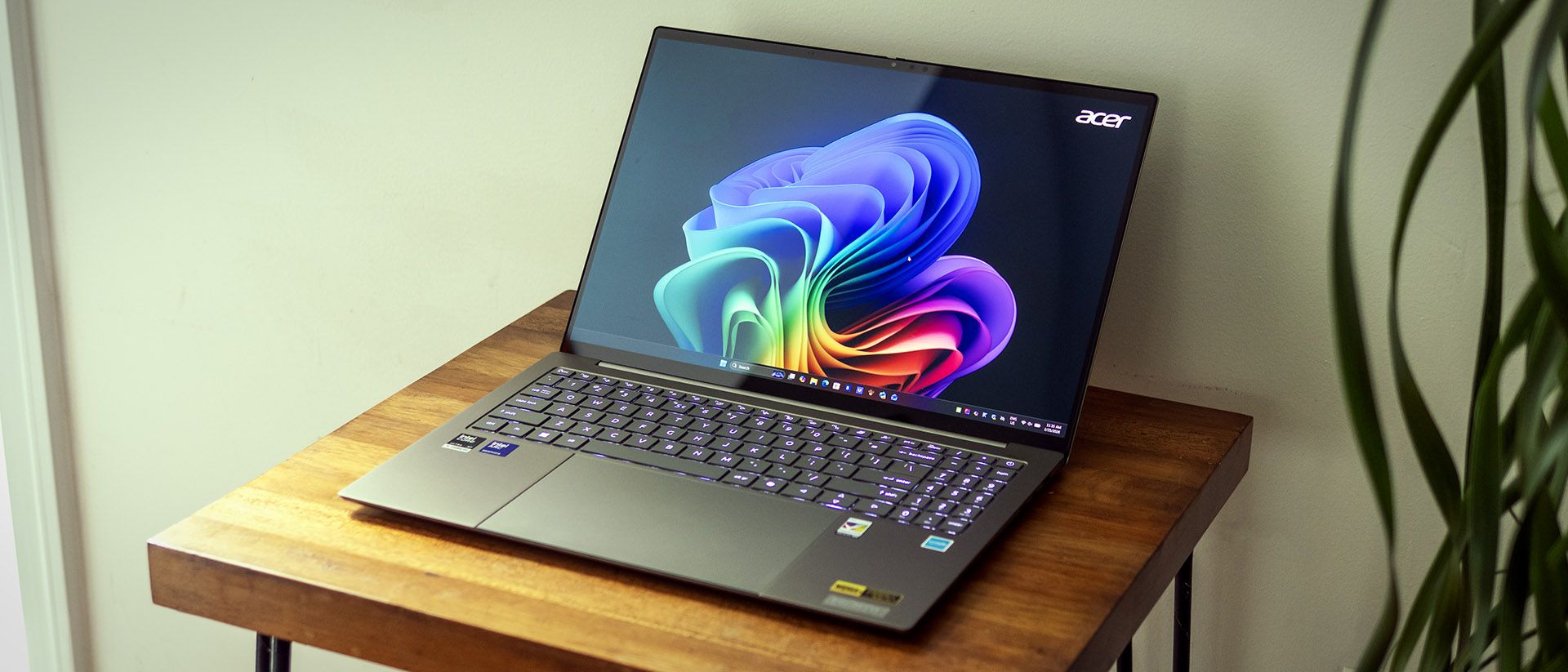
OLED screens rarely fail to impress and this one certainly doesn’t, showing off the rich colors and inky contrast the technology is renowned for. The glossy surface is more reflective than I’d hoped, but the 120 Hz refresh rate makes for smooth scrolling. The refresh rate automatically switches to 60 Hz on battery to conserve power. Note that while the surface supports touch, it does not support the included stylus, which only works on the touchpad.
Watching Silo on Apple TV is a treat on this Acer. While the show’s overall drab tones rarely gave the OLED display a chance to show off its color, it produced immaculate detail in the shadowy and dimly-lit scenes that dominate the show, adding extra depth and an immersion factor to scenes that can’t be experienced without a top-tier display.
Acer’s screen showed remarkable color coverage, with full coverage of DCI-P3, next to the Zenbook’s 87.2% and the MacBook’s 83.5%. It also showed good if not exceptional brightness for an OLED panel, averaging 364 nits, nearly tying the Dell’s 367 nits but trailing the Zenbook’s 476 nits.
This Acer’s full-size keyboard is a joy to type on, with soft but precise feedback and ample up-and-down travel. Bold white backlighting is easily visible in all lighting conditions. The number pad is small, and the arrow keys aren’t all the same size, but the rest of the layout poses no surprises. I nearly reached my top typing speed in MonkeyType, about 114 words per minute with perfect accuracy, on the first try.
Acer calls this the world’s largest haptic touchpad, measuring 6.9 by 4.3 inches. To put that in perspective, it’s only marginally smaller than an Apple iPad mini. For daily use, I found the size unnecessary as my fingers favored the center of the pad, rarely venturing towards the edges except when I used multi-finger sweeping gestures, which felt downright luxurious because of all the space. The haptic feedback accurately simulates a physical click mechanism and can be adjusted for intensity in the Windows Touchpad settings app.
The real reason this touchpad is so large is because it supports MPP styli, and Acer includes one in the box. The idea is this could be used as a drawing pad. The touchpad has the same 16:10 aspect ratio as the screen to make this as intuitive as possible.
In practice, I didn’t find the stylus useful. It’s designed well enough – it’s about the size of a real pen, supports tilt, features two buttons, and is powered by a AAAA battery – but writing and doodling on the pad is awkward. Palm rejection didn’t always register, so I ended up not wanting to rest my palm on the surface while writing, which felt unnatural. I had a hard time writing legibly or getting the brush strokes I wanted in Photoshop either way. Overall, the experience felt imprecise and limiting. It could be handy for signing the occasional digital document, but artists would be much better off with a USB drawing pad or simply buying a tablet or 2-in-1 convertible laptop to begin with. Think of thwe stylus as more of a bonus than a feature you’d depend on for real work.
Acer puts on a solid audio performance from the dual downward-firing speakers under the palm rest. Listening to the acoustic “Too Late for Love” by Deep Chills, I heard clear instrument separation and noticeable bass in drum hits. The vocals sounded a bit strained at upper volume levels, but the DTS: X Ultra app equalizers mitigated that most of the time. The equalizers are essential for bass; the sound is nearly flat with them disabled. The music preset sounded best to my ears, with the Movie preset a bit too distant. I tried making a custom preset, but the Music preset always seemed to be what I went back to – it’s balanced just right.
The sound also did Silo justice, with detailed vocals and convincing virtual surround-sound effects. The volume seems to top out around 75 to 80%, though. My ears couldn’t tell whether the sound actually got louder beyond that.
Eight Torx screws secure the Swift 16 AI’s bottom cover. Once removed, the only place to find purchase is along the display hinge, where I was able to wedge a plastic trim tool and pop the retainer clips. This took a lot more effort than I expected. I then worked up each edge until all the clips released, taking my time as to not break the clips.
Serviceable components are limited to the M.2 SSD and the battery, with all other components soldered or integrated. Having so little upgradeability isn’t surprising in this class.
Our battery test consists of web browsing, running OpenGL tests, and streaming videos with the screen at 150 nits while connected to Wi-Fi.
With 12 hours and 12 minutes of runtime, the Acer disappointed, only outlasting the power-hungry Dell (7:15). It fell over two hours short of the dual-screen Asus and three hours shy of the MacBook. While the Acer’s time is hardly unusable, the bar has been raised beyond the time it showed here.
The Swift 16 AI’s cooling system uses two fans that exhausts towards the display hinge. These operated quietly for daily tasks. While audible under load, the noise level is unobtrusive and shouldn’t disturb others.
During our Cinebench stress test, we measured peak surface temperatures of 92 degrees F between the keyboard’s G and H keys, 78 degrees on the touchpad, and 95 degrees on the bottom towards the hinge. Meanwhile, the Core Ultra X7 358H CPU ran at an average of 80 degrees C. Overall, this is more than acceptable thermal performance.
Acer Sense is the most important app, launchable with the shortcut key along the top row. The app has diagnostics, software updates, an optimized battery charge mode, a blue light filter, and adaptive brightness settings. You can also set the performance profile – silent, normal (the default), or performance.
Further personalization settings can be found in the Acer User Sensing app, with a proximity sensor enabling auto-lock when stepping away or wake on approach, andoptional screen dimming when you look away, a break reminder, and a screen distance reminder.
Acer preloads a fair number of trial apps, like DropBox, which I uninstalled immediately. There shouldn’t be any bloatware on a premium laptop.
Acer covers the Swift 16 AI with a standard one-year warranty.
Key considerations
- Investor positioning can change fast
- Volatility remains possible near catalysts
- Macro rates and liquidity can dominate flows
Reference reading
- https://www.tomshardware.com/laptops/ultrabooks-ultraportables/SPONSORED_LINK_URL
- https://www.tomshardware.com/laptops/ultrabooks-ultraportables/acer-swift-16-ai-review-appremium-contender-with-a-curious-twist#main
- https://www.tomshardware.com
- Microsoft debuts DirectStorage 1.4 at GDC 2026, with Zstandard compression and GACL — update promises developers improved compression ratios, faster loading, an
- NVIDIA and ComfyUI Streamline Local AI Video Generation for Game Developers and Creators at GDC
- ROG Xbox Ally X gaming handheld to get Auto Super Resolution boost in April — Microsoft touts 30% performance boost thanks to AI-powered image upscaling
- How to use Precision Boost Overdrive and Curve Optimizer to improve Ryzen CPU performance
- IBM and Lam Research team up on High NA EUV dry resist to push chip scaling past 1nm
Informational only. No financial advice. Do your own research.