
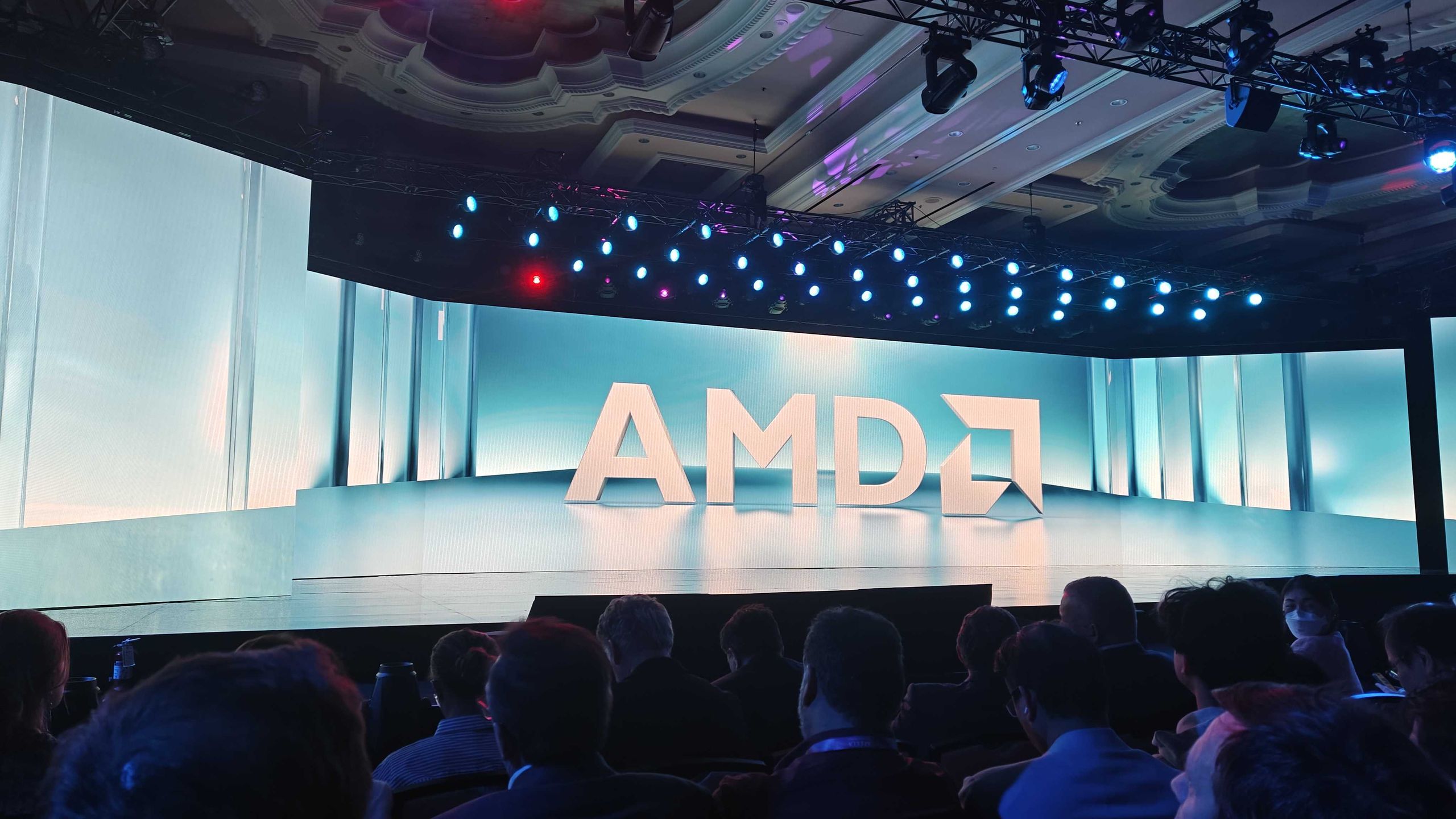
AMD Representative: I'll get to GPUs in a second; I'm not going to forget. I had a bet, honestly, going into this, that this would be the first question, so thank you for that.
Journalist 1: So you're saying that Zen+ and Zen 2 parts are popular, from your own data; the upgrade path to Zen 3 — a lot of that's been blocked; the 5800X3D isn't available, the 5700X3D isn't available, and there's no option to scale up to AM5. I know you've done a couple of the Zen 3 refreshes, for the XT models, was it? In 2024? Are there any plans to refresh any of those, given how much demand there is for them now?
AMD Representative: I don't — so with those XT models, for instance, I think one of the things that we found is a small speed bump in a product doesn't materially affect the experience that a customer gets out of those CPUs, right? And I don't know that it's tremendously valuable to a user to do like a little tweak to an existing product definition. That being said, if you look globally at the sales and the demand that we see for our products, our AM4 processors and products still represent a very healthy, like, I'm going to say, between 30-40% of our total sales revolve around that AM4 platform. Some of that's new build, some of that's upgrade-in-socket, but it's still a platform which has very, very healthy demand that goes along with it. We're certainly looking at everything we can do to bring more supply and kind of reintroduce products back into the AM5 ecosystem to satisfy the demands of gamers that maybe want that significant upgrade in their AM4 platform without having to rebuild their entire system, so that's definitely something we're very actively working on right now.
I think on the GPU question, there is no product that has memory in it that's immune to some of these forces around DRAM pricing and what it's doing to the market, and I think the truth is the volatility that we've seen over the past two months or so has really been unprecedented. I think that there's a lot of behavior that we saw in the market with — um, once those deals were announced, significant acquisition of DRAM products to make sure that some of the larger customers have supply for those products, and I think that's what created a large volatility. What I expect to happen is that some of that volatility is going to settle out over the first half of this year, I think some of that volatility is going to settle out in the market over the next 3-6 months, and I think we're going to see pricing stabilize.
That being said, I think it is a given that the cost of memory is going to go up in every platform. That's going to affect prices in desktop builds, graphics cards, you name it, and we're doing everything we can to mitigate those cost increases, but our commitment is, just as we launched the product, to make sure that we're, from a price-performance and competitive positioning standpoint, maintaining the value that the Radeon 9000 Series products brought into the market when we launched them, and we're going to do everything we can to maintain that.
Journalist 3: You want to talk about X3D, and memory, and how it [unintelligible]?
AMD Representative: Okay, that's, that's a good point, and what is interesting —I think that there's maybe two aspects to the topic that Matt was bringing up. One is, for our X3D processors, often, kind of the rule of thumb with Ryzen products from the very beginning was you need the fastest memory kit so you can overclock the fabric on the processor to get the most gaming performance out of it, and that's, I think, a true statement for all of our products except for the X3D products. The X3D products, because of that really large cache next to the processor, are much, much less sensitive to memory latency, to fabric overclocking, and so I think one of the things that we've seen as we've peeled the onion and tried to dissect 'how do you build the best value for somebody that's trying to build a new system', I think one of the things the X3D products do really well is they mitigate that need to have the most expensive, lowest latency, fastest kit that you can buy. You can get almost all of that performance with a much less premium kit that's part of that. Now, I'm not saying that — of course, there's a premium across all memory kits right now — but I think it gives you an opportunity to open that search range and still get great performance without having to buy the best of the best memory kit to really push the envelope.
And I think the other thing that we've seen is, again, I'll say, in some parts of the world, not every market, every part of the world, there's a lot of our partners and customers that are looking at, 'okay, what does single memory channel versus dual memory channel performance look like?' And I think the thing that we've seen in some of the data is, of course it's title dependent, but a lot of games that are that are super popular, that people play all around the world, have relatively little sensitivity to dual channel versus single channel memory. So I'm not necessarily advocating that single memory channel systems are the right choice for everybody, but I think that one of the things that's going to be a theme throughout 2026 is really scrutinizing every component that's a part of the build to make sure that you're getting the best value for what you're putting together. And I think the second part of it is this phenomenon of a more significant trend toward component upgrades versus full system upgrades. I think it's something we're going to see, like upgrading the CPU, or the GPU, or the motherboard to get a little bit more out of that system without having to refresh everything. I think is going to be something that's really a trend throughout the year.
Journalist 4: The other big story […] What will PCs, what will gaming desktops look like, between the Steam machines, between collaboration with Microsoft and whatever they're doing, it seems like the gaming desktop could look very different this year, and I'm just wondering how you guys are thinking about that as you're doing […] because not everyone needs a big tower.
AMD Representative: That's true. So, I'll use the Halo box down there as a great example, right? I think that the Strix Halo product was a product where, when we first were going through the process of designing and building the part, there was a lot of conversation about what really is the value proposition of of this really unique architecture and its capabilities, and I think certainly we saw an opportunity as a single chip that could replace a mid range to lower end GPU really, really interesting, really compelling. As a mobile workstation product, super interesting as well, or even a small form factor like that, as a desktop workstation is a really interesting use case as well. And then I think, over the course of the past 18 months, the role of local AI has really changed so much, the memory architecture of that type of product has kind of given it a whole other dimension of spaces and use cases and workloads that it can serve very, very effectively with [a] kind of unprecedented level of capabilities. So I think that when we look at 'what does a desktop look like over the next couple of years,' I think that that's a great example of a unique system architecture that solves the problem in a different way, potentially leads to something that is more "console like," in terms of its size, capabilities, and dimensions. I think that you're already seeing the transformation that's happening, like with these FSR capabilities that we're introducing, and how much ML or AI-enhanced techniques for rendering are augmenting more traditional rasterization techniques to drive the gaming experience. I think there will always be a space for those mid-tower desktop systems, for people who want the absolute best, and the highest resolutions, the fastest refresh rates, the most detail in their games that they play. But I think there's also a pretty significant class of gamers who want something that is just easy, small, quiet, and fits about anywhere, and I think that you will see this — I guess 'resurgence' may be the wrong word, but I think the demand for the small form factor gaming desktop will be something that really picks up steam in 2026 and 2027, and I think it's just going to be something that continues forward as you look at how ML capabilities affect the way that GPUs render different games, and experimenting with different architectures to just get the most out of limited power, and maybe slightly different silicon capabilities and construction to go solve that gaming problem.
Journalist 3: Is graphics memory protected in some way from the surges in memory pricing, or are they in the same boat as main memory?
AMD Representative: I think that if you look at who builds graphics memory, it's the same DRAM manufacturers that build DDR memory, HBM memory; again, there's a relatively small set of companies on the planet that build those chips. There is a lot of overlap in the technology, and again, that's why I say I don't think that any memory type is immune to the effects of how AI is shaping the overall supply and demand picture for memory this coming year.
Journalist 3: It seems like the industry [could have] planned a little better, because you need a lot of AI PCs out there to meet that AI demand…
AMD Representative: I can't comment on planning cycles of the DRAM manufacturers, but maybe, just going back to it, the DRAM industry, if you look back in history, has been characterized by these mega cycles, right? And I think you're seeing another mega cycle right now that maybe is exacerbated a little bit by this very sudden demand shift to AI GPUs, which makes it probably a little bit more painful because of the speed at which it went from 'no problem' to, you know, 'DEFCON 1'. Yeah, I think that's very true, that just, the speed at which the change happened in the market is pretty unprecedented, and I think that everybody is reacting to the sudden demand shift that you're seeing, but it takes time, right? It takes time to bring new capacity online, to increase production, and all of those things are problems that could still have in past memory cycles, but I think we're definitely seeing this one hit very, very suddenly.
Journalist 4: Do you think we're working on a longer timeline in that cycle? We've heard anywhere from like —
AMD Representative: I am not the expert there to be totally — what I couldn't tell you — I don't know who you speak with, from some of the DRAM manufacturers or things like that, but I think those are good questions for some of the companies that make DRAM, to understand what they're doing, what their timelines are. If history is any indication, it follows the same pattern that we've seen in the past, right? Demand outstrips supply, more fab capacity gets put in place, and eventually you get to a point where you have oversupply compared to the demand that's in the market, and the cycle repeats itself. So, I don't know the answers to those questions. I think you'd have to talk to those guys to really get the get a get a better understanding of what they're planning on doing and how they're planning on reacting to the current situation.
Journalist 3: I think I read too that Samsung came out and said, 'expect your cell phone to go up,' right?
AMD Representative: Yeah. I think I saw Samsung said nothing's immune, TVs, dishwashers, and then everything else.
Journalist 4: I do have a question you can answer about the 9850X3D. So, during the pre-brief, we got a taste of — I think 7% was the number that was quoted, we got performance after the fact, and I think it was averaging 3% or somewhere around that?
AMD Representative: I remember hearing 7% in the pre-brief, but I think the 7% was mis-statement. There are some games — it depends on what your suite is, right? You look at e-Sports games, and it's going to be in that 5 to 7% range; you look at AAA games and it may be parity on an AAA game where the X3D effect dominates the influence on the game engine and how it plays. I know that from our internal data, and correct me if I'm wrong, but I think, like over a suite of 25 to 35 games, blended, it's in that 2-3% range overall, with the outliers on one end and the 'no change' on the other end.
Journalist 4: Well, my question wasn't so much the discrepancy, my question was — the point is to have these two live side-by-side, we don't know pricing yet; I just want to confirm once again that that is the plan, given the small gap in both performance and frequency? Given that you can just turn on PBO with the 9800X3D and easily get another 200 MHz or so out of it. The plan is to still have both of them?
AMD Representative: Absolutely, absolutely, we will definitely have both of them. I think that as our Ryzen business has gotten more diverse, I think what you'll see is — look, a lot of system builders like stability. They'll want to keep that 9800X3D in a lot of the prebuilt systems that they're manufacturing. I think even as an individual processor in a box sale, you'll see both available in the market. The 9800X3D has been a stellar product for us, tried and true, such a great reputation. These transitions take time, and we're certainly not going to do anything to artificially force this to be a faster transition that it needs to be. Both are really valuable products, and have have their own space where people are going to gravitate to one or the other.
Journalist 3: I also think it's going to be a fun value proposition; how you guys characterize it, right? Because there are some people that absolutely want the best of the best. Obviously, there'll be a price gap there, but they will go for the top-end one. The other thing that's going to be interesting is eSports professionals. There are people that, 'five frames per second? Here's my money.' So it will be the top, they will exist together, and I'm really excited to see how you guys — because I'm pretty sure when you do the math, the best dollar per frame is going to be the 9800, right? Because of that gap. But what is it worth to you? You know? And to David's point of in socket upgrades, do I want to go for that? So to have that choice is really cool. For me, I'll turn on PBO. Like, that's no problem for me. There are people that don't want to — have never entered the bios, right? So you can tell them — and PBO is 200 megahertz? You're not going to get 600, or 400, excuse me. So this came up; I don't know if it was on you guys' call or another one, but somebody asked about the 400 [MHz], and our overclocking team was like, "if you squint at like, you have to dial that in, to get anywhere close to that." You can! But a number of things have to fall in line to get there, including silicon lottery.
Journalist 4: I'm just curious to see how much it costs.
Key considerations
- Investor positioning can change fast
- Volatility remains possible near catalysts
- Macro rates and liquidity can dominate flows
Reference reading
- https://www.tomshardware.com/tech-industry/SPONSORED_LINK_URL
- https://www.tomshardware.com/tech-industry/amd-ces-2026-gaming-trends-press-q-and-a-roundtable-transcript-we-see-a-little-bit-of-an-uptick-in-the-percentage-of-am4-versus-am5-platforms#main
- https://www.tomshardware.com
- After 34 years, the Linux kernel community finally has a contingency plan to replace Linus Torvalds — formal plan drawn up now community is 'getting grey and ol
- Intel shows off leading-edge tech with massive AI processor test vehicle — huge chip features four logic tiles, 12 HBM4 stacks, and 8X reticle size
- GeForce NOW Brings GeForce RTX Gaming to Linux PCs
- SK hynix invests $10 billion in creating a U.S.-based 'AI solutions' company — company to restructure California-based Solidigm enterprise SSD brand to bolster
- Intel shows off leading-edge tech with massive AI processor test vehicle — huge chip features four logic tiles, 12 HBM4 stacks, and 8X reticle size
Informational only. No financial advice. Do your own research.