
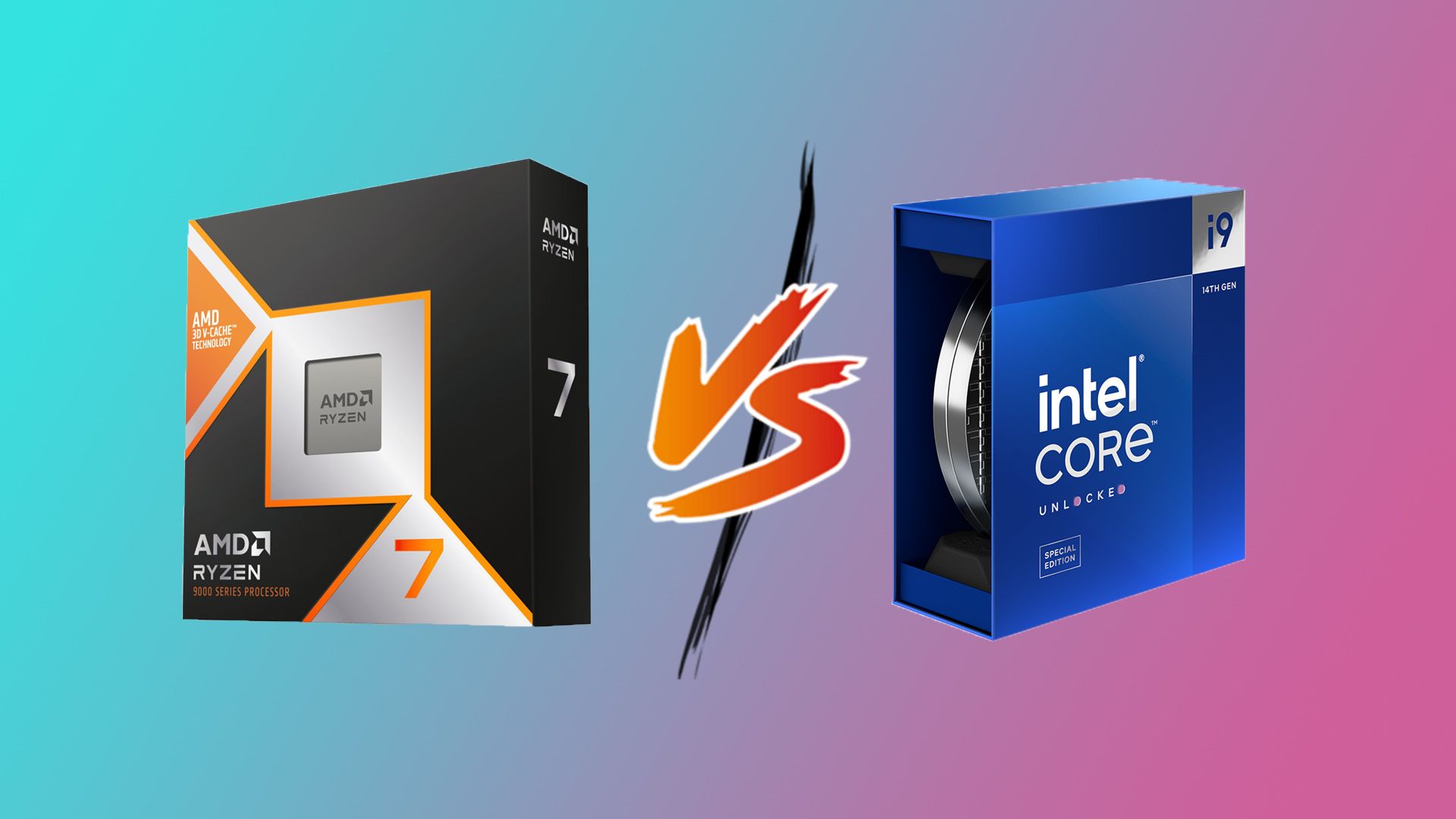
Taking over the title for best desktop CPU for gaming from its predecessor, the Ryzen 7 9850X3D is specifically made for gamers who care about squeezing every last drop of performance. But how does the Core i9-14900K fare against it?
To understand the differences, we tested both CPUs with a range of modern games at 1080p. The reason for choosing 1080p resolution was to see how the CPUs scaled without running into a GPU bottleneck. Graphics duties were handled by the mighty Nvidia RTX 5090.
(Image credit: Future) (Image credit: Future) (Image credit: Future) (Image credit: Future) (Image credit: Future) (Image credit: Future) (Image credit: Future) (Image credit: Future) (Image credit: Future) (Image credit: Future) (Image credit: Future) (Image credit: Future) (Image credit: Future) (Image credit: Future) (Image credit: Future) (Image credit: Future) (Image credit: Future) (Image credit: Future) (Image credit: Future) (Image credit: Future) (Image credit: Future) Based on our 15-game 1080p geomean, the Ryzen 7 9850X3D sits comfortably at the top of the chart, outperforming the Core i9-14900K by an average margin of 23.9%. That is a considerable lead over the Intel chip which managed 171.1 FPS on average, which stands as the fastest Intel desktop CPU for gaming, and a more suitable choice over the current-gen Core Ultra 9 285K flagship.
Looking at some individual game results, the Ryzen 7 9850X3D offers a huge advantage in Baldur’s Gate 3 with a 50.28% uplift at 209.8 FPS compared to the 139.6 FPS on the Core i9-14900K. The trend continues with AMD’s latest chip easily pulling ahead of Intel with a 49.48% uplift in F1 2024 , 48.43% in Final Fantasy XIV , 42.38% in Far Cry 6 , and 30.99% in Hitman 3 . The gap tends to decrease in games like DOOM: The Dark Ages (5.78%), Starfield (11.74%), and The Last of Us Part 1 (14.43%), with Monster Hunter Wilds being the only game in our tests where the Core i9-14900K had an edge of 7.17% over the Ryzen 7 9850X3D.
Looking at the 1% lows, the Ryzen 7 9850X3D maintains a 21.49% lead on average over the Core i9-14900K. The only real outlier was A Plague Tale: Requiem where the Intel chip managed to beat AMD with a 3.88% lead.
Despite having boost clock speeds of up to 6 GHz on its P-cores, the Core i9-14900K was only able to maintain an average of 4.87 GHz in our gaming benchmarks. Since the Ryzen 7 9850X3D has a more thermally sound design, it is able to hold higher clock speeds on average at 5.45 GHz. Another reason for its higher average boost clock speeds is the lower memory access latency, which helps the chip sustain stronger performance over time, particularly in games.
A major benefit of choosing the AMD chip over Intel is its efficiency. It delivers 2 FPS/W, compared to 1.28 FPS/W for Intel. During gaming, the Ryzen 7 9850X3D averaged 106.1W of power consumption, which is roughly 20.7% more efficient than its competitor. By comparison, the more power-hungry Core i9-14900K consumed an average of 133.9W in our testing.
At their current market price, the Ryzen 7 9850X3D falls behind in value-per-dollar with 0.42 FPS/$ as opposed to 0.37 FPS/$ for the Core i9-14900K. With that said, this metric is only relevant when solely looking at the cost of the CPU.
The Ryzen 7 9850X3D offers impressive gaming performance, draws less power, and delivers superior efficiency compared to the Core i9-14900K. While it is slightly more expensive and offers less compelling value per dollar on paper, the real-world price gap is relatively minor and doesn’t necessarily outweigh its advantages.
The Core i9-14900K dominates in our set of productivity benchmarks thanks to its higher core and thread count along with peak clock speeds. If we take a look at the multi-threaded performance ranking geomean, the gap between the two CPUs is quite evident. The Core i9-14900K delivered a geomean score of 543, which places it near the top of the stack and reflects its advantage in heavily threaded workloads. On the other hand, the Ryzen 7 9850X3D trails significantly with a score of 364, which is roughly 49% lower than Intel.
(Image credit: Future) (Image credit: Future) (Image credit: Future) (Image credit: Future) (Image credit: Future) (Image credit: Future) (Image credit: Future) (Image credit: Future) (Image credit: Future) (Image credit: Future) (Image credit: Future) (Image credit: Future) (Image credit: Future) Intel consistently extends its lead across individual productivity benchmarks. In Cinebench R23 multi-core, the Core i9-14900K scores 38,131 points which is about 63% higher than the Ryzen 7 9850X3D’s 23,362. Cinebench 2024 tells a similar story, with Intel scoring 2,210 compared to AMD’s 1,393, a gap of roughly 58%. In POV-Ray multi-core, we saw the Core i9-14900K achieve 13,262 PPS, a 73% advantage over the Ryzen 7 9850X3D which was able to deliver 7,632 PPS.
In SVT-HEVC video encoding, the Core i9-14900K delivers 159 FPS, comfortably ahead of the AMD Ryzen 7 9850X3D at 104 FPS. That’s a difference of 52.88% which essentially highlights Intel’s strength in sustained encoding tasks that can scale across its multiple cores and threads. The trend continues in Blender’s Classroom render, where the Core i9-14900K processes 110 samples per minute, compared to 73 samples per minute for the Ryzen 7 9850X3D.
(Image credit: Future) (Image credit: Future) (Image credit: Future) (Image credit: Future) (Image credit: Future) (Image credit: Future) (Image credit: Future) (Image credit: Future) AMD gains some ground in single threaded productivity but overall Intel tends to stay ahead. As per our single-threaded performance ranking geomean, the Core i9-14900K offers a 2.7% advantage with 266 points compared to the Ryzen 7 9850X3D at 259 points. In Cinebench 2024 single-core benchmark, the Ryzen chip pulls slightly ahead by 3.6%, but falls back down as Intel leads by 6.6% in Cinebench R23 single core. Both chips tend to remain neck to neck in other single threaded tests including audio encoding, lossless image encoding, and image decoding.
Based on our testing, both CPUs perform similarly in single-threaded workloads, but Intel stays firmly ahead in multi-core workloads. AMD’s 3D V-Cache delivers its biggest gains in gaming, rather than in the broad range of productivity tasks that we have tested. For workloads that lean heavily on multi-threaded performance, the Core i9-14900K is simply the faster processor, leading in most productivity benchmarks. When you factor in its lower price, it also ends up being the better value for users who care more about productivity than gaming.
The Intel Core i9-14900K is rated to be one of the best CPUs for overclocking as it is fully unlocked and offers multiplier support along with voltage tuning controls. It also supports manual frequency adjustments and per-core ratio controls, allowing enthusiasts to push individual performance cores. .
Using the Intel Extreme Tuning Utility (XTU) software, one can tinker with various parameters directly from Windows, rather than entering the BIOS. Additionally, it supports AI Assist where Intel has trained a neural network on hundreds of processors to suggest optimized CPU overclock settings. With its ease of use, you shouldn't expect big performance gains out of AI Assist in XTU.
The Ryzen 7 9850X3D is also fully unlocked and can be overclocked as it supports multiplier changes, manual frequency adjustments, and voltage controls. You can also use PBO 2 (Precision Boost Overdrive 2) where the CPU dynamically handles boost clocks depending on the available power and temperature. PBO 2 also includes a Curve Optimizer for voltage tuning and the Curve Shaper feature.
AMD’s X3D CPUs offer impressive performance in gaming thanks to 3D V-Cache, but that same design tends to limit the benefits of memory overclocking. From our testing, we have found that memory tuning is not entirely beneficial as it leads to less than 2% gains, which additionally leaves little headroom for enthusiasts who enjoy manual tuning.
Intel offers better manual overclocking potential and higher frequency headroom, making it the preferred choice for enthusiasts who care about maximum clock speeds. In addition, Intel offers a more mature overclocking ecosystem with comprehensive software tools, extensive voltage controls, and proven ability to achieve extreme frequencies. AMD’s Ryzen processors often provide better out-of-the-box performance with automated boosting, making manual overclocking less necessary, though still possible on chips like the Ryzen 7 9850X3D.
Both chips seem to be closely matched with the Ryzen 7 9850X3D having a 120W TDP and Intel holding a rated 125W TDP (253W for PL2). Our gaming benchmarks already established Team Red’s latest offering as the more power efficient chip between the two, but now let’s take a deeper look at peak power draw, idle power consumption, and the cooling requirements needed to keep each processor operating at its best under extended heavy workload conditions.
(Image credit: Future) (Image credit: Future) (Image credit: Future) (Image credit: Future) (Image credit: Future) (Image credit: Future) (Image credit: Future) (Image credit: Future) (Image credit: Future) (Image credit: Future) (Image credit: Future) (Image credit: Future) (Image credit: Future) (Image credit: Future) At idle, the Core i9-14900K consumed 25W which is around 13.5% more power than the Ryzen 7 9850X3D (22W) in our testing. The narrative completely flips though, as the AMD chip consumes 32W in our active idle power consumption test, while the Core i9-14900K pretty much offered the same result at 26W. This noticeable gap of roughly 23% is due to Intel’s hybrid architecture that can handle low-power states better when compared to the Ryzen 7 9850X3D.
Demanding workloads reveal a consistent efficiency gap between the two processors. In y-cruncher multi-threaded AVX workloads, the Intel chip pulls 309W versus 173W on the AMD side which is around a 79% increase in power draw. Even in the single-threaded AVX test, the Core i9 consumes more than double the power at 90W compared to 44W on the Ryzen 7 9850X3D. Linpack follows the same pattern, with the Core i9-14900K consuming roughly 70% more power.
The Ryzen 7 9850X3D draws 155W in Cinebench 2024 multi-core benchmark while the Core i9-14900K hit 309W, which is almost 100% higher power consumption. We also tested the chips with Blender Monster, Classroom, and Junkshop scenes, where we noticed Intel’s power draw anywhere between 83% to just over 101% higher than the AMD chip.
The power draw delta between Intel and AMD grows even bigger in video encoding workloads. HandBrake tests using modern codecs like x265, VP9, and x264 resulted in the Core i9-14900K drawing around 105–114% more power, while the SVT-AV1 encode peaked at nearly 119% higher consumption. These results point to significantly higher power delivery demands for sustained creative workloads as well as a strong cooling solution requirement for the Intel platform.
(Image credit: Future) (Image credit: Future) To further understand efficiency between the two chips, the estimated task energy scatterplots give us a clearer picture. The Ryzen 7 9850X3D delivers a much better balance of performance and energy use than the Core i9-14900K in the Handbrake x265 power efficiency test. While Intel’s flagship is capable of reaching higher raw FPS, it does so with a large increase in task energy, placing it far higher on the power axis. In contrast, the Ryzen 7 9850X3D consumes significantly less energy per encode, making it clearly more efficient for sustained video encoding workloads.
Similarly, the Ryzen 7 9850X3D sits in a far more efficient position in the Blender Classroom power efficiency test, delivering strong samples-per-minute output with low task energy. The Core i9-14900K offers high rendering performance but at the cost of substantially higher power consumption, requiring far more energy to complete the same workload.
With high power draw ranging between 300W to 320W under sustained loads, the Core i9-14900K demands robust and heavy cooling solutions. To avoid thermal throttling and keep noise levels in check, you'll need to pair the chip with a top CPU cooler .
By comparison, the Ryzen 7 9850X3D should be far easier to cool, with peak power draw landing between 160W and 180W across our benchmarks. This allows it to run comfortably on a solid dual-tower air cooler or a 240mm or 280mm AIO, which lowers overall system cost and complexity while also keeping noise under control.
Although Intel maintains a small edge at idle and in light workloads, AMD’s substantially lower power draw under load makes a far bigger difference in real-world use. The Ryzen 7 9850X3D not only keeps power and efficiency demands in check, it should also run cooler and quieter, thus making it the more practical option for most systems.
Pricing between the two chips appears closer than expected. The AMD Ryzen 7 9850X3D carries an MSRP of $499, while the Intel Core i9-14900K is now commonly available for around $450. The gap in price doesn’t really tell the full story as the actual difference can only be justified once you factor in the entire platform.
The LGA 1700 platform has served a total of three generations for Intel which has resulted in broader availability and competitive pricing. A reliable Z-series board for the 14900K generally falls between $130 and $250, while premium Z790 models can climb past $400–$500. Lower-tier B660 boards starting at $100 are also an option, though pairing one with an unlocked CPU doesn't make much sense. Intel blocks CPU core overclocking on its B-series chipsets.
The AMD Ryzen 7 9850X3D requires an AM5 motherboard, where budget options include B650 motherboards that start around the $100 mark, but well-built options typically sell around $150–$200. High-end X-series boards begin around $200 and can easily exceed $500 depending on the feature set and power delivery capabilities. Unlike Intel, you can overclock AMD CPUs on B-series motherboards.
Memory is an important component that further separates the two platforms. Both CPUs support DDR5 memory, but Intel retains compatibility with DDR4 provided you have a compatible motherboard. Given today's market conditions where memory prices are on the higher side, Intel has a slight advantage. While DDR5 is the go to choice for maximizing performance on either platform, the ability to reuse or buy cheaper DDR4 can potentially reduce total system cost when choosing the Core i9-14900K.
Cooling is another area where the platform cost gets a shakeup. With a 120W TDP and peak power draw in the 160–180W range, the Ryzen 7 9850X3D is comparatively easy chip to manage. A quality air cooler or a mid-range 240mm AIO should be sufficient, with air cooling options priced anywhere between $40 to $100 and a good liquid cooler available between $60–$150.
The Core i9-14900K runs hot, and thus, requires a robust thermal solution. The chip comes with a TDP of 253W but has the capability of drawing power that can exceed 350W under heavy workloads. High-end air coolers typically start around $80–$130, while 280mm to 360mm AIO liquid coolers are often available in the $100–$200 range.
When taken as a complete build, the Intel platform ends up being slightly cheaper, especially if you are not opting for DDR5 memory. Between the lower CPU price, broader motherboard options, and lower DDR4 memory costs, total savings can potentially go anywhere from $100 to $200, or more, compared to an equivalent AM5 setup with the Ryzen 7 9850X3D.
Power Consumption, Efficiency, and Cooling
Key considerations
- Investor positioning can change fast
- Volatility remains possible near catalysts
- Macro rates and liquidity can dominate flows
Reference reading
- https://www.tomshardware.com/pc-components/cpus/SPONSORED_LINK_URL
- https://www.tomshardware.com/pc-components/cpus/amd-ryzen-7-9850x3d-vs-intel-core-i9-14900k-faceoff#main
- https://www.tomshardware.com
- New SemiAnalysis InferenceX Data Shows NVIDIA Blackwell Ultra Delivers up to 50x Better Performance and 35x Lower Costs for Agentic AI
- Leading Inference Providers Cut AI Costs by up to 10x With Open Source Models on NVIDIA Blackwell
- Corsair Sabre v2 Pro Wireless MG Review: Not enough magnesium?
- 390TB video game archive being taken offline due to skyrocketing RAM, SSD, and hard drive prices — AI-driven supply squeeze results in closure of one of the lar
- Lenovo brings a blue ThinkPad T14 to Mobile World Congress — slew of new devices includes a Legion 7a with Strix Halo
Informational only. No financial advice. Do your own research.