
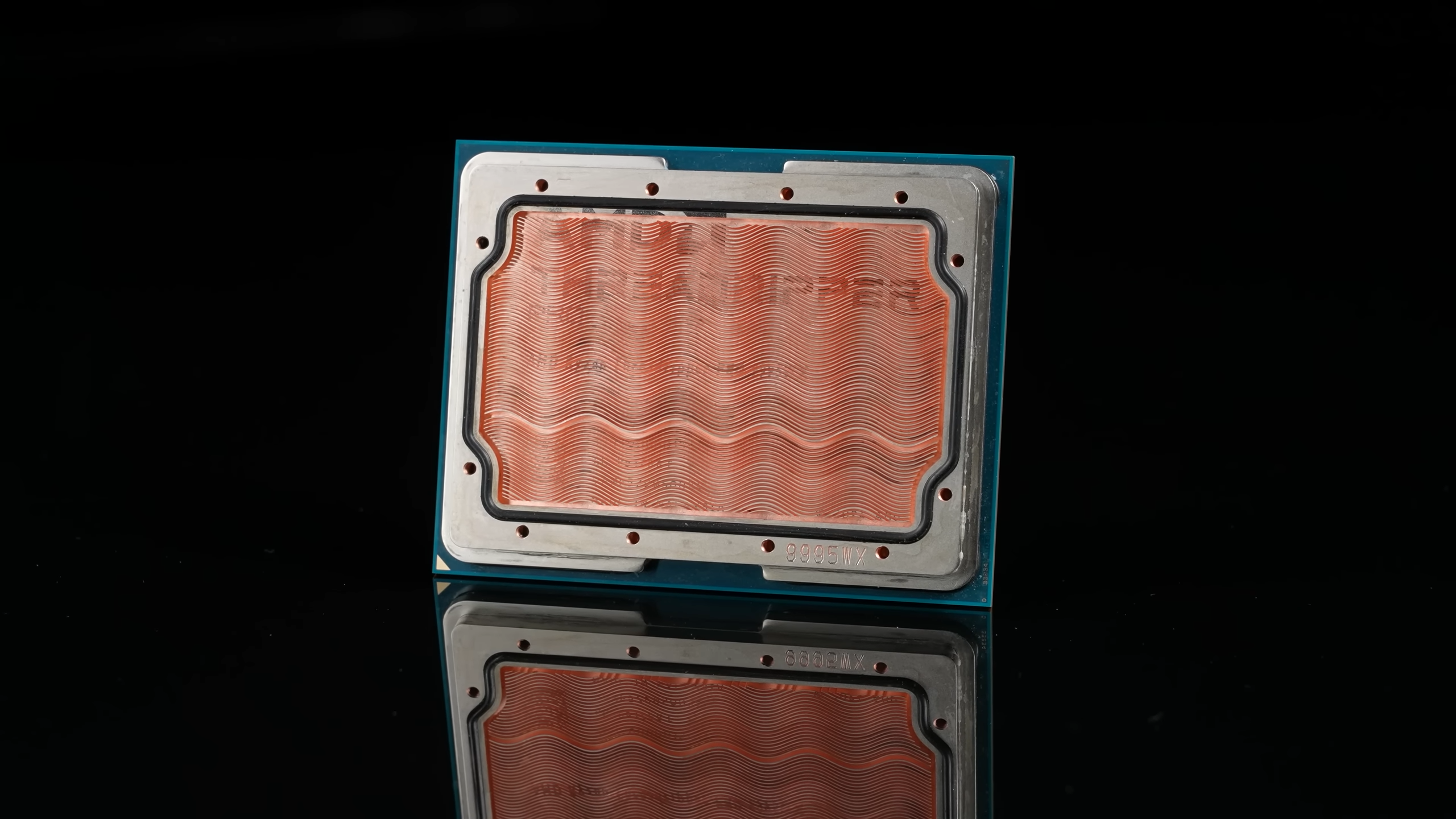
Geekerwan overclocked the Ryzen Threadripper Pro 9995WX to 5.325 GHz, drawing around 176W and idling at just five degrees Celsius. The liquid temperature was approximately two degrees Celsius, so heat transfer from the 96-core chip to the water tank was highly efficient. During the Cinebench 2024 and Cinebench 2026 runs, the processor consumed around 1,340W with core temperatures oscillating between 30 degrees and 50 degrees Celsius. The entire system was pulling a little over 1,700W.
The performance gains were logically substantial. The Ryzen Threadripper Pro 9995WX at 5.3 GHz delivered up to 18% higher multi-core performance than the stock PBO setting, which had the cores running at around 4.8 GHz. Against the global overclocking leaderboards at HWBot, Geekerwan's overclocked Ryzen Threadripper Pro 9995WX ranked 7th in Cinebench R23, a hairline behind a Ryzen Threadripper Pro 7995WX at 6.2 GHz under liquid nitrogen. In Cinebench 2024 and Cinebench 2026, the Zen 5 chip came in third and second places, respectively, and trailed a Ryzen Threadripper Pro 9995WX at 5.7 GHz and an Xeon 698X at 4.9 GHz.
Geekerwan's project shows that you don't always need exotic liquid helium or liquid hydrogen cooling to chase world records. Sometimes, a little bit of ingenuity and engineering can go a long way. But for those of us who lack access to either, we can always look forward to next-generation AIO liquid coolers, such as Cooler Master's 360² (360 x 360mm) , which claims to dissipate up to 2,000W of heat.
Follow Tom's Hardware on Google News , or add us as a preferred source , to get our latest news, analysis, & reviews in your feeds.
Zhiye Liu is a news editor, memory reviewer, and SSD tester at Tom\u2019s Hardware. Although he loves everything that\u2019s hardware, he has a soft spot for CPUs, GPUs, and RAM. ","collapsible":{"enabled":true,"maxHeight":250,"readMoreText":"Read more","readLessText":"Read less"}}), "https://slice.vanilla.futurecdn.net/13-4-13/js/authorBio.js"); } else { console.error('%c FTE ','background: #9306F9; color: #ffffff','no lazy slice hydration function available'); } Zhiye Liu News Editor, RAM Reviewer & SSD Technician Zhiye Liu is a news editor, memory reviewer, and SSD tester at Tom’s Hardware. Although he loves everything that’s hardware, he has a soft spot for CPUs, GPUs, and RAM.
Stomx This just confirms that overclocking high end workstation chips has zero sense. Cooling them for extended longevity or reduced noise has increased and increased sense. Also solutions to use these kilowatts instead of disposing them to heat the atmosphere are welcome. Soon we will have 256-core chips which are alrady in testing, then 500 which are in development before we all switch on GPU dumped from the first generations of upgrading every few years AI Reply
bit_user This is a lot more interesting to me than liquid nitrogen overclocking – which is neat in a sort of "hold my beer" sense, but lacks any practical value, whatsoever. Reply
alan.campbell99 Stomx said: Also solutions to use these kilowatts instead of disposing them to heat the atmosphere are welcome. Something I'd like to see happen as well. I'd suspect it's highly unlikely if not impossible for 100% heat to electricity conversion but some level of conversion would be good. I did read recently about a material under study that appeared to achieve conversion without needing a thermal gradient like a typical TEG, just tried looking for the article but as yet didn't find it. Random aside, that's reminding of this one player back during Action Quake 2 days detailing his PII overclocking with Peltier devices. Reply
DS426 alan.campbell99 said: Something I'd like to see happen as well. I'd suspect it's highly unlikely if not impossible for 100% heat to electricity conversion but some level of conversion would be good. I did read recently about a material under study that appeared to achieve conversion without needing a thermal gradient like a typical TEG, just tried looking for the article but as yet didn't find it. Random aside, that's reminding of this one player back during Action Quake 2 days detailing his PII overclocking with Peltier devices. Yep, just like I said in another topic as heat recapture pertains to the scale of data centers. A 1.3 KW workstation here and there is one thing, but 300 MW+ datacenters have a lot more heat on there hands, even if it's too low-temp for things that rely on the Rankine cycle (other solutions like district heating as utilized in cold places like Finland already employ this, but hotter climates require more creativity…). Reply
DS426 bit_user said: This is a lot more interesting to me than liquid nitrogen overclocking – which is neat in a sort of "hold my beer" sense, but lacks any practical value, whatsoever. I agree. Being able to provide this much cooling continuously 24/7 is more useful for real-world purposes. Reply
Key considerations
- Investor positioning can change fast
- Volatility remains possible near catalysts
- Macro rates and liquidity can dominate flows
Reference reading
- https://www.tomshardware.com/pc-components/cpus/SPONSORED_LINK_URL
- https://www.tomshardware.com/pc-components/cpus/amds-96-core-beast-with-watercooling-engraved-into-cpu-joins-car-and-industrial-parts-in-a-2-000w-direct-die-cooling-setup-usd12-000-cpu-runs-at-5-3-ghz-devours-1-300w-and-still-runs-cooler-than-your-gaming-pc#main
- https://www.tomshardware.com
- From Pilot to Profit: Survey Reveals the Financial Services Industry Is Doubling Down on AI Investment and Open Source
- OLED gaming monitor shows only light burn-in after 3,000-hour torture test — 500 hours of Overwatch gameplay leaves a faint scar on the premium panel
- The high-speed Bambu Lab P1S is back in stock at its record-low $399 price — save $300 on enclosed Core XY 3D printer with quick assembly for beginners
- MSI MEG X870E Ace Max Motherboard Review: A second Ace up MSI’s AM5 sleeve?
- Amazon’s European data center projects stalled by grid delays spanning up to seven years — no new connections until after 2030
Informational only. No financial advice. Do your own research.