
When you purchase through links on our site, we may earn an affiliate commission. Here’s how it works .
Arm's introduction of its AGI CPU last week was an expected yet, still a milestone event that marked the transformation of Arm from a technology IP licensor into a supplier of standard CPUs competing directly with AMD, Ampere, and Intel. But the surprises did not end there, as the company intends to sell AGI processors to customers in China, despite the fact that Neoverse V3 cores that power the new silicon cannot be licensed to Chinese CPU developers due to sanctions.
"We just do not have any customers today that we are able to talk about publicly," said Rene Haas, chief executive of Arm, in an interview with ChinaDaily . "But we would expect the demand for this product to be just as strong in China as it is in the rest of the world."
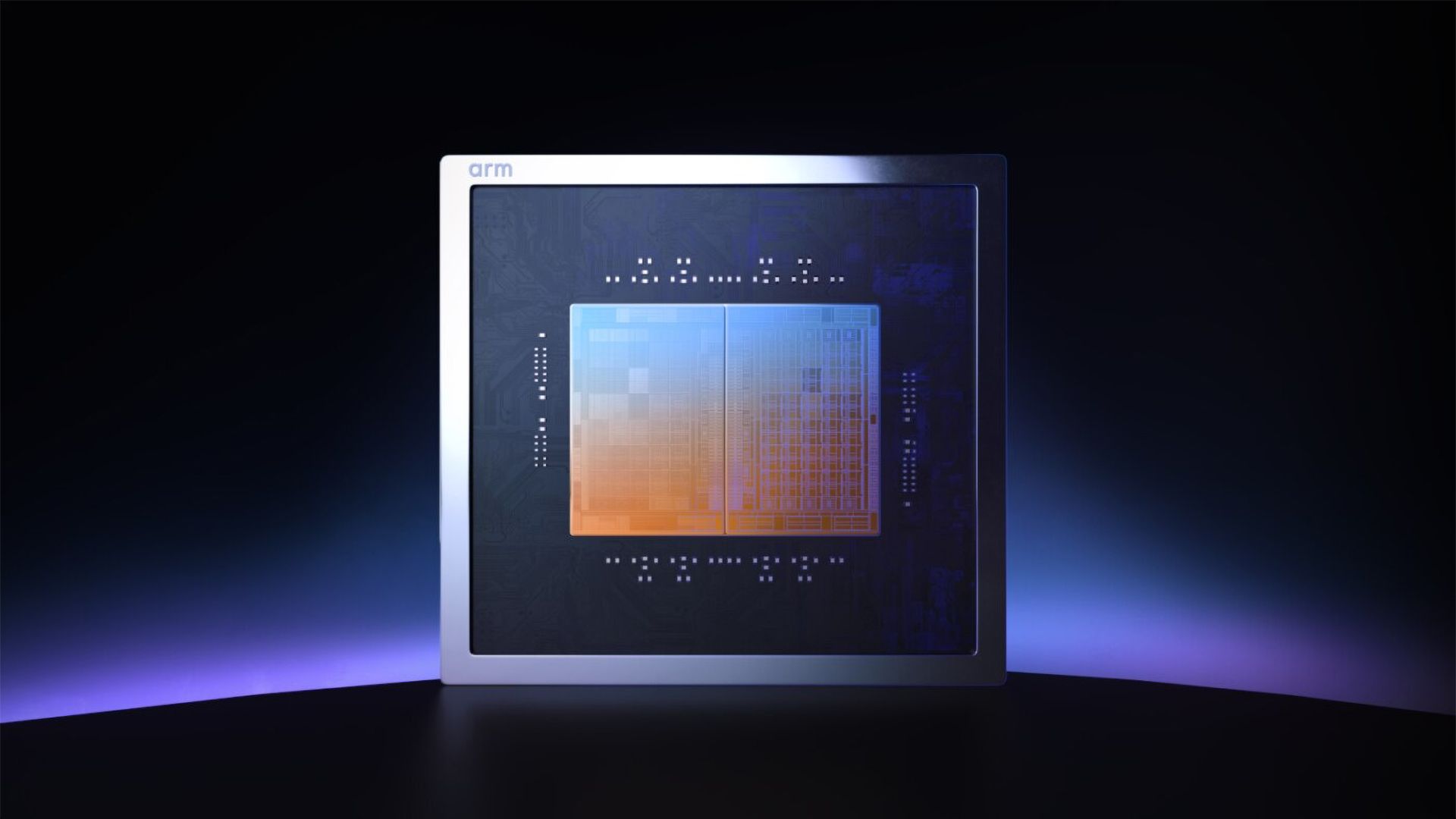
Arm's AGI dual-chiplet processor packs 136 Neoverse V3 cores with 2 MB L2 cache per core running at 3.70 GHs, features a 12-channel DDR5 memory subsystem supporting 8800 MT/s memory, and has an I/O that supports 96 PCIe Gen6 lanes with CXL 3.0 on top for caching and memory expansion. The CPU is made using a 3nm-class process technology and consumes around 300W.
You may like Arm moves beyond IP with AGI CPU silicon U.S. posts official H200 and MI325X AI GPU export rules to China, but with plenty of caveats Nvidia says H200 demand in China is 'very high' as export licenses near completion
While Arm certainly would like to sell its AGI CPU everywhere, an interesting wrinkle from the announcement is that these processors will be available to buyers in China. This is a bit surprising as Arm cannot license its HPC-oriented Neoverse V cores to entities from the People's Republic (PRC) due to export restrictions. If Arm were to provide this core (or related design, such as CSS) directly to a Chinese chip designer, that would transfer advanced semiconductor know-how to a potential foe, something current U.S./U.K.-aligned controls aim to limit. However, the Arm AGI CPU is a finished product, not IP, which enables Arm to sell it to Chinese entities.
As Arm's AGI processor is a commercial semiconductor device, and by selling it, no design transfer occurs, its export is governed by different rules, such as performance thresholds like absolute performance, compute density, interconnect bandwidth, and so on. As it turns out, Arm's AGI processor with 136 cores offers performance that is compliant with the current U.S./U.K.-aligned export controls.
Arm positions Neoverse V3 as its fastest infrastructure and supercomputer core to date, but unlike prior generations, the company has not disclosed FP32/FP64 throughput, leaving only indirect clues from SIMD width and pipeline count. As a result, any FLOPS estimate today is inferred, not specified, so we cannot really say whether or not Chinese entities can now get a high-performance HPC-oriented processor with a high core count without any restrictions.
This is particularly interesting as Arm offers a reference-design 2-node blade, which is designed to fully populate a standard air-cooled 36kW rack that delivers 8160 cores. Arm has also teamed up with Supermicro to develop a 200 kW liquid-cooled system that can accommodate 336 Arm AGI processors and deliver over 45,000 CPU cores in a single deployment. Obviously, such building blocks can be used to build actual supercomputers with decent FP32 and FP64 throughput, possibly giving Chinese entities an opportunity to get modern Western supercomputer technologies.
Get Tom's Hardware's best news and in-depth reviews, straight to your inbox.
Key considerations
- Investor positioning can change fast
- Volatility remains possible near catalysts
- Macro rates and liquidity can dominate flows
Reference reading
- https://www.tomshardware.com/pc-components/cpus/SPONSORED_LINK_URL
- https://www.tomshardware.com/pc-components/cpus/arm-to-sell-its-new-agi-cpu-in-china-we-would-expect-the-demand-for-this-product-to-be-just-as-strong-in-china-as-it-is-in-the-rest-of-the-world#main
- https://www.tomshardware.com
- Grab an SSD or HDD upgrade for World Backup Day 2026 to keep your files safe, with 1TB drives starting from $109 — beat the AI-fueled storage price hikes with t
- Oracle believed to have cut 10,000 positions across multiple divisions as mass layoffs begin to fuel AI investments — company is reportedly reducing headcount t
- One of JavaScript's most popular libraries compromised by hackers — Axios npm package hit in supply chain attack that deployed a cross-platform RAT
- Into the Omniverse: NVIDIA GTC Showcases Virtual Worlds Powering the Physical AI Era
- Save $100 on the gaming powerhouse AMD Ryzen 5 7600X3D, now $246 on Amazon — budget-friendly X3D processor with 96MB cache, low power draw, and excellent gaming
Informational only. No financial advice. Do your own research.