
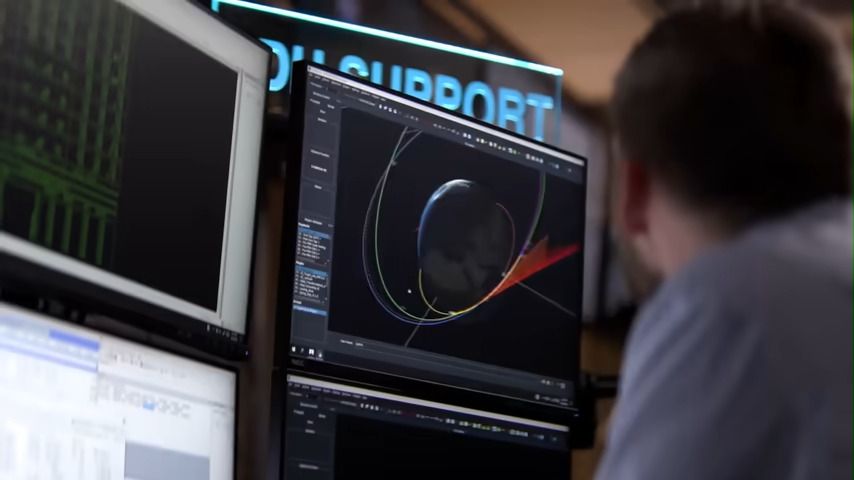
NASA's O2O system can handle 260 Mbps transfers and will give us the first glimpses of the far side of the moon.
When you purchase through links on our site, we may earn an affiliate commission. Here’s how it works .
NASA’s Artemis II mission blasted off on Wednesday. Now brace yourselves for exciting high-resolution 4K footage live-streamed from the surface of the moon thanks to NASA's laser-based O2O system. The cutting-edge Orion Artemis II Optical Communications system (O2O) will be used to beam 4K moon footage at up to 260 Mbps. We should also be treated to never-before-seen views of “the far side of the Moon, using Nikon digital cameras,” reports The BBC’s Sky at Night magazine.
So, what is O2O? NASA prepared a page dedicated to the technology ahead of the beginning of the Artemis II mission, here . Basically, O2O is a laser-based communications system that will be able to pipe the headlining 4K footage from astronauts on the moon to the Earth. Data rates of 260 Mbps can be achieved by O2O, and it isn’t just for fancy videos; it will also be used for fast and efficient transmission and receipt of procedures, pictures, flight plans, and more.
Meanwhile, on Earth, laser ground stations are situated in Las Cruces, New Mexico, and Table Mountain, California. These locations were chosen for their typically clear skies, important for fast and reliable laser communications.
You may like Europe achieves record-breaking gigabit per second data transfer between a geostationary satellite and an aircraft NASA engineers reprogrammed Mars helicopter's Snapdragon chip to run the rover instead, reconfiguring system from 140 million miles away Optical device beams data at speeds up to 25 Gbps via light, up to 25 kilometer range with ultra-low latency However, the astronauts will also use traditional radio communications to stay in contact with the ground team via NASA's Deep Space Network (DSN). With prior mention of the potential for cloud interference, this could be an essential backup. DSN was the key communications tech used by Voyager, the Mars rover, and Artemis I.
Losing sight of the Earth on a planned mission to the far side of the Moon will block both laser and DSN comms, notes the source report. NASA is well aware of this ‘dark window,’ which is estimated to last for 41 minutes.
Watch On If you aren’t that impressed by the 260 Mbps O2O laser comms terminal's performance, NASA’s page about this laser tech highlights a Lunar Laser Communications Demonstration it has completed that achieved 622 Mbps. Moreover, some nearer-Earth space laser comms projects have reached data speeds up to 200 Gbps.
Follow Tom's Hardware on Google News , or add us as a preferred source , to get our latest news, analysis, & reviews in your feeds.
Get Tom's Hardware's best news and in-depth reviews, straight to your inbox.
Key considerations
- Investor positioning can change fast
- Volatility remains possible near catalysts
- Macro rates and liquidity can dominate flows
Reference reading
- https://www.tomshardware.com/networking/SPONSORED_LINK_URL
- https://www.tomshardware.com/networking/artemis-ii-will-use-laser-beams-to-live-stream-4k-moon-footage-one-giant-step-beyond-the-s-band-radio-comms-of-the-apollo-era#main
- https://www.tomshardware.com
- China's homegrown silicon suppliers gain traction as Nvidia struggles to get its chips into the market — Huawei, Cambricon and more step up to fill crucial mark
- Iran issues direct strike threat to Nvidia, Microsoft, Apple, Google, 14 other US tech companies — 'These companies should expect destruction of their facilitie
- Nvidia App adds 'Auto Shader Compilation' for faster load times in games — beta feature automatically recompiles shaders in the background after every driver up
- How Autonomous AI Agents Become Secure by Design With NVIDIA OpenShell
- Tryx Stage 360 AIO Review: Luxurious, unique, and quiet
Informational only. No financial advice. Do your own research.