
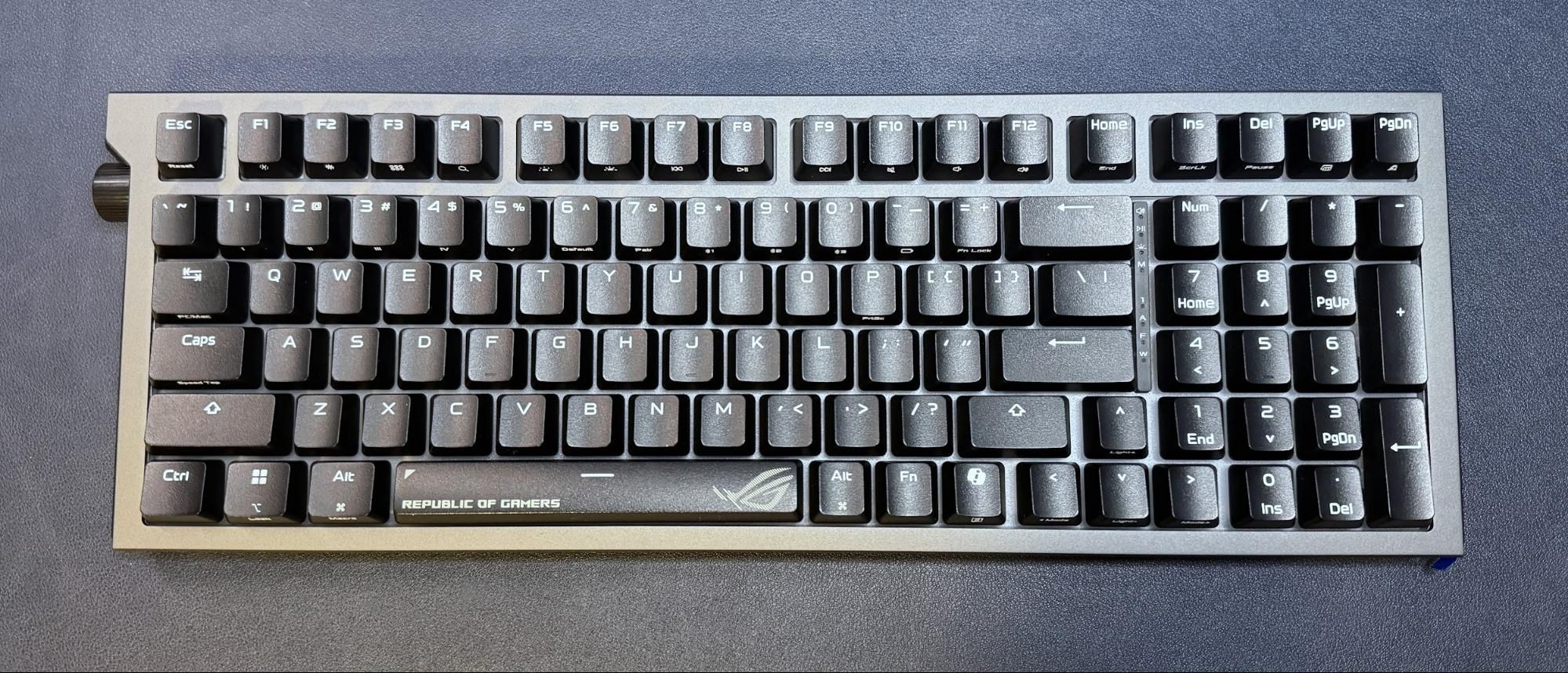
The Strix Morph 96 Wireless comes with your choice of Asus' NX V2 mechanical switches in Snow V2 (linear) or Storm V2 (clicky). Our review unit came with the Snow V2 (linear) switches, which the brand describes as "refined linear" — factory-lubed linear switches with a 40gf initial force (53gf total force) and an actuation point of 1.8mm. This isn't the first time I've used these switches, and they're pretty nice for linear switches: Smooth, stable, speedy, and lightweight — perfect for gaming, and surprisingly pleasant for typing.
Like most of Asus' gaming keyboards today, the Strix Morph 96 Wireless also comes with a hot-swappable PCB that accepts both 3- and 5-pin mechanical switches, so you can swap in your own switches if you don't find Asus' options appealing.
(Image credit: Tom's Hardware) (Image credit: Tom's Hardware) (Image credit: Tom's Hardware) Typing on the Strix Morph 96 is a very pleasant experience — more pleasant than I was expecting, and I already had somewhat high expectations given Asus' track record with gaming keyboards. The linear switches are smooth and lightweight, which, combined with the low-profile, textured keycaps, makes it easy to type quickly for long periods without feeling any fatigue. The keyboard does feature a gasket mount design and a translucent PC positioning plate — it's comfortable to type on, and it gives off a crisp, clacky sound. There are two layers of dampening material in the case, but case ping was pretty minimal. It wasn't the most perfect-sounding keyboard I've used, but for a relatively budget-friendly mainstream gaming keyboard, it's impressive.
The NX Snow V2 linear switches are excellent for gaming, as they're smooth and swift with quick actuation so your fingers can fly across the board without any second guesses (or re-presses). The extra keys in a 96-percent keyboard are also handy for games that need extra keybinds (and it's not nearly as difficult to get used to the 96-percent layout when you're gaming, as opposed to touch-typing). This is still a mechanical keyboard, not a magnetic one — while Asus does have some gaming-oriented functionality you can turn on in its Gear Link app, including "Speed Tap," the brand's implementation of SOCD, you won't find Hall Effect-specific features such as RapidTrigger.
The Strix Morph 96 is fully customizable via Asus' new online app, Gear Link. You can use Gear Link to customize the keyboard without plugging the keyboard in (provided the 2.4GHz dongle is plugged in), which is convenient (and unique — most web-based apps require a wired connection to work). You can use Gear Link to remap keys (though you only get one, limited secondary Fn layer), turn on and adjust Speed Tap, customize the rotary knob and lighting, and adjust the power settings.
(Image credit: Tom's Hardware) (Image credit: Tom's Hardware) (Image credit: Tom's Hardware) (Image credit: Tom's Hardware) (Image credit: Tom's Hardware) (Image credit: Tom's Hardware) It's not entirely web-based, however. Asus simply cannot stop itself from installing software on your PC — if you'd like to do things like record and setup macros or customize the rotary knob to open up a website or input a preset string of text when you turn/click it, you'll need to download and install the appropriate Gear Link Companion "extension" app. Gear Link Companion apps are smaller extension apps that let you access more of your device's functionality, but they need to be installed on your PC (and you do need to restart your PC upon installation). So close, Asus… so close.
The Strix Morph 96 Wireless offers three forms of connectivity: 2.4GHz wireless, Bluetooth, and wired (via USB-C). Asus rates the board's battery life at 590 hours over a 2.4GHz wireless connection with the lighting turned off; that number drops to around 100 hours with the lighting turned on. In Bluetooth mode, the battery is rated for about 750 hours with the lighting turned off (110 hours with the lighting turned on). This isn't quite as impressive as the Asus Strix Scope II 96 Wireless , which gets 1,500 hours of battery life over a 2.4GHz wireless connection with the lighting turned off (90 hours with the lighting turned on, though, so it seems like the Strix Morph 96 Wireless' lighting might be a tad more efficient).
The ROG Strix Morph 96 Wireless is everything I've come to expect from Asus' keyboards — it has a nice, clean build, it's comfortable to type on and excellent for gaming, and it gets excellent battery life. I'm a big fan of the move to this new Gear Link app (even if I felt slightly tricked when I still had to download an extra companion app), as it works well and doesn't add 75 unnecessary background processes like Armoury Crate does. At $140, the ROG Strix Morph 96 is also much more budget-friendly than the ROG Azoth line (the Azoth X debuted with a retail price more than twice this — $300 — last year).
But I'll also point out that at this exact moment, the pricier Asus ROG Strix Scope II 96 Wireless is currently selling for $129.99 at Best Buy . That's $50 off of its debut retail price ($179.99), $80 off its "current retail price" of $209.99, and still $10 less than the ROG Strix Morph 96 Wireless. The ROG Strix Scope II 96 Wireless also has a 96-percent layout, a hot-swappable PCB, a similarly-limited multi-function roller, and it feels and sounds great. It also comes with a wrist rest, double-shot PBT keycaps, and significantly better battery life (even though the ROG Strix Morph 96 Wireless' battery life is pretty impressive).
Keyboards aren't like other components — you don't need to upgrade every couple of years, and the tech is largely the same (just implemented differently), so the ROG Strix Scope II 96 Wireless is still a great buy. The ROG Strix Morph 96 Wireless will probably end up being a good option in the future, once the ROG Strix Scope II 96 Wireless clears shelves, but for now… I'd wait.
Sarah Jacobsson Purewal is a senior editor at Tom's Hardware covering peripherals, software, and custom builds. You can find more of her work in PCWorld, Macworld, TechHive, CNET, Gizmodo, Tom's Guide, PC Gamer, Men's Health, Men's Fitness, SHAPE, Cosmopolitan, and just about everywhere else. ","collapsible":{"enabled":true,"maxHeight":250,"readMoreText":"Read more","readLessText":"Read less"}}), "https://slice.vanilla.futurecdn.net/13-4-19/js/authorBio.js"); } else { console.error('%c FTE ','background: #9306F9; color: #ffffff','no lazy slice hydration function available'); } Sarah Jacobsson Purewal Social Links Navigation Senior Editor, Peripherals Sarah Jacobsson Purewal is a senior editor at Tom's Hardware covering peripherals, software, and custom builds. You can find more of her work in PCWorld, Macworld, TechHive, CNET, Gizmodo, Tom's Guide, PC Gamer, Men's Health, Men's Fitness, SHAPE, Cosmopolitan, and just about everywhere else.
Key considerations
- Investor positioning can change fast
- Volatility remains possible near catalysts
- Macro rates and liquidity can dominate flows
Reference reading
- https://www.tomshardware.com/peripherals/gaming-keyboards/SPONSORED_LINK_URL
- https://www.tomshardware.com/peripherals/gaming-keyboards/asus-rog-strix-morph-96-wireless-review#main
- https://www.tomshardware.com
- New NVIDIA Nemotron 3 Super Delivers 5x Higher Throughput for Agentic AI
- SMIC sent chipmaking tools to Iran's military, Trump administration officials say — report claims exchange began a year ago, 'almost certainly included technica
- Chinese military reveals drone wolf pack capable of swarm operations — robot dogs can be equipped with grenade launchers and machine guns for urban combat
- New Cambridge human brain-inspired chip could slash AI energy use — new type of memristor has roughly a million times lower switching current than conventional
- Razer Kiyo V2 Review: USB-C required
Informational only. No financial advice. Do your own research.