
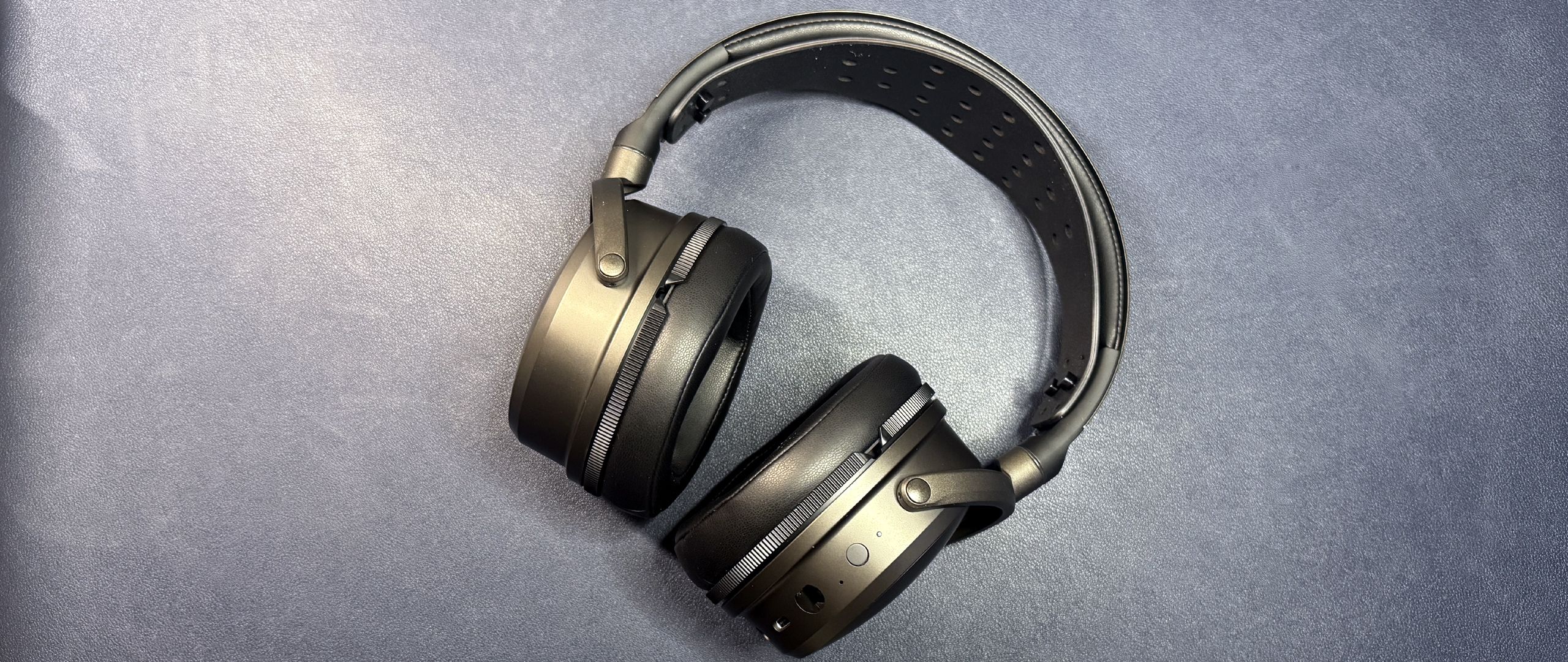
The Maxwell 2 has Audeze's 90mm planar magnetic drivers, which have a frequency response of 10 – 50,000 Hz (wider than most gaming headsets, which typically stick around the 20 – 20,000 Hz range). These are an updated version of the 90mm planar magnetic drivers you'll find in the original Maxwell, and they sound great — though there were some issues with bass power when I first received the headset that seem to have been mostly fixed by a recent firmware update.
If you're looking for a gaming headset that you can also listen to music on, this is it. There's nothing quite like planar magnetic drivers (in my opinion) for hearing all those crisp, minuscule details in your favorite tracks, without sacrificing that powerful, thumping bass. As I mentioned earlier, there were some issues with the bass when I first received the headset (it just wasn't as powerful as I expected it to be), but a recent firmware update seems to have largely addressed that issue. (So, that's also good news — there's a lot that can be fixed through firmware updates, and the Audeze team seems to be paying some attention to issues people are having.)
Anyway, thanks to the firmware update, music sounds great on the Maxwell 2. You can hear all of the details and layers in complex songs like Beyonce's Single Ladies , and the subtle roll of the timpani at the beginning of Lorde's Royals . Mid-range heavy songs such as Enya's Orinoco Flow and K-391's Lonely World are especially dynamic, and there's plenty of spark in the high end without anything feeling too unbearable. The firmware update brought back the thumping bass you'll "feel" rather than hear in songs like Kaskade's POW POW POW , but it's still not quite as powerful as the bass in the original Maxwell, so hopefully we'll see another firmware update in the near future. It is a little disappointing, however, as a "punchier bass response" was one of the promised upgrades in the Maxwell 2, and I have yet to be impressed.
Games also sound excellent on the Maxwell 2, though I didn't notice much difference between the game-specific EQ presets (e.g. "Footsteps" didn't seem to do much to boost the sound of footsteps or reloads for me). Immersive audio is especially good, thanks to the Maxwell 2's wide sound stage and highly-detailed planar magnetic drivers: I was (finally) able to effectively track those crickets in Where Winds Meet by auditory cues alone (though I still needed to look at the screen to capture them).
The Maxwell 2 has both a detachable boom microphone and built-in mics in the earcups. The boom mic sits at the end of a 4-inch-long flexible metal gooseneck arm, and is pretty good — it's not the best boom mic I've seen on a headset, but it does a decent job of capturing the fullness of your voice and giving it a broadcast-y quality.
(Image credit: Tom's Hardware) (Image credit: Tom's Hardware) The built-in mics are still pretty bad, though. They don't seem to be quite as bad as the built-in mics on the original Maxwell, but that might be the AI noise reduction tech at work. There's definitely a noticeable difference between the boom mic and the built-in mics; the built-in mics sound hollow and have a lot of echoing, though they're decent enough for casual communication. Both mics work with the headset's "AI-powered noise removal," which can be activated by pressing the button on the front of the left earcup. There are three levels (high, low, and off), and while it doesn't seem to do much to reduce background noise (though background noise pickup was pretty minimal to begin with in my testing), it does boost your voice so it comes through louder and clearer.
The Maxwell 2 works with Audeze's new Audeze app, which is fairly simple and straightforward, with a handful of settings that can (mostly) also be adjusted directly from the headset.
(Image credit: Tom's Hardware) (Image credit: Tom's Hardware) (Image credit: Tom's Hardware) These include game / chat mix, microphone sidetone, and the AI noise reduction feature for the mic. It also has a 10-band EQ, with six presets and four custom options. Your custom options save directly to the headset, and you can cycle through all options on the headset by pressing the volume wheel and scrolling. I was a little disappointed to find that only the custom options are customizable, especially since I didn't find the game-ready presets to be quite what I was looking for. It would be nice to be able to customize the existing presets, in addition to being able to add your own.
Battery life and connectivity of the Maxwell 2 is basically the same as what you'll find on the original Maxwell. The Maxwell 2 has 2.4GHz wireless and Bluetooth 5.3 connectivity, but not it’s simultaneous and there's no way to manually switch between the two: It switches automatically, prioritizing the Bluetooth connection. I cannot emphasize how frustrating this is — while it's true that not everyone needs or will find a use for a simultaneous dual-wireless connection (like you'll find on the HyperX Cloud Alpha 2 or the Razer BlackShark V3 Pro ), I cannot imagine most people will always want their Bluetooth device to take priority, without the option to manually switch.
The Maxwell 2 gets up to 80 hours of battery life over both its 2.4GHz wireless and Bluetooth connection, which is still pretty solid. It's no longer leagues ahead of the competition, but it's longer than you'll get on most wireless gaming headsets, and it's especially good for planar magnetic drivers.
The Maxwell 2 is a great headset, because the original Maxwell was a great headset. And the Maxwell 2 is… very, very similar. Maybe too similar. This feels more like a product refresh than a second generation, and not much of a refresh at that — it is heavier , after all (though, in my opinion, more comfortable). Even with its slightly lackluster bass response, music and games sound very, very good on the Maxwell 2, and I want to recommend it on audio quality alone (including outgoing audio quality; the mic's pretty good). But it seems to be going through some stuff at the moment: It's heavier than the original Maxwell, the earcups no longer swivel flat, and it still has the most frustrating application of dual wireless connectivity I've ever seen in any headset, ever. As far as I'm concerned, this is not practical as a dual-wireless headset: I don't want my Bluetooth device to take priority every single time, so I end up having to disconnect Bluetooth.
And, well, you can get all these things — great sound, decent mic, extremely frustrating Bluetooth situation — in the original Maxwell headset. The Maxwell 2 starts at $329 for the PlayStation version and goes up to $349 for the Xbox version (both versions work with PC), which makes it one of the priciest gaming headsets around. The BlackShark V3 Pro may not sound as good, but it's lighter and has real dual-wireless connectivity and costs almost $100 less.
Sarah Jacobsson Purewal is a senior editor at Tom's Hardware covering peripherals, software, and custom builds. You can find more of her work in PCWorld, Macworld, TechHive, CNET, Gizmodo, Tom's Guide, PC Gamer, Men's Health, Men's Fitness, SHAPE, Cosmopolitan, and just about everywhere else. ","collapsible":{"enabled":true,"maxHeight":250,"readMoreText":"Read more","readLessText":"Read less"}}), "https://slice.vanilla.futurecdn.net/13-4-13/js/authorBio.js"); } else { console.error('%c FTE ','background: #9306F9; color: #ffffff','no lazy slice hydration function available'); } Sarah Jacobsson Purewal Social Links Navigation Senior Editor, Peripherals Sarah Jacobsson Purewal is a senior editor at Tom's Hardware covering peripherals, software, and custom builds. You can find more of her work in PCWorld, Macworld, TechHive, CNET, Gizmodo, Tom's Guide, PC Gamer, Men's Health, Men's Fitness, SHAPE, Cosmopolitan, and just about everywhere else.
Key considerations
- Investor positioning can change fast
- Volatility remains possible near catalysts
- Macro rates and liquidity can dominate flows
Reference reading
- https://www.tomshardware.com/peripherals/gaming-headsets/SPONSORED_LINK_URL
- https://www.tomshardware.com/peripherals/gaming-headsets/audeze-maxwell-2-review#main
- https://www.tomshardware.com
- Scientists share design so you can make your own 3D-printable 'eFlesh' for robots — affordable, easy to produce, and highly-tactile robot sensor grips can be pr
- External disc drive now a mere $9.99 on Woot — Access any CD or DVD with a modern USB-C interface at 55% off
- Japan Science and Technology Agency Develops NVIDIA-Powered Moonshot Robot for Elderly Care
- Gaming market melts down after Google reveals new AI game design tool — Project Genie crashes stocks for Roblox, Nintendo, CD Projekt Red, and more
- Maingear brings back the 90s nostalgia with old-school pre-built PCs with RTX 5090 and Ryzen 9 9950X3D — limited edition Retro98 PCs are available now
Informational only. No financial advice. Do your own research.