
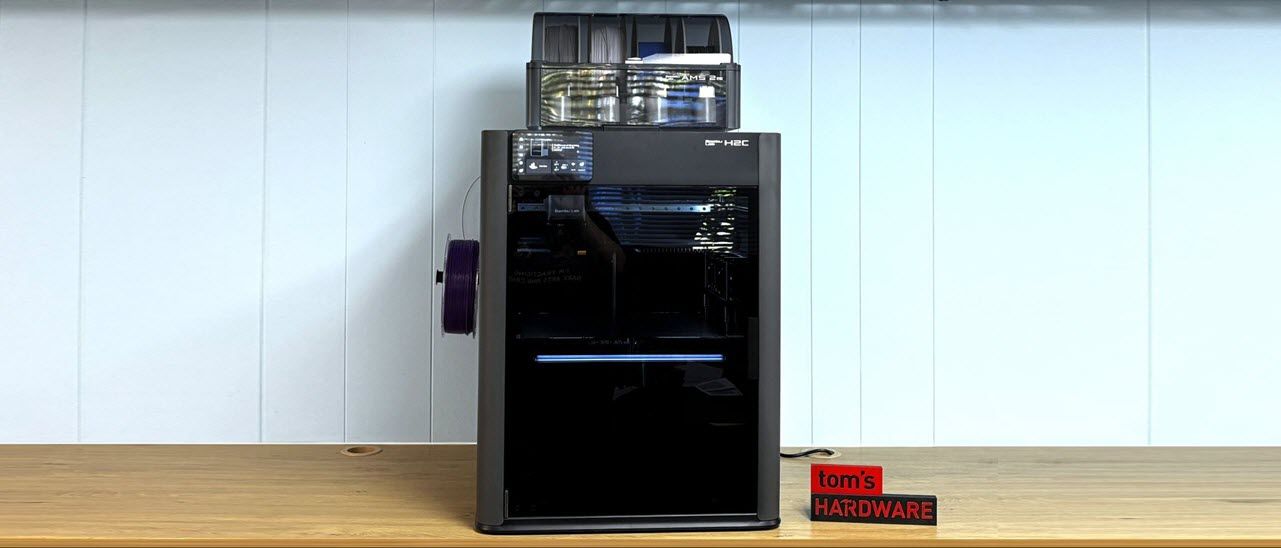
And if you’re wondering, yes, you need the purge tower. If you look at the photo below, you’ll see all the stray bits of filament flying off the edge. If you try to print without the purge tower, that mess will be on your print. I tried it, and the print didn’t even make it halfway before it completely failed.
For PETG, I printed a box I made myself using MakerWorld’s parametric model maker on MakerLab. I really like being able to just give the program the dimensions I need and getting a clean, functional print. I needed a box to hold my wax seal kit, so I measured all the things it would hold, punched in the numbers into MakerLab, and got the perfect size. I also whipped up a vase mode inner compartment in Tinkercad to keep it organized. The box is printed with Octogram Spiral as the top surface and gyroid infill to give it a more interesting appearance.
This was mostly printed in Greengate American Blue recycled PETG , but then I ran out and finished it with Greengate Deepwater Blue , which has a similar shade with added glitter. It was perfectly smooth and gorgeous. The sparkles on the vase mode insert really pop.
The print took about seven hours altogether to print. Each piece was printed on its own, as this was a rather large (200 x 160 x 70 mm) project.
For TPU, I tried something new: Siraya Tech’s 95A PEBA . This is a rubbery TPU with more energy return. I’ve been seeing people print basketballs with it, but I settled for a quicker “air tennis ball” and was not disappointed. It still was a bit wispy, even after drying, and supports are difficult to remove. I attempted one with PETG supports, which immediately failed. This may take a bit more research.
Bambu is now saying that TPU should be run directly from the top, without tubing, into a dedicated Vortex nozzle. This is to avoid cross contamination, but you can still clean the nozzle out with a bit of high temp filament (I used PETG) and go on about your business. However, the slicer will not let you put TPU in the left nozzle without pulling a major fake out on it. This was a bit of a production, so I doubt I will be running TPU in this machine again.
(Image credit: Tom's Hardware) (Image credit: Tom's Hardware) The Airless Tennis Ball V2 was found on Printables by Kimmehead . It took 4 hours and 47 minutes to print with a .4 nozzle and standard TPU settings. I printed it without supports, only a brim. It’s a tiny bit messy, but better than clipping off the supports. It bounces just like a real store bought ball.
I ran a bunch of things in high temp materials, but here’s a fun one I’m working on. This is a dashboard hula girl I’m trying to sort out for my truck driving son. I used all Ambrosia Filament ASA filament, so it will be able to be displayed inside a vehicle without risk of melting. The custom model is by Wekster , who owed me a favor. I then made a skirt inspired by the classic “hairy lion” in Tinkercad. Once I figure out how to 3D print a spring, I’ll share the finished model.
This example isn’t perfect. The supports failed on the flower in her hair, after printing great a half dozen times in PLA while I prototyped it. I think the ASA is a little harder to get to stick to the plate. The failed support put some ripples on her face, so I’ll need to reprint this one later.
Otherwise, it was pretty cool being able to print five colors of ASA. I used a .12mm layer height to bring out the details, so this print took a rather slow 19 hours and 39 minutes to print just her upper half. The legs only took 3 hours and 49 minutes to print, since it was a simpler paint job.
Custom model by Wekster (Image credit: Tom's Hardware) Custom model by Wekster (Image credit: Tom's Hardware) Bottom Line Bambu Lab’s H2C is a great printer, with its timing spoiled by the competition. Though the Vortek system certainly fixes the filament waste problems, putting it on the most expensive machine is troubling to me. I would very much like to see a “normal” sized printer with a Vortek or, better yet, a full tool changer that takes advantage of Bambu Lab’s full Core XY speed.
With a retail price of $2,399 for the H2C Combo – and, for obvious reasons, no “single color” version – this is not a printer I’d recommend for anyone with a tight budget. But if a large, premium machine is in your future, this is it.
If the Bambu Lab H2C seems out of reach, I’d suggest checking out the Creality K2 Plus , a larger format Core XY with a standard AMS on sale for $1,199. The Snapmaker U1 is the most affordable tool changer on the market right now, and though it is smaller and only has four colors, the $849 price tag looks very nice. If you want a true five-color tool changer, then the Prusa Research XL is the way to go…at least until the INDX is released in 2026.
Denise Bertacchi Social Links Navigation Freelance Reviewer Denise Bertacchi is a Contributing Writer for Tom’s Hardware US, covering 3D printing. Denise has been crafting with PCs since she discovered Print Shop had clip art on her Apple IIe. She loves reviewing 3D printers because she can mix all her passions: printing, photography, and writing.
S58_is_the_goat I just got an h2s recently, good enough for me since I barely print multi colour stuff. Just couldn't justify the price for the h2c since it only solves half of the issue, waste but not time like a real tool changer. Reply
Key considerations
- Investor positioning can change fast
- Volatility remains possible near catalysts
- Macro rates and liquidity can dominate flows
Reference reading
- https://www.tomshardware.com/3d-printing/SPONSORED_LINK_URL
- https://www.tomshardware.com/3d-printing/bambu-lab-h2c-review#main
- https://www.tomshardware.com
- Australian modder solves PC in a freezer conundrum with sheer size, socks filled with silica gel powder — condensation conquered and minimal overclocking gains
- Report estimates $17 billion worth of bitcoin was stolen in 2025 alone —massive haul arises from impersonation tactics and the use of AI for scams
- Meta sets up 'Meta Compute' organization for gigawatt-scale AI data centers — initiative is said to consume hundreds of gigawatts over time
- Australian modder solves PC in a freezer conundrum with sheer size, socks filled with silica gel powder — condensation conquered and minimal overclocking gains
- Trump's cryptic remark states Apple has invested in Intel — tells press 'Apple went in, Nvidia went in, a lot of smart people went in'
Informational only. No financial advice. Do your own research.