
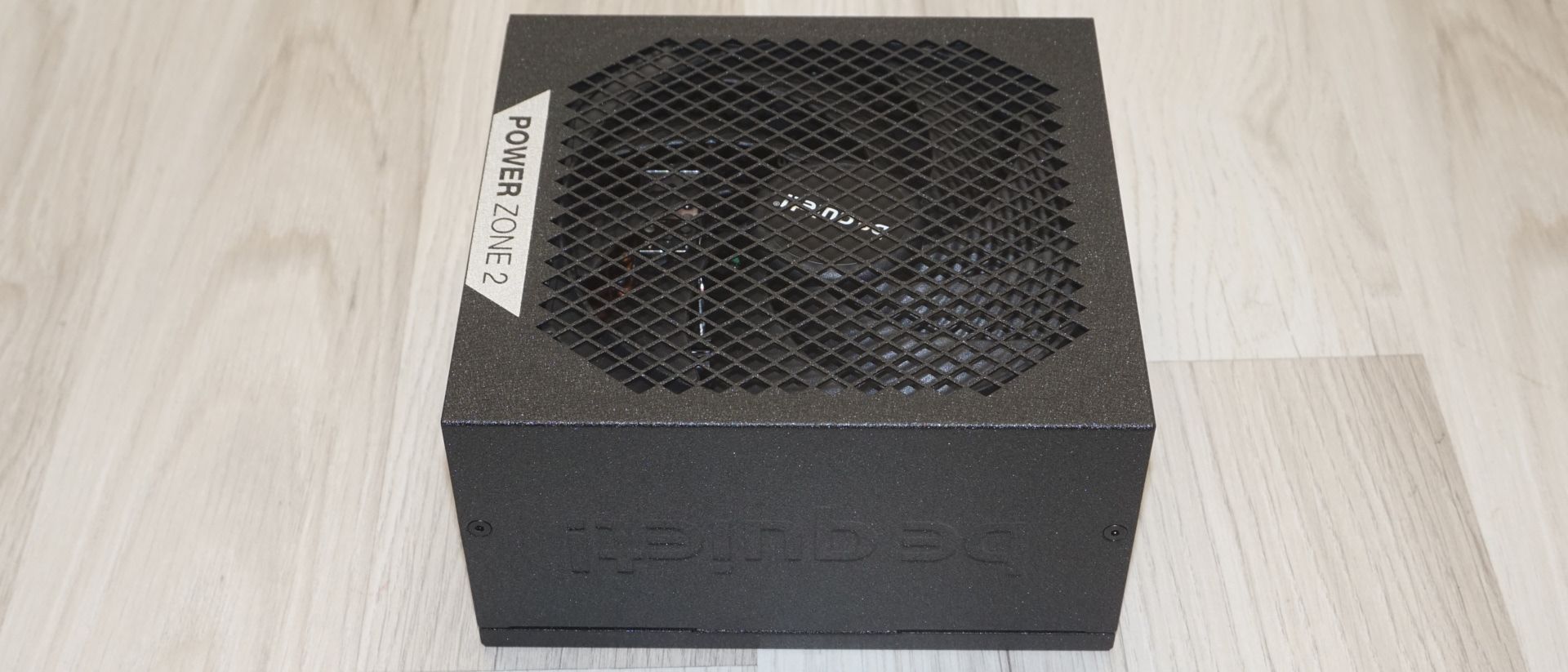
The unit measures 160mm in length, exceeding the ATX design guide's standard 140mm specification. This extended depth allows for improved component spacing and thermal management, as well as it makes the use of a 140 mm fan comfortably possible, but requires verification for compatibility with compact cases or unique chassis designs. Most modern ATX cases accommodate this dimension without issue, but builders working with small form factor or older enclosures should confirm clearance before purchasing.
(Image credit: Tom's Hardware) (Image credit: Tom's Hardware) Internal Design At the heart of the Power Zone 2's acoustic philosophy sits a Pure Wings 3 140mm fan, designed in-house by be quiet! themselves. The fan employs a rifle bearing engine, representing a middle-ground solution between basic sleeve bearings and premium fluid dynamic bearing (FDB) alternatives. Rifle bearings advance traditional sleeve bearing technology through improved lubrication retention, delivering better longevity while maintaining characteristically low noise output. The maximum rotational speed of 1800 RPM appears aggressive for a unit in this power class, though be quiet!'s semi-passive control strategy ensures this maximum rarely engages during typical operation. The oversized 140mm diameter provides a distinct advantage over standard 120mm implementations.
The OEM behind the Power Zone 2's creation is FSP (Fortron-Source), one of the industry's most established manufacturers with decades of platform development experience. FSP produces a substantial portion of mid- and high-tier power supplies available today, lending credibility to the final product. This partnership allows be quiet! to leverage proven design expertise while focusing internal resources on acoustic optimization and thermal management refinement.
(Image credit: Tom's Hardware) (Image credit: Tom's Hardware) The input filtering stage implements an adequate configuration of four Y capacitors, two X capacitors, and two filtering inductors. Two rectifying bridges share a sizable heatsink positioned immediately after the filtering components. The APFC circuitry shares a large heatsink with the primary inversion components along the unit's edge. Active components consist of two Magnachip 65R090R MOSFETs paired with a single diode, handling power factor correction duties. One wrapped inductor and two Elite capacitors (330 μF and 270 μF) comprise the passive components.
The primary inversion stage employs two Magnachip 65R115R MOSFETs configured in half-bridge topology. These components can be found on the same generously-proportioned heatsink as the APFC circuitry. Half-bridge topologies represent standard practice for mainstream units, offering reliable performance without the complexity and cost of full-bridge alternatives.
The secondary side implementation places four Nexperia PSMN1R4-40YLDX MOSFETs on the PCB's underside, handling synchronous rectification for the primary 12V rail. These represent solid mainstream components with appropriate specifications for their role. The unit employs DC-to-DC conversion circuitry for the 3.3V and 5V minor rails, mounted on a vertical daughterboard – a design approach that has become standard practice for modern power supplies and offers improved regulation compared to older group-regulated alternatives.
(Image credit: Tom's Hardware) (Image credit: Tom's Hardware) The capacitor selection throughout the secondary side presents the Power Zone 2's most controversial design decision. Elite supplies all secondary side capacitors, and while all carry appropriate 105°C temperature ratings, Elite does not command the reputation associated with premium power supply construction. Elite products typically appear in budget-oriented designs rather than units targeting mainstream or enthusiast markets. This represents a clear cost-optimization decision—Elite capacitors will function reliably within their specifications, but they typically do not offer the performance margins or longevity expectations associated with Japanese manufacturers like Nippon Chemi-Con, Rubycon, or even respected Taiwanese alternatives like Teapo. For a unit backed by a 10-year warranty, this component selection requires faith in FSP's engineering margins and be quiet!'s reputation.
(Image credit: Tom's Hardware) (Image credit: Tom's Hardware) Cold Test Results Cold Test Results (25°C Ambient) For the testing of PSUs, we are using high precision electronic loads with a maximum power draw of 2700 Watts, a Rigol DS5042M 40 MHz oscilloscope, an Extech 380803 power analyzer, two high precision UNI-T UT-325 digital thermometers, an Extech HD600 SPL meter, a self-designed hotbox and various other bits and parts.
(Image credit: Tom's Hardware) (Image credit: Tom's Hardware) (Image credit: Tom's Hardware) (Image credit: Tom's Hardware) (Image credit: Tom's Hardware) Under controlled cold testing conditions with 25°C ambient temperature, the be quiet! Power Zone 2 850W delivers efficiency performance that comfortably satisfies its certification requirements. At 115 VAC input voltage, the unit achieves an average nominal load efficiency of 90.6%, while 230 VAC input improves performance to 93.1%, figures that place it solidly within 80 Plus Platinum parameters and validate its Cybenetics Platinum certification. The efficiency curve exhibits almost typical behavior, peaking at approximately 40% load before gradually declining as output increases, but we can see that the platform is optimized towards a 230 VAC input. Low-load efficiency proves fair rather than exceptional. The Power Zone 2 delivers acceptable performance across its entire operational range without chasing diminishing-return optimizations.
The fan behavior during cold testing validates be quiet!'s acoustic-first design philosophy spectacularly. The Pure Wings 3 fan remains completely inactive across an impressive portion of the load spectrum, maintaining absolute silence until the load exceeds 70%. Even after activation, the fan maintains low speeds until load reaches 90%, creating an acoustic experience that essentially eliminates the power supply as a noise source during typical gaming or productivity workloads. Only when pushing the unit to operate at its rated capacity for prolonged periods does the fan become clearly audible, which is not a feasible real-world scenario. The thermal performance proves equally impressive, with internal temperatures remaining exceptionally low throughout testing. The component choices create substantial thermal headroom, allowing the unit to operate well below maximum temperature specifications even when the fan runs at minimum speeds.
Elevated ambient temperature testing reveals the Power Zone 2's engineering margins with particular clarity. At approximately 45°C ambient, high temperatures exert modest detrimental effects on electrical performance, but the effects are measurable. Average nominal load efficiency measures 89.3% at 115 VAC and 91.8% at 230 VAC under hot conditions, representing a significant efficiency drop of 1.3% compared to cold testing. Efficiency degradation remains relatively uniform across the load range rather than concentrating at maximum output. This behavior suggests that component thermal limits remain comfortably distant even at full load under adverse conditions. There are some signs of small thermal stress at maximum load, as the efficiency drop is slightly greater, but the effect is not worrying.
(Image credit: Tom's Hardware) (Image credit: Tom's Hardware) (Image credit: Tom's Hardware) (Image credit: Tom's Hardware) (Image credit: Tom's Hardware) The fan profile under hot conditions reveals the unit's thermal management priorities with crystal clarity. The semi-passive threshold drops to 60% load, allowing the fan to engage only slightly earlier than in cold testing. Once active, the fan increases speed more aggressively than before, reaching near-maximum RPM by the time the unit operates at full load. The unit becomes clearly audible when heavily loaded in hot environments, with the fan producing substantial airflow noise. However, context matters tremendously. Despite the aggressive fan response, internal temperatures remain exceptional throughout hot testing and components operate well below their maximum ratings, even at full load. The PSU maintains internal thermal conditions that would be considered passable for cold testing, let alone operation in a 45°C environment. The Power Zone 2 becomes audible when pushed hard in challenging environments but it ensures components never approach thermal limits that could compromise reliability or lifespan. For users in warm climates or systems with restricted airflow, this represents an intelligent tradeoff. The unit will generate noticeable noise during sustained high-load operation but it will continue operating reliably while keeping components in thermal conditions that promise excellent longevity. Users in cool environments or with well-ventilated cases will rarely experience this behavior, instead enjoying the benefits of silence-centered design across nearly all realistic usage scenarios.
The be quiet! Power Zone 2 850W's electrical performance delivers results that align appropriately with its positioning and Platinum certification. Voltage ripple filtering proves adequate across all rails, with maximum measurements of 54 mV on the 12V rail and 20 mV on both the 5V and 3.3V rails. These figures comfortably satisfy ATX specifications, which permit up to 120 mV on the 12V rail and 50 mV on minor rails. While the results do not achieve the elite sub-30 mV 12V performance found in premium units, they represent solid mainstream implementation that ensures stable power delivery for all components. However, the 54 mV maximum 12V ripple merits brief discussion. This measurement occurs at maximum load under challenging test conditions and represents worst-case behavior rather than typical operation. Modern components tolerate ripple well within these specifications without issue, and the vast majority of users will never operate their systems at sustained maximum load where these peak ripple values appear. Nonetheless, enthusiasts accustomed to flagship power supplies delivering sub-30 mV ripple across all conditions may find these figures less impressive, representing one area where the Power Zone 2's budget-oriented component selection manifests in measurable performance differences. Voltage regulation proves fair across all rails. The 12V rail maintains 1.2% regulation, while the 5V and 3.3V rails achieve 1.4% and 1.1% regulation respectively. The regulation results reveal a competent but unsurprising design.
During our thorough assessment, we evaluate the essential protection features of every power supply unit we review, including Over Current Protection (OCP), Over Voltage Protection (OVP), Over Power Protection (OPP), and Short Circuit Protection (SCP). All protection mechanisms were activated and functioned correctly during testing.
The protection features function correctly, though with characteristics typical of FSP designs. Over Current Protection (OCP) on the primary 12V rail activates at 120%, a reasonable threshold that provides headroom for transient spikes while protecting against sustained overcurrent conditions. The minor rail OCP settings prove notably higher, triggering at 140% on the 3.3V rail and 142% on the 5V rail. These aggressive thresholds represent characteristic FSP implementation, providing substantial margin for legacy devices and unusual load conditions while potentially offering less protection than more conservative designs. Over Power Protection (OPP) activates at 126% under hot conditions, allowing the unit to very briefly handle loads approaching 1070 watts before shutting down protectively. All protection mechanisms activated sharply and correctly during testing, shutting down the unit cleanly without damage when triggered.
The be quiet! Power Zone 2 850W can very well exist as a study in priorities: a high-tier PSU that unapologetically elevates acoustic performance and thermal management above all else, including component pedigree. From a user experience perspective, this unit excels dramatically. The cooling system delivers genuine silence during the vast majority of real-world usage, the thermal performance ensures components operate in conditions that promise excellent longevity, and the efficiency meets Platinum certifications while keeping operating temperatures and noise levels remarkably low.
However, the specification sheet reveals compromises that cannot be ignored. The extensive use of Elite capacitors and budget-tier components represents clear cost optimization that places the Power Zone 2's internal quality below competitors at similar price points. These component selections do not suggest the unit will fail – FSP's engineering margins and be quiet!'s 10-year warranty provide reasonable assurance of reliability – but they indicate the unit operates with less margin than alternatives.
Yet these criticisms must be weighed against what users actually experience. The Power Zone 2 delivers exceptional acoustic performance that genuinely enhances the computing experience, particularly for users building quiet workstations or minimizing noise pollution in shared spaces. The thermal management proves genuinely impressive, maintaining component temperatures that suggest components will operate reliably for years even under challenging conditions. The electrical performance, while not class-leading, proves entirely adequate for modern systems and meets all relevant specifications with comfortable margins.
At its current $140 sale retail price, the Power Zone 2 positions itself competitively within the mainstream Platinum-certified segment. This pricing sits below many premium alternatives while remaining above budget options that sacrifice features or performance for lower cost. It succeeds admirably at what it attempts, which is delivering exceptional acoustic performance and impressive thermal management at a competitive price point, backed by modern connectivity and appropriate certifications. Whether those priorities align with individual needs determines whether this represents an excellent choice or merely an adequate one.
E. Fylladitakis Contributing Editor Dr. E. Fylladitakis has been passionate about PCs since the 8088 era, beginning his PC gaming journey with classics like Metal Mutant and Battle Chess. Not long after, he built his first PC, a 486, and has been an enthusiast ever since. In the early 2000’s, he delved deeply into overclocking Duron and Pentium 4 processors, liquid cooling, and phase-change cooling technologies. While he has an extensive and broad engineering education, Dr. Fylladitakis specializes in electrical and energy engineering, with numerous articles published in scientific journals, some contributing to novel cooling technologies and power electronics. He has been a hardware reviewer at AnandTech for nearly a decade. Outside of his professional pursuits, he enjoys immersing himself in a good philosophy book and unwinding through PC games.
Notton https://cdn.mos.cms.futurecdn.net/GZJxDFvhouRh9hWA7Zud4M-970-80.jpg.webpIt's a matter of personal preference, but when it comes to the SATA power cables, I absolutely loathe crimp-on 90d connectors used mid cable like the one shown here. Not only is it never the right length, it adds unnecessary strain on the cable and male connector. Y-splitters are way better in every regard, especially when it comes to bundling the excess neatly. As for the connectors on the PSU side… A minor detail, but it's cramped https://cdn.mos.cms.futurecdn.net/u6Jx9jAxqGg3WPvHekTaAM-970-80.jpg.webpYeah, I don't think my fingers are going to fit in there. I see the Drive connectors have their latch on the short side, which is a nice touch, but that needed to happen on the P8 and PCIe connectors too. Either that or move around the placement. There's so much extra room on the plate. Reply
Mindstab Thrull It's really hard for me to take a review seriously when I see a simple error that I've seen multiple times from this individual on this site. This is a review for a be quiet! branded 850W power supply. Why do I see a table for included cables clearly labelled as for Seasonic G12 GC-750 ? Please, for the love of sanity, to ALL authors and editors everywhere, make sure you're checking for simple logical mistakes like this! Otherwise I just see random interchangeable chunks of text (here's an intro for Corsair, here's one for EVGA, here's one for Silverstone, etc) and it feels like minimal time was spent with the unit. At this point I'd rather check LTT Labs to see what they have to say. Signed, A disappointed reader. Reply
Key considerations
- Investor positioning can change fast
- Volatility remains possible near catalysts
- Macro rates and liquidity can dominate flows
Reference reading
- https://www.tomshardware.com/pc-components/power-supplies/SPONSORED_LINK_URL
- https://www.tomshardware.com/pc-components/power-supplies/be-quiet-power-zone-2-850w-power-supply-review#main
- https://www.tomshardware.com
- Nvidia prepares shipment of 82,000 AI GPUs to China as chip war lines blur — H200 shipments with 25% tax to begin as US loosens restrictions
- [Daily Due Diligence] NVDA NVDA
- Get a pre-built PC with 32GB of RAM for under $1,000 — this mid-range gaming desktop delivers decent performance for an affordable price during these trying tim
- Game the Halls: GeForce NOW Brings Holiday Cheer With 30 New Games in the Cloud
- NVIDIA Acquires Open-Source Workload Management Provider SchedMD
Informational only. No financial advice. Do your own research.