
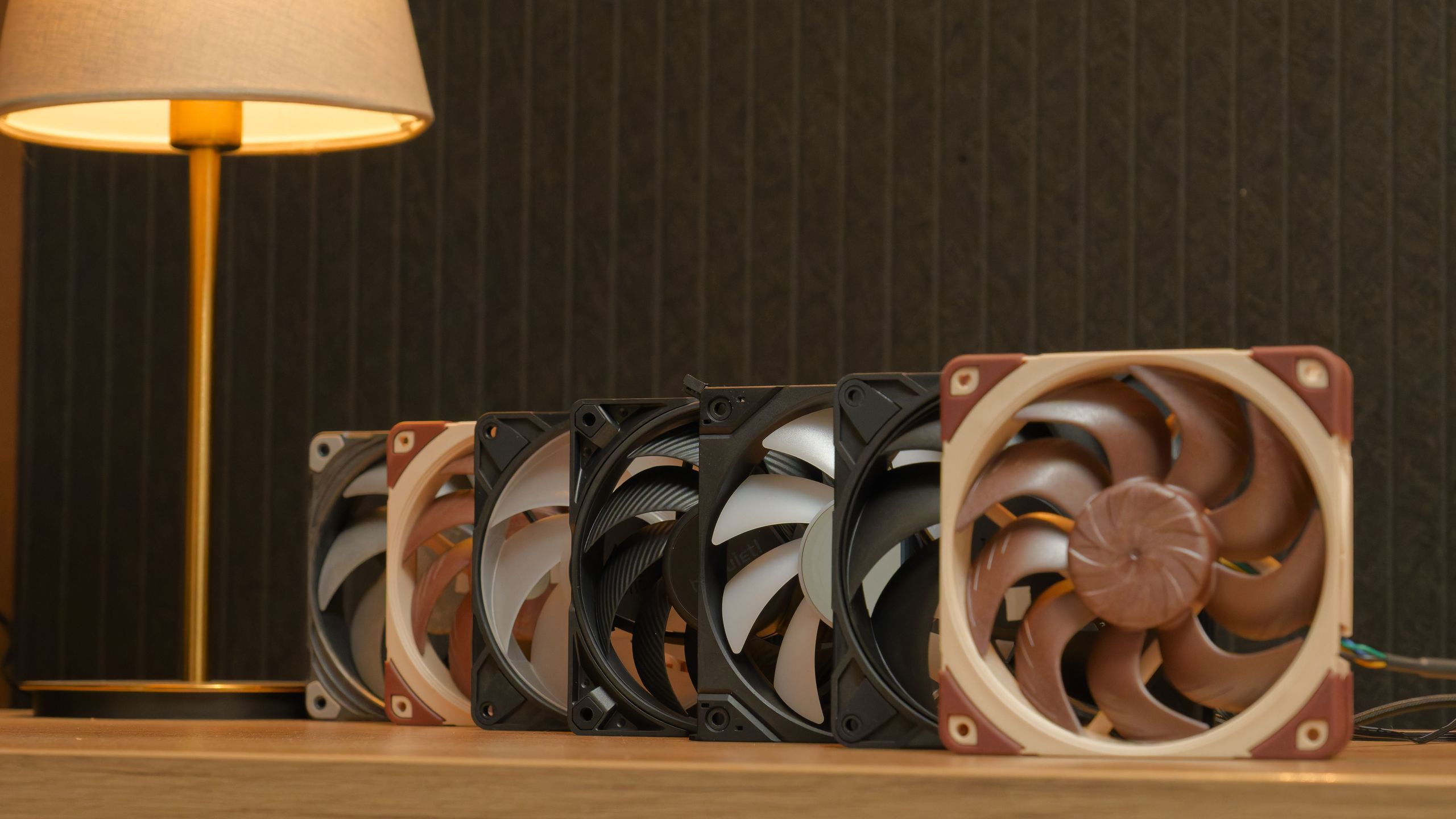
We’ve tested several recent PC fans to figure out which impellers are sellers and which spinners are sinners.
When you purchase through links on our site, we may earn an affiliate commission. Here’s how it works .
Cooling a computer isn’t terribly complicated in and of itself. But if you want to do it right, selecting the best cooling fan can be a daunting task. It’s easy to throw money at Noctua , and we wouldn’t fault you for doing so, but that strategy gets very expensive very quickly. And not everyone digs the beige-and-brown theme – and the company flat-out refuses to do RGB.
Of course, you can opt to go the other easy route and just use what’s included with the case and cooler you bought. But that’s also rarely the optimal solution, and many premium cases come with no fans or just one for exhaust. Ideally, you want a fan that’s quiet, effective at moving air, attractive, and affordable. And since you’ve landed on this page, chances are you bought one of the cases that doesn’t come with enough fans, or you’re not happy with the included fans' performance or audio profile, and are looking for something better.
Recently, we’ve picked up fan testing again, and we’re working hard to test a bunch of different models to figure out the best options in this very crowded field. Over the past several months, we’ve worked in cooperation with industry experts to flesh out a benchmarking methodology, and we expect to update this page regularly with new models we’ve tested.
Our Testing methodology is built on real-world applications, and there are a handful of scenarios a fan needs to perform well in. Naturally, we’re testing airflow in an unrestricted environment as a ‘vanilla’ test, but this is often not indicative of performance inside a PC case.
What’s also not indicative of real-world performance is static pressure testing. Yes, it’s an industry standard, but it really only measures how much pressure a fan can generate when blowing into a closed tube, or up against a wall in a more real-world scenario. It does not account for the changes in acoustics when a fan is mounted on a radiator, heatsink, or behind a mesh intake.
Instead, we’ve decided to measure a fan’s acoustic performance not only when unrestricted and suspended mid-air, but also when strapped to a radiator and again when behind a mesh intake. The results from this paint a much more nuanced, real-world picture, often with interesting outcomes.
For more information about how we test PC fans, scroll to the bottom of this page.
The Noctua NF-A12x25 G2 is our top pick for silence-optimized fans because it delivers huge amounts of airflow while running at low RPMs. It's a whisper-quiet fan with chart-topping performance when used on a radiator or behind a dust filter . Built with Noctua’s SSO2 bearing, a 3-phase etaPERF motor, and refined PWM control, these fans are pricey, but they're worth every penny if you're need outstanding performance and quiet operation.
Arctic’s P12 Pro isn't quite the best PC fan you can buy, but it stands out thanks to its impressive airflow performance, neck-and-neck with the Noctua. It’s not quite as refined as the Noctua: Our testing showed it makes a bit more mechanical noise, and the performance loss on mesh was slightly more. But the drastically lower price point makes the P12 Pro one of the best value-oriented fans that still maintains great performance and quiet operation. It also has a 6-year warranty, like its pricier competition.
The P12 Pro RGB earned the best RGB fan title by offering the same outstanding cooling performance as the non-RGB version and a fantastic noise-to-airflow ratio. The translucent white fan blades (and edge of the hub) let the RGB light shine through, lighting up your chassis without sacrificing value or acoustics, though they are priced ever-so-slightly higher than the non-RGB variant.
The Phanteks T30 tops our best high-performance fan list, simply outmuscling standard 120mm designs. The thicker 30 mm frame and LCP impeller (like Noctua) let it push more air with better noise-to-airflow results than traditional 25mm fans. Just note you’ll need to set the switch to ‘advanced’ for peak performance and the 3,000RPM specification (default is 2,000RPM). T30 also comes with a 6-year warranty, daisy-chaining, and is our best choice for high-performance cooling.
Why you can trust Tom's Hardware Our expert reviewers spend hours testing and comparing products and services so you can choose the best for you. Find out more about how we test .
Noctua’s NF-A12x25 G2 is game-changing , offering the quietest, most refined fan we’ve ever seen. In our testing, it delivered whisper-quiet performance and managed an impressively huge amount of airflow despite running at very low RPMs.
Managing such big airflow despite not needing to spin fast to accomplish it means it’s also not a very turbulent fan, which translates to chart-topping performance when installed on a radiator or behind an intake mesh. In fact, it’s the only fan we’ve tested thus far that ran quieter on a radiator than when suspended mid-air without any load.
In addition to pulling off airflow miracles, the NF-A12x25 also offers a seriously advanced internal hub, featuring Noctua’s refined, tried-and-tested SSO2 bearing, a new 3-phase etaPERF motor, and a new PWM controller with SupraTorque functionality. This sounds like a bunch of marketing talk, but after testing the fan, we can tell you with confidence that it has zero audible mechanical noise.
The Arctic P12 Pro is an interesting fan, because it offers performance that is, as far as the charts go, nearly neck-and-neck with Noctua’s NF-A12x25 . Except, the Arctic does something Noctua doesn’t: It only costs $8.50 for one fan.
The price you pay for the Arctic fan is, in part at least, in its level of refinement. It uses a plastic ring to strengthen the impeller. And, in order to achieve its airflow, it relies on spinning up to higher speeds. Consequently, it’s a more turbulent fan than the Noctua, so it takes a bit more of a hit when mounted close to a mesh intake. It also produces a few mechanical noises, but even so, it’s a highly capable fan.
If, however, you just want a fan to move lots of air quietly, and you don’t want it to cost much, the Arctic P12 Pro is in a league of its own.
It feels a bit weird to place essentially the same Arctic fan on the Best list twice, but it truly is that good. The P12 Pro RGB is, for all intents and purposes, the exact same fan as the non-RGB variant, except with a white translucent impeller so that the RGB lighting from the hub shines through.
It performs on par with the non-RGB variant in our testing, offering wicked performance at up to 3000 RPM and a fantastic noise-to-airflow ratio. The best part: it barely costs more than the non-RGB variant.
The Phanteks T30 ( review here ) is one of the fans that somewhat copied the NF-A12x25 – it featured a similar blade shape, and also used a LCP (liquid crystal polymer) plastic for the impeller. Except, it wasn’t quite a copy, and now, even half a decade later, it’s still king of the hill in the ultra-high-performance fan space.
Why is it so good? Phanteks cheated. I wish I could say they didn’t, but they did. The industry standard for a 120mm fan is 25mm thickness. So what did Phanteks do? They made a 30mm fan. In fact, Phanteks was so proud of this fan that when they sent it out for review, they put together a wind tunnel kit for us because they wanted everybody to know Phanteks meant business and had defeated Noctua at their own game. And they did – it performed notably better than Noctua’s finest when tested for noise-to-airflow.
Moreover, the good stuff doesn’t stop at just 5mm of extra thickness. The company also built in a mode selector at the back of the hub that lets you select quiet, regular, and advanced modes. If you ask me, though, advanced should be called Final Destination mode it lets spin all the way up to 3,000 RPM. With its added thickness, high speed, and LCP material, it’ll gobble air and your fingers if you’re not careful.
Fans. They spin. They move air. They make noise. Sometimes they have lights, and more recently, some have LCD screens . It may seem like a silly thing to obsess over, but picking the right, or wrong, fan can make a major difference in a PC build.
Not everybody looks for the same thing in a fan, and whereas picking the Best CPU or Best GPU is often a matter of what’s best-performing for the dollar in your allocated budget, fans don’t evolve at nearly the same pace, so picking one is much more of a subjective exercise. With that said, depending on your situation, there can be a few key considerations that can make the choice easier.
Alternatively, if you’re someone who works on your PC in silence all day long, it may be worth investing in more refined fans that offer less wind and mechanical noise, with a more durable motor.
Personal sensitivity to certain noise types and frequencies also plays a role.
Key considerations
- Investor positioning can change fast
- Volatility remains possible near catalysts
- Macro rates and liquidity can dominate flows
Reference reading
- https://www.tomshardware.com/pc-components/case-fans/SPONSORED_LINK_URL
- https://www.tomshardware.com/pc-components/case-fans/best-pc-fans#main
- https://www.tomshardware.com
- Everything Will Be Represented in a Virtual Twin, NVIDIA CEO Jensen Huang Says at 3DEXPERIENCE World
- India Fuels Its AI Mission With NVIDIA
- India Fuels Its AI Mission With NVIDIA
- Corsair Sabre v2 Pro Wireless MG Review: Not enough magnesium?
- Newegg’s 25th anniversary sale is here, unlocking huge discounts on gaming PCs, laptops, RAM, SSDs, and more — jaw-dropping Doorbuster deals include a rare RTX
Informational only. No financial advice. Do your own research.