
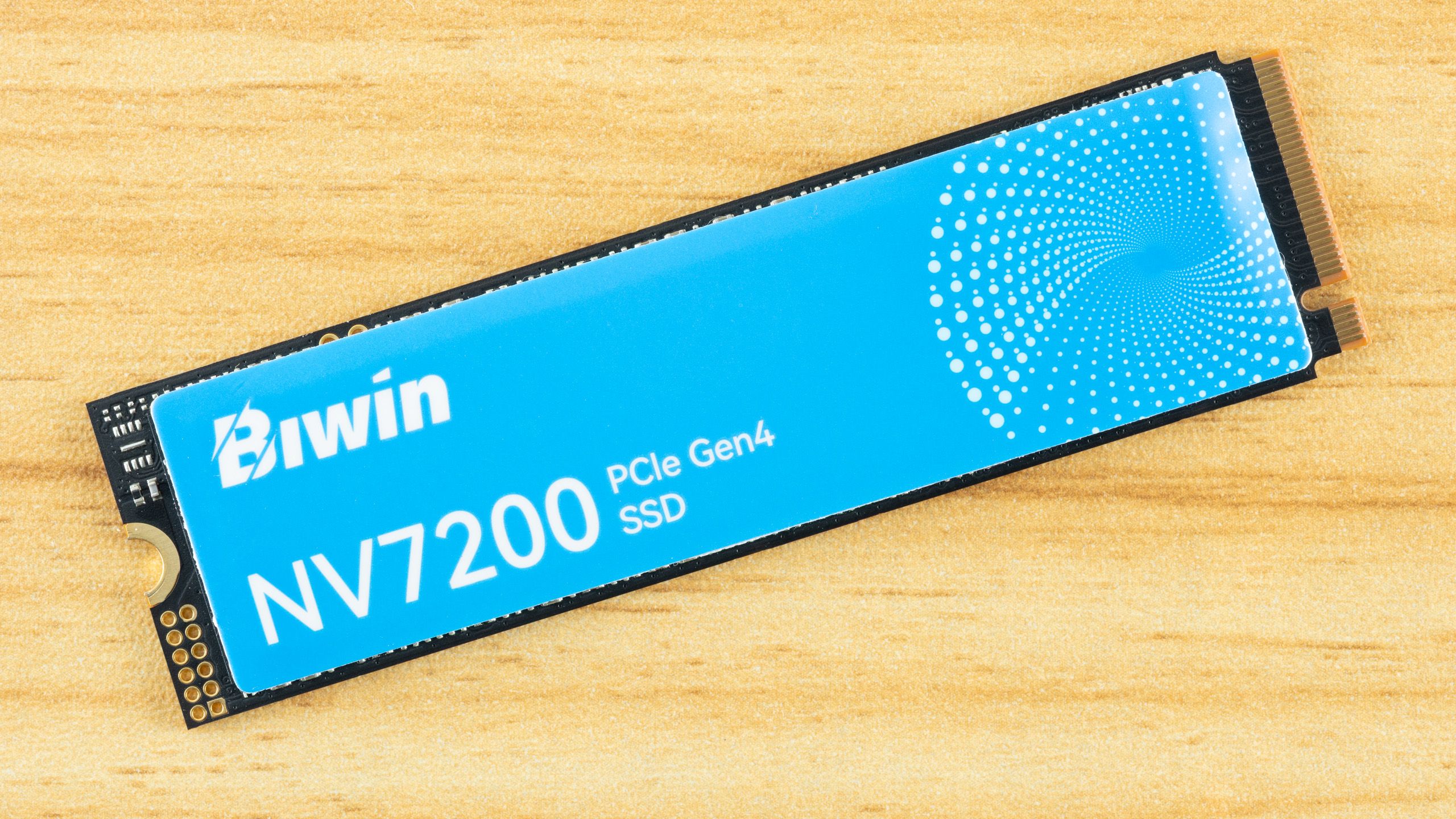
A heatspreader is most applicable to this type of problem because equalizing heat away from the controller and spreading it over a wider surface area assists in dissipation, but also spreads some heat onto the NAND flash. NAND flash does have an operating temperature range, too, but heat can be useful in some circumstances. This is particularly true under sustained write workloads, as flash programs more efficiently at higher temperatures. On the whole, we don’t think flash temperature is a concern for consumer SSDs, but we want to point out that wicking heat away from the controller is effective and safe.
Moving to the back label, the drive is rated for 3.3V at 2.0A. Multiplying these gives an estimate of power draw, which would be 6.6W with some voltage leeway in either direction. If we check SMART, the highest power state is rated for 6.50W, so this is in line with expectations. In most cases, the power draw will be lower than this, especially at lower capacities. A drive’s power draw gives some indication of how hot and efficient the drive is and whether or not the drive is suitable for a laptop. Modern consumer NVMe drives can draw between about 5W and over 11W, putting the NV7200 in the medium to low range.
(Image credit: Tom's Hardware) (Image credit: Tom's Hardware) (Image credit: Tom's Hardware) The NV7200 is DRAM-less, so aside from power management circuitry, the primary components are only the controller and the NAND flash. The controller is the F3C variant of the Maxio MAP1602, which, as we mentioned above, is better able to tackle higher capacities. DRAM-less controllers are designed for budget drives, saving money on DRAM but also on the controller, as it doesn’t need the full DRAM management module as part of the ASIC.
Furthermore, costs can be saved on the controller by reducing flash channels from eight to four. This has direct effects, such as reducing capacity and performance limits, and indirect effects, since it’s simpler to drive four channels at speed. These changes, as a whole, usually make budget drives more efficient, with lower power draw, particularly for everyday workloads.
Identifying the hardware on your own drive can be fun and informative as long as you’re willing to learn the basics. Technically, many manufacturers will warn that your warranty is lost with label removal, but this isn’t enforceable in many jurisdictions, including the United States. However, we recommend removing any labels carefully so they can be re-applied in case an RMA is later necessary.
A quick example of information that you can easily get is the date this hardware was manufactured. The “2440” on the flash likely means week 40 of 2024, or the first week of October of last year. The controller also has “2446,” suggesting it was made 6 weeks later than that, in November. We’ve already pointed out the “F3C” designation for the controller, so let’s look more closely at the flash. We already have expectations that this is QLC, and, as it’s paired with the MAP1602, we would expect it to be YMTC flash. This makes sense with Biwin, and we can work from there.
The first two letters – “BW” – refer to Biwin. “N0” means NVMe NAND flash, while “AQ” tells us that each NAND flash package uses 1Tb QLC dies. “F1” tells us the nominal voltages and that this flash is 8-bit, which is common for consumer flash. “B1” tells us the package type or form factor, while “HC” gives us more information about the flash. In this case, it means that there are 4 dies per package – 4Tb or 512GB – with the typical 0°C to 70°C rated temperature range, and that’s its client or consumer flash. Finally, “AD” gives us the interface speed and flash generation, in this case ONFi 5.0 or 2,400 MT/s Gen 4 X3-6070 QLC flash. While there are tools that can assist with hardware identification, they are only necessary in cases of obfuscation or hardware counterfeiting.
Shane Downing Social Links Navigation Freelance Reviewer Shane Downing is a Freelance Reviewer for Tom’s Hardware US, covering consumer storage hardware.
Key considerations
- Investor positioning can change fast
- Volatility remains possible near catalysts
- Macro rates and liquidity can dominate flows
Reference reading
- https://www.tomshardware.com/pc-components/ssds/SPONSORED_LINK_URL
- https://www.tomshardware.com/pc-components/ssds/biwin-nv7200-2tb-ssd-review#main
- https://www.tomshardware.com
- Silicon Valley data centers totalling nearly 100MW could 'sit empty for years' due to lack of power — huge installations are idle because Santa Clara can't cope
- Future of cable-less PC builds revealed — single 50-pin connector supports up to 2,145 watts to power a CPU and GPU with BTF 3.0
- Only $399 for the Bambu Lab P1S 3D printer — an all-time low price in its early Black Friday sales blowout
- Fueling Economic Development Across the US: How NVIDIA Is Empowering States, Municipalities and Universities to Drive Innovation
- J.P. Morgan calls out AI spend, says $650 billion in annual revenue required to deliver mere 10% return on AI buildout — equivalent to $35 payment from every iP
Informational only. No financial advice. Do your own research.