
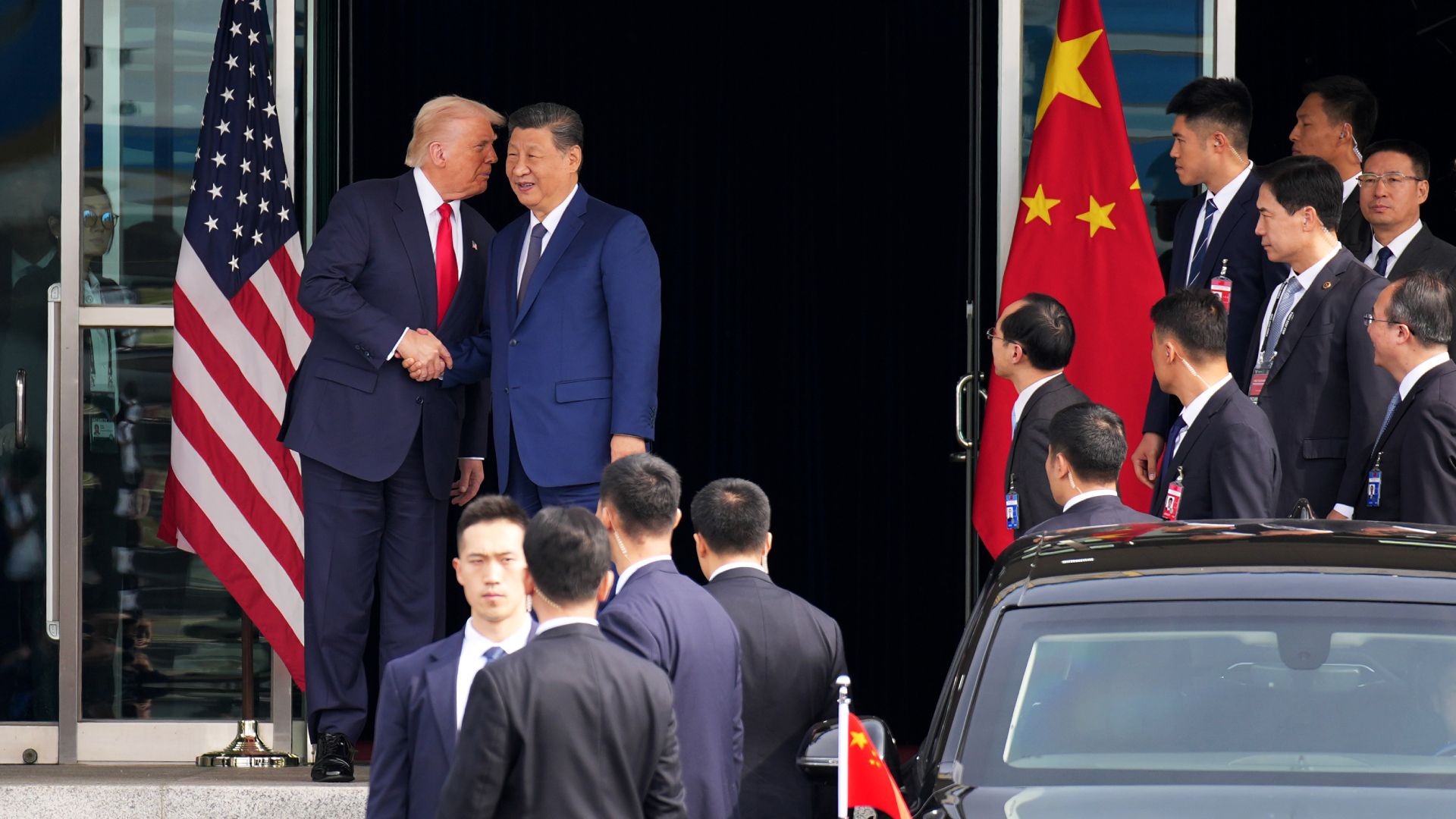
U.S. negotiators claim that those rules have been paused for at least a year, which gives chipmakers and industrial suppliers a lifeline, especially as reshoring projects in the U.S. scramble to reach commercial scale.
But rare earths underpin the very machinery used to fabricate, etch, and package advanced silicon, and China dominates more than 90% of rare earth processing. So, while the truce ensures continuity for now, it does nothing for control. Chinese regulators can reinstate the paused rules whenever they choose, and we already know that AI chips are a major target.
Conspicuously absent from the agreement was any discussion of AI silicon. Ahead of the meeting between the two premiers, some observers speculated that the U.S. might carve out a path for limited high-end GPU exports. That didn’t happen. Instead, Trump told reporters flatly: “We’re not talking about the [ sic ] Blackwell.”
To say that this is something Nvidia doesn’t want to hear would be an understatement. Blackwell is a fundamental shift in how compute power is packaged and deployed. The GB200 integrates GPU and CPU silicon with an NVLink interconnect, and is the heart of Nvidia’s DGX SuperPODs. China can’t buy it. They can’t even buy the trimmed-down versions like the H200 under current restrictions.
Watch On Meanwhile, Nvidia is rumored to be working on a China-specific chip, the B30A , a Blackwell-derived part intentionally hobbled to work around U.S. export restrictions. If it goes into production, it would slot somewhere between the H20 and GB200, giving Chinese companies a new option without technically violating the rules. Think of it as Blackwell lite: fewer NVLink lanes, reduced memory bandwidth, and firmware constraints to keep throughput in check.
Earlier this month, however, Nvidia CEO Jensen Huang said, “At the moment, we [Nvidia] are 100% out of China, ” adding, “We went from 95% market share to 0%.” In essence, the political climate makes it pointless for Nvidia to even try to continue trade with China while Beijing is understood to be actively discouraging domestic companies from importing Nvidia chips as part of a broader push toward ecosystem self-reliance.
Any attempts to export Blackwell or Blackwell-derived parts to China would also be likely to face resistance from U.S. lawmakers, even if they technically don't fall afoul of export restrictions. On Wednesday, October 29, Republican Representative John Moolenaar, the House Select Committee on China Chairman, said that selling Nvidia’s AI chops to China “would be akin [to] giving Iran weapons-grade uranium,” arguing that doing so would shrink the U.S. advantage in AI.
Nvidia reportedly shows China-specific B30 chips with 80% of the performance of the standard Blackwell GPU to the U.S. government
Nvidia responds to claim China is urging local companies to avoid Nvidia H20
Key considerations
- Investor positioning can change fast
- Volatility remains possible near catalysts
- Macro rates and liquidity can dominate flows
Reference reading
- https://www.tomshardware.com/tech-industry/SPONSORED_LINK_URL
- https://www.tomshardware.com/tech-industry/china-delays-rare-earth-export-curbs-but-ai-chip-ban-stays-in-place#main
- https://www.tomshardware.com
- Windows insider creates Windows 7 install measuring just 69MB — system boots, but has been pruned so severely ‘virtually nothing can run’ for now
- American startup Substrate promises 2nm-class chipmaking with particle accelerators, at a tenth of the cost of EUV — X-ray lithography system has potential to s
- LG's 32-inch, 4K OLED gaming monitor falls to $799 — dual-mode display is $500 off
- Australia's police to use AI to decode criminals' emoji slang to curb online crime — "crimefluencers" will be decoded and translated for investigators
- Elon Musk says idling Tesla cars could create massive 100-million-vehicle strong computer for AI — 'bored' vehicles could offer 100 gigawatts of distributed com
Informational only. No financial advice. Do your own research.