
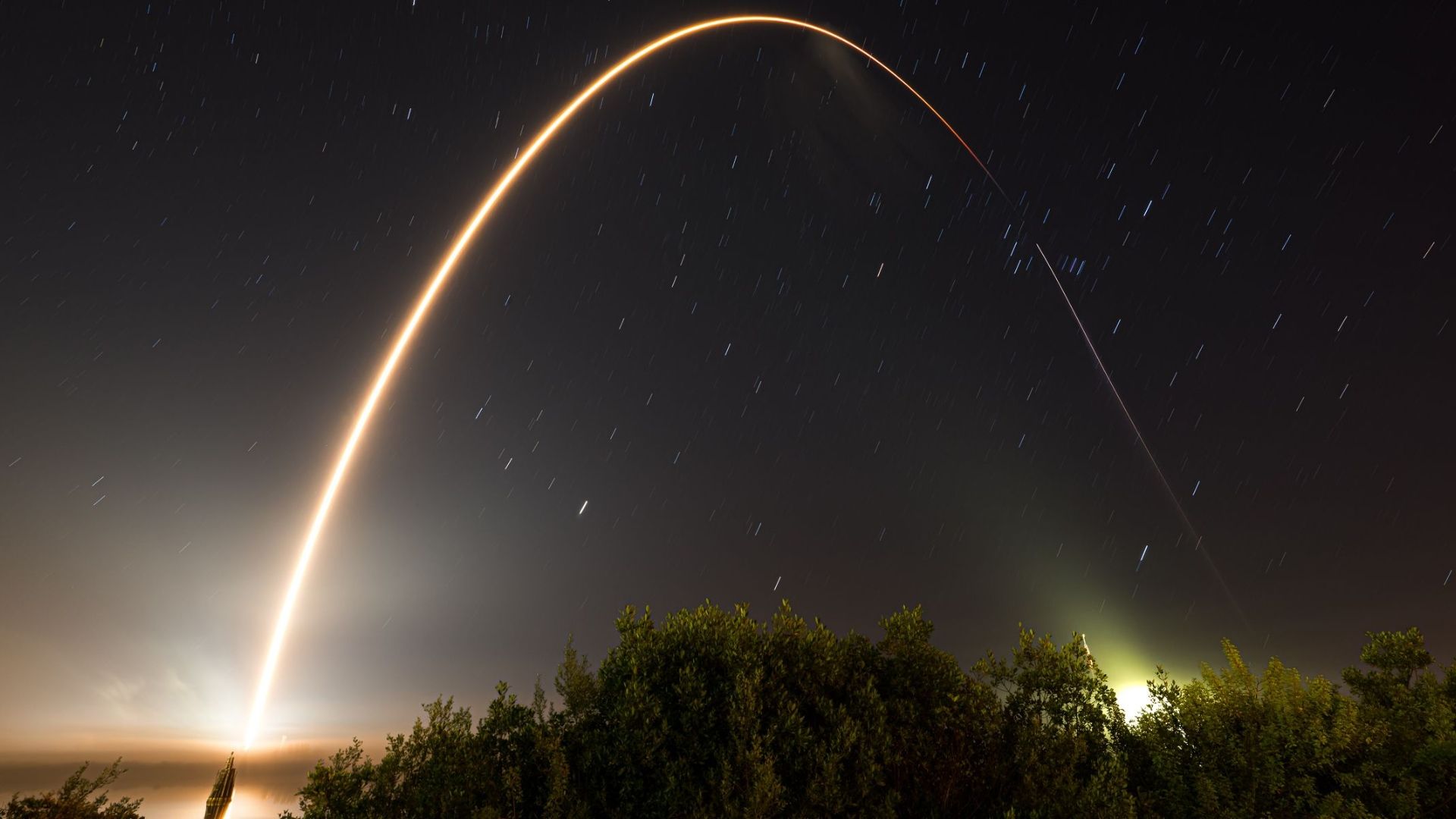
The 70km (43mi) altitude reduction will reduce the risk of collisions for Starlink satellites.
When you purchase through links on our site, we may earn an affiliate commission. Here’s how it works .
(Image credit: SpaceX) Share Share by: Copy link Facebook X Whatsapp Reddit Pinterest Flipboard Email Share this article 2 Join the conversation Follow us Add us as a preferred source on Google Researchers from the Chinese Academy of Sciences Institute of Software reported that Starlink has reduced its altitude for a big chunk of its software constellation after one of Musk’s satellites had a near-miss with a Chinese satellite . According to the South China Morning Post , the close call was the primary reason why the company announced the move to lower the altitude of more than 4,000 Starlink satellites from 550 km (340 mi) to 480 km (around 300 mi). SpaceX VP for Engineering Michael Nicolls also said on X that the company is doing this with a view to “increasing space safety.”
“Starlink is beginning a significant reconfiguration of its satellite constellation focused on increasing space safety,” Nicolls wrote on the social media platform. “We are lowering all @Starlink satellites orbiting at ~550 km to ~480 km (~4400 satellites) over the course of 2026. The shell lowering is being tightly coordinated with other operators, regulators, and USSPACECOM."
Starlink is beginning a significant reconfiguration of its satellite constellation focused on increasing space safety. We are lowering all @Starlink satellites orbiting at ~550 km to ~480 km (~4400 satellites) over the course of 2026. The shell lowering is being tightly… January 1, 2026
According to Discover Magazine , there are about 15,000 satellites currently in orbit, most of which sit at the 500 to 1,000km low-earth orbit (LEO) altitude. Starlink owns the majority of this number, with Nicolls saying that it has over 9,000 operational satellites. However, it has plans to further expand this to a total of 34,400 satellites, with the U.S. FCC granting a 7,500-satellite expansion that would let it bring its current fleet to more than 19,000 units. Competitors like Amazon’s Project Kuiper and China’s SpaceSail also plan to launch their own satellite constellations with thousands of units, potentially turning the LEO part of outer space into a crowded space.
Starlink VP confirms ‘dangerously close’ Chinese launch incident
Key considerations
- Investor positioning can change fast
- Volatility remains possible near catalysts
- Macro rates and liquidity can dominate flows
Reference reading
- https://www.tomshardware.com/tech-industry/SPONSORED_LINK_URL
- https://www.tomshardware.com/tech-industry/china-close-call-prompts-starlink-to-reduce-satellite-altitudes-more-than-4-000-satellites-pulled-to-300-mile-orbit-to-increase-space-safety#main
- https://www.tomshardware.com
- Here are the tools I use as Tom’s Hardware resident CPU reviewer — a cheap aluminum open bench, thermal paste wipes, platform-labeled external power buttons, an
- Nvidia updates FrameView performance measurement tool — version 1.7 promises accurate results even at 800+ FPS
- From Pilot to Profit: Survey Reveals the Financial Services Industry Is Doubling Down on AI Investment and Open Source
- Save big on an AM5 bundle perfect for AMD's imminent Ryzen 7 9850X3D — $499 Newegg X870 motherboard and 32GB DDR5 RAM bundle is the ideal start for your build
- Accelerating Science: A Blueprint for a Renewed National Quantum Initiative
Informational only. No financial advice. Do your own research.