
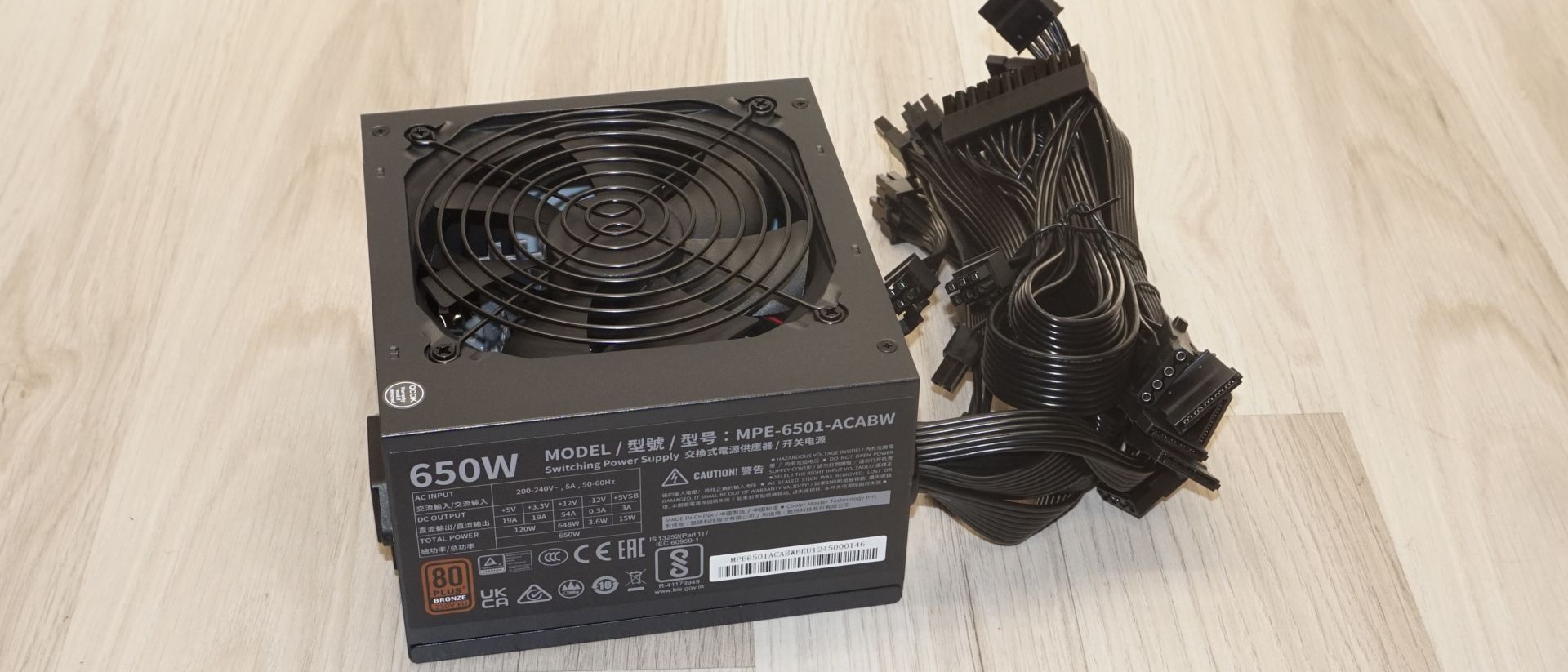
The fan finger guard uses a classic concentric ring design. The left side carries the electrical specification and certification sticker. The front panel holds the standard power switch and AC receptacle. The rear panel is completely bare except for the cable exit point.
(Image credit: Tom's Hardware) (Image credit: Tom's Hardware) One detail on the top panel is unusual – four punched holes serve as mounting points for the internal PCB, a technique more commonly associated with PSU construction from the 1990s than with modern units. It is not a functional issue, but it is a visible indicator of how aggressively the cost envelope has been managed.
(Image credit: Tom's Hardware) (Image credit: Tom's Hardware) Internal Design Cooling is provided by a Hong Hua HA1225H12F-Z 120mm fan with a fluid dynamic bearing. Fluid dynamic bearings represent a reasonable compromise between longevity and noise at moderate speeds. They are quieter than ball bearings at low RPM and more durable than sleeve bearings under sustained use. The rated maximum speed is 2400 RPM, which is notably high for a 650W unit.
The OEM is Gospower, a Chinese manufacturer operating since 2006. Gospower is a familiar name in budget and mid-tier PSU production, and their platforms have appeared inside products from several recognized brands. Assembly quality here is consistent, even remarkable for such a tier, and the design choices reflect a team that understands what is required.
(Image credit: Tom's Hardware) (Image credit: Tom's Hardware) The input filtering stage is properly equipped with four Y capacitors, two X capacitors, two filtering inductors, and a single rectifying bridge mounted on a basic heatsink. A physical metallic EMI shield is present at the input stage, which is something rarely seen at this price point and speaks to a conscious effort to maintain power cleanliness beyond what the budget strictly demands.
The APFC circuit uses two Jilin Sino-Microelectronics JCS13N50FC MOSFETs and one diode. The passive components include a small taped inductor and a CapXon 470µF bulk capacitor rated at 85°C. CapXon is a reputable manufacturer and their capacitors are generally reliable under normal operating conditions. The 85°C temperature rating is the concern here – it means that sustained high temperatures inside the chassis will noticeably shorten this capacitor's service life, even if the temperature will not reach that mark. For a unit deployed in a well-ventilated case in a temperate room and not heavily loaded most of the time, this is not a serious issue. If the PSU is stressed though, this becomes a liability worth taking seriously.
The primary inversion stage employs two Jilin Sino-Microelectronics JCS18N50FH MOSFETs in a full-bridge configuration, sharing a heatsink with the APFC MOSFETs. A half-bridge + LLC topology is nowadays typical for quality PC PSUs. The heatsink itself is rudimentary, but adequate for the power output involved.
On the secondary side, four NCE Power 40H12 MOSFETs generate the 12V rail through synchronous rectification, mounted on a pair of simple heatsinks. Synchronous rectification replaces the diodes used in older designs with active switches, improving efficiency and reducing heat at the secondary stage. A vertical daughterboard handles DC-to-DC conversion for the 3.3V and 5V rails. A copper strip EMI shield protects the output wiring. Secondary side filtering is handled entirely by CapXon capacitors, electrolytics and polymer alike, with the exception of one unidentified polymer capacitor on the DC-to-DC board.
For the testing of PSUs, we are using high precision electronic loads with a maximum power draw of 2700 Watts, a Rigol DS5042M 40 MHz oscilloscope, an Extech 380803 power analyzer, two high precision UNI-T UT-325 digital thermometers, an Extech HD600 SPL meter, a self-designed hotbox and various other bits and parts.
(Image credit: Tom's Hardware) (Image credit: Tom's Hardware) (Image credit: Tom's Hardware) (Image credit: Tom's Hardware) (Image credit: Tom's Hardware) The MWE Bronze V2 meets the 80Plus Bronze certification requirements comfortably on a 230 VAC input. Efficiency across the nominal load range is stable and consistent, averaging at 87.3%, with no significant drops at either end of the load curve. As noted earlier, the 230V certification threshold is more demanding than 115V testing, so the unit's actual performance may be stronger than the Bronze badge suggests when considered in a global context. There are many “Gold” PSUs in the market with similar average efficiency as this one – they have just been certified with an 115 VAC input.
Average efficiency at 230 VAC under elevated ambient conditions reaches 86.3% across the nominal load range. The degradation compared to cold testing is modest, and there are no visible signs of thermal stress at full load, which reflects well on Gospower's thermal design margins.
(Image credit: Tom's Hardware) (Image credit: Tom's Hardware) (Image credit: Tom's Hardware) (Image credit: Tom's Hardware) (Image credit: Tom's Hardware) However, the fan tells a different story – it reaches maximum speed at 70% load and stays there, producing clearly audible noise through to 100% output. Internal temperatures remain relatively controlled up to 50% load. Beyond that point, the fan is working at its limit and the chassis temperatures rise. The unit was not designed for sustained heavy loading in warm environments, and it does not pretend otherwise.
Voltage regulation is mediocre by current standards. The 12V rail holds to within 2.1%, the 5V rail to 3.4%, and the 3.3V rail to 2.8%. These figures are not alarming for a budget unit but they would be unacceptable in a mid-range or premium product. Ripple suppression is equally unexceptional. The 12V rail peaks at 68mV, the 5V rail at 28mV, and the 3.3V rail at 26mV. All three sit well inside the ATX specification limits of 120mV on the 12V rail and 50mV on the minor rails. For a product in this class, those are fairly good numbers.
During our routine evaluation, we examine the fundamental protection features of all power supply units we review, including Over Current Protection (OCP), Over Voltage Protection (OVP), Over Power Protection (OPP), and Short Circuit Protection (SCP). Protection circuit behavior is acceptable but quite slack for a unit this stressed. The 3.3V rail triggers OCP at 140% of rated current, the 5V at 146%, and the 12V at 138%. OPP under hot conditions activates at 142% of rated output. These are OK settings for a product designed for gamers and enthusiasts but floppy on a product that will be fighting for its life if stressed that much.
The MWE Bronze V2 230V 650W is a unit with an identity that hardly matches its price. Strip away the budget packaging, the nylon bag instead of foam, the basic leaflet, and the hardwired flat cables, and what is inside represents platform-level engineering that belongs in a higher class of product. Gospower has used a platform and topologies more commonly associated with mid-tier products. DC-to-DC conversion for the 3.3V and 5V rails keeps the minor lines isolated and regulated independently of the 12V output, which is meaningful under asymmetric loading conditions and practically necessary for modern PCs. Many corners had to be cut to lower the price of this unit down to the absolute minimum but what matters is there.
Acoustics deserve a thorough mention. Under light and moderate load at room temperature, the unit performs quite well and it will not trouble anyone. Once the ambient rises and/or the sustained load is high, the Hong Hua fan reaches its upper speed range and the result can easily get beyond just audible. This is a unit that was not designed for silent operation under pressure, and it does not pretend otherwise. Builders who need a quiet PSU for a machine that runs intensive workloads should look elsewhere.
Dr. E. Fylladitakis has been passionate about PCs since the 8088 era, beginning his PC gaming journey with classics like Metal Mutant and Battle Chess. Not long after, he built his first PC, a 486, and has been an enthusiast ever since. In the early 2000\u2019s, he delved deeply into overclocking Duron and Pentium 4 processors, liquid cooling, and phase-change cooling technologies. While he has an extensive and broad engineering education, Dr. Fylladitakis specializes in electrical and energy engineering, with numerous articles published in scientific journals, some contributing to novel cooling technologies and power electronics. He has been a hardware reviewer at AnandTech for nearly a decade. Outside of his professional pursuits, he enjoys immersing himself in a good philosophy book and unwinding through PC games. ","collapsible":{"enabled":true,"maxHeight":250,"readMoreText":"Read more","readLessText":"Read less"}}), "https://slice.vanilla.futurecdn.net/13-4-20/js/authorBio.js"); } else { console.error('%c FTE ','background: #9306F9; color: #ffffff','no lazy slice hydration function available'); } E. Fylladitakis Contributing Editor Dr. E. Fylladitakis has been passionate about PCs since the 8088 era, beginning his PC gaming journey with classics like Metal Mutant and Battle Chess. Not long after, he built his first PC, a 486, and has been an enthusiast ever since. In the early 2000’s, he delved deeply into overclocking Duron and Pentium 4 processors, liquid cooling, and phase-change cooling technologies. While he has an extensive and broad engineering education, Dr. Fylladitakis specializes in electrical and energy engineering, with numerous articles published in scientific journals, some contributing to novel cooling technologies and power electronics. He has been a hardware reviewer at AnandTech for nearly a decade. Outside of his professional pursuits, he enjoys immersing himself in a good philosophy book and unwinding through PC games.
Key considerations
- Investor positioning can change fast
- Volatility remains possible near catalysts
- Macro rates and liquidity can dominate flows
Reference reading
- https://www.tomshardware.com/pc-components/power-supplies/SPONSORED_LINK_URL
- https://www.tomshardware.com/pc-components/power-supplies/cooler-master-mwe-bronze-v2-230v-650w-power-supply-review#main
- https://www.tomshardware.com
- Efficiency at Scale: NVIDIA, Energy Leaders Accelerating Power‑Flexible AI Factories to Fortify the Grid
- Corsair's new customizer tool lets buyers trick out the Frame 4000D case — configurator lets you explore every possible option for this highly modular enclosure
- be quiet! Pure Power 13 M 1200W supply review: Platinum-level efficiency, premium pricing
- From RTX to Spark: NVIDIA Accelerates Gemma 4 for Local Agentic AI
- Newbie overclocker destroys $5,000 RTX 5090 Lightning Z GPU they used 'to learn how to solder' — practicing newfound hobby goes wrong in the most expensive way
Informational only. No financial advice. Do your own research.