
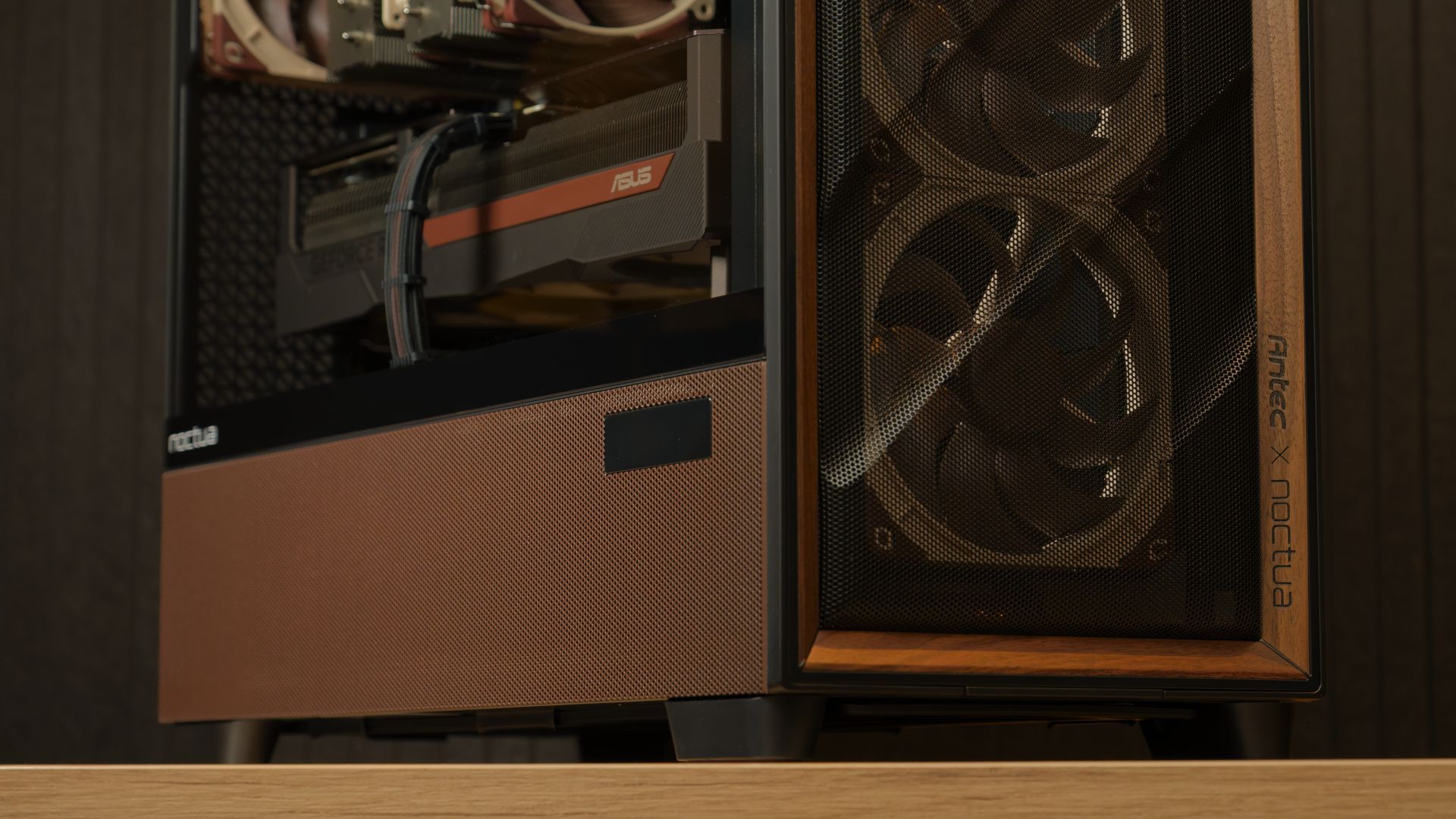
Recently, I built a PC I called “The Stout Owl.” This was an immense undertaking, as it involved learning a new craft, months of meticulously hand-crafting a wooden case, and housing a Noctua-themed build, which suited the wood well. To me, personally, that was absolute endgame, but not everyone is willing to spend three months building a wooden PC.
At this point, I’m quite attached to The Stout Owl. I really didn’t want to, but I took this PC apart to use its components in this current build. The job comes first, and this meant that other than the Flux Pro Noctua-Edition case, no new hardware had to be acquired for this build story.
I decided to stick with the ProArt Z890-Creator from Asus. I’d go into tech specs, but let’s be real: Asus’ ProArt boards, with their classy black-and-gold design pair beautifully with Noctua’s colorway, so the specs aren’t the main priority here.
The whole reason Noctua exists is because the founders were growing tired of the bold and flashy ‘Gamer’ aesthetic with all the lights, and wanted something classier. This motherboard, and its AM5 counterpart, are properly-kitted high-end boards, and come with chique looks to match. (The Dutch spelling of chic is chic-er than the accepted English spelling, and I’m Dutch, so I’m using it).
The Intel Core Ultra 9 285K gets a lot of flack for not being the best gaming CPU, but I actually think it’s a fantastic chip despite not offering chart-topping gaming performance.
With 8 performance cores and 16 efficiency cores, the chip certainly is no slouch. Although it can run seriously hot and hungry when heavily burdened, it also runs incredibly cool and efficient when just idling. If you’re not a gamer, but you need a workhorse chip, the Intel Core Ultra chips are seriously worth considering, especially if you live in a place with high electricity costs and run the PC idling or just browsing for many hours. Though, at its price, the Core Ultra 7 265K or about-to-launch 270K promises very similar performance for a fraction of the cost. But Intel’s new chip isn’t quite available yet, so we’re using the 285K.
The NH-D15 G2 is Noctua’s flagship CPU cooler, so naturally, it had to be installed in this system. Noctua doesn’t make a liquid cooler yet, and although one is slated for release later this year, this is the reference Noctua PC build, so I didn’t feel it was right to use another brand’s AIO and swap the fans.
The NH-D15 G2 comes with two round-frame NF-A15x25r fans with the Sx2-PPO speed offset, to ensure the fans never harmonize. With 8 heatpipes, the cooler is good for dissipating heat from even the hottest chips.
The Seasonic x Noctua Prime TX-1600 is currently the only Noctua-Edition power supply you can buy.
Usually, this power supply comes with a first-generation NF-A12x25 fan. However, for the aforementioned wooden PC build, I had modded the PSU to use a G2 fan. I decided to keep it this way for this build.
I do have to note, that this power supply, with its 1600-watt envelope, is grossly oversized for this build. Later this year, Seasonic aims to release the Prime PX Noctua-Edition series power supplies, which will come in 850-to-1200-watt envelopes. These would be much more suitable for most builds.
But they aren’t out yet, so we’re using this modded TX-1600.
Key considerations
- Investor positioning can change fast
- Volatility remains possible near catalysts
- Macro rates and liquidity can dominate flows
Reference reading
- https://www.tomshardware.com/pc-components/pc-cases/SPONSORED_LINK_URL
- https://www.tomshardware.com/pc-components/pc-cases/endgame-whats-it-like-to-build-the-noctua-everything-pc-inside-the-antec-flux-pro-noctua-edition#main
- https://www.tomshardware.com
- Jensen Huang says gamers are 'completely wrong' about DLSS 5 — Nvidia CEO responds to DLSS 5 backlash
- Score a liquid-cooled Asus ROG 4K gaming PC with a 9800X3D and RX 9070 XT for under $1,900 right now — powerhouse rig comes equipped with 32GB of DDR5 RAM and a
- Score a liquid-cooled Asus ROG 4K gaming PC with a 9800X3D and RX 9070 XT for under $1,900 right now — powerhouse rig comes equipped with 32GB of DDR5 RAM and a
- Nvidia demonstrates Rubin Ultra tray, the world's first AI GPU with 1TB of HBM4E memory — new chips will slot into Kyber racks
- Nvidia Groq 3 LPU and Groq LPX racks join Rubin platform at GTC — SRAM-packed accelerator boosts 'every layer of the AI model on every token'
Informational only. No financial advice. Do your own research.