
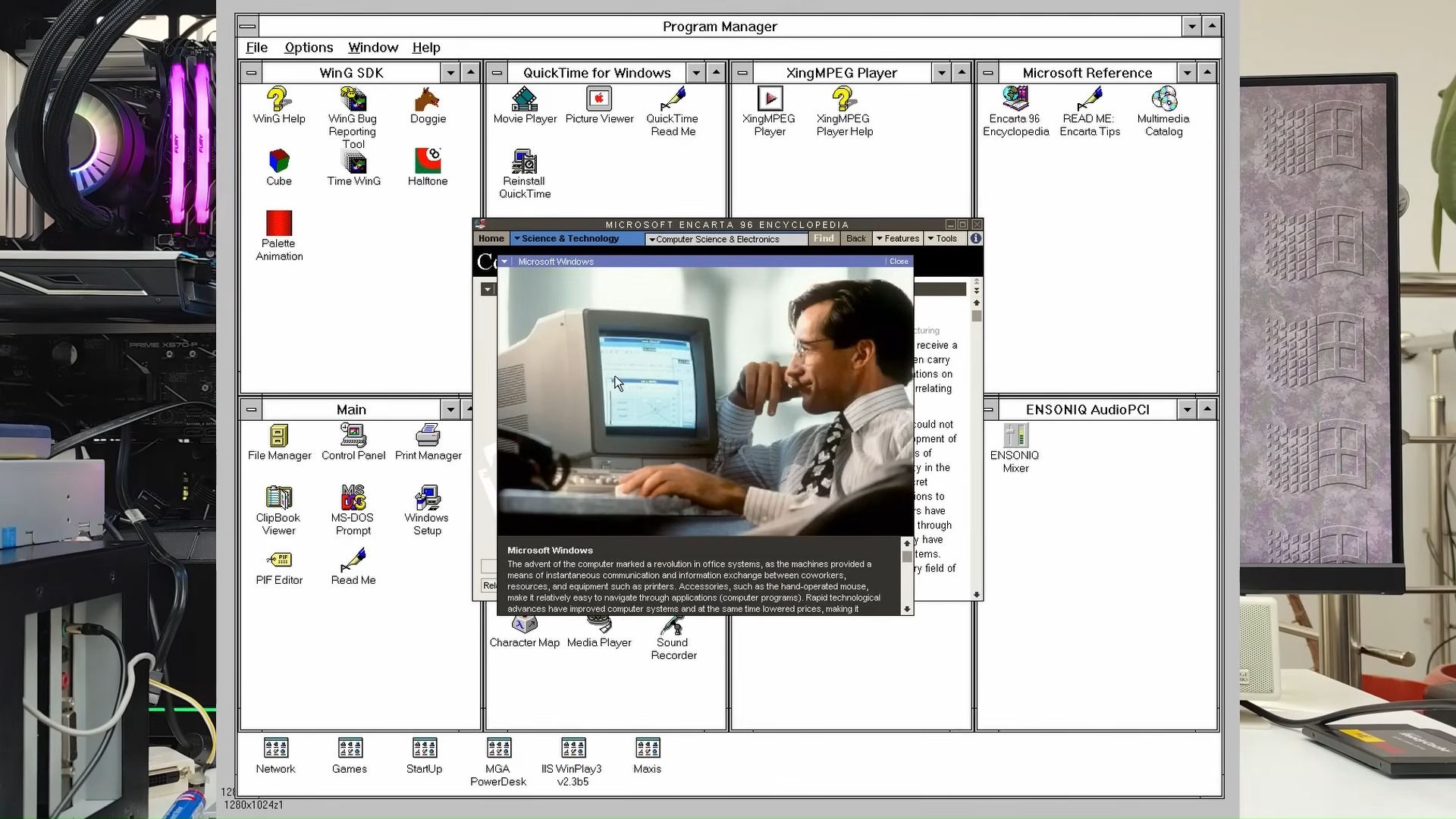
Adding the graphics driver VBESVGA from PluMGMK on GitHub made a big difference. The UI was scaled up to the display’s native 1920 x 1080 pixels properly. Moreover, the RTX 5060 Ti graphics card now worked without any irksome issues. The tinkerer had used this driver with previous projects, but sounds surprised by how well the driver has matured. It was previously “picky with Nvidia cards” and slightly glitchy, he comments. The driver has seen 44 releases, observes Omores, but it remains in beta.
(Image credit: Omores ) (Image credit: Omores ) (Image credit: Omores ) With graphics fixed, the TechTuber’s attention switched to trying to get Enhanced Mode working for benefits such as virtual memory and improved multitasking. Omores’ chosen sound card also required Enhanced Mode.
So AHCIFIX.386 (from the same GitHub source as VBESVGA) was also installed. Installation was a simple file copy plus the adding of a line to System.ini. With that done, Omores fits his Ensoniq ES1370 audio PCI card. Though other cards he’s tried have Windows 3.1 drivers, this is the only one the TechTuber knows that works on modern hardware with original drivers and MIDI support . Please note that other brand cards using the same chip aren’t compatible, in the TechTuber’s experience.
If you are interested in following in these retro footsteps, the video description includes a link to a Windows 3.1 update script, which will help you go from floppies to a fully working Enhanced Mode system running on bare metal.
Follow Tom's Hardware on Google News , or add us as a preferred source , to get our latest news, analysis, & reviews in your feeds.
Mark Tyson is a news editor at Tom's Hardware. He enjoys covering the full breadth of PC tech; from business and semiconductor design to products approaching the edge of reason. ","collapsible":{"enabled":true,"maxHeight":250,"readMoreText":"Read more","readLessText":"Read less"}}), "https://slice.vanilla.futurecdn.net/13-4-19/js/authorBio.js"); } else { console.error('%c FTE ','background: #9306F9; color: #ffffff','no lazy slice hydration function available'); } Mark Tyson Social Links Navigation News Editor Mark Tyson is a news editor at Tom's Hardware. He enjoys covering the full breadth of PC tech; from business and semiconductor design to products approaching the edge of reason.
scidhuv00 I appreciate the cool feat but Windows 3.1X is not a version. There was windows 3.0 3.1 and 3.11 3.11 was the update that included windows for workgroups. Also Windows 3.1 is NOT and operating system. The system did not boot Windows. Windows 3.1 had no kernel, it was a GUI. Reply
nimbulan And here I thought it was cool when I did this on a Pentium 4 system years ago. Reply
ThisIsMe Just did this on a Core 9 ultra 285k with a GeForce 5080 in August of ‘25. I do this every few years when I get the opportunity to build a new PC for myself. It’s pretty funny to see a working GUI instantly flash up on the screen with virtually no boot time. Blink and you’ll miss it. Reply
usertests I skimmed the video and it seemed very snappy, but I don't know the details. If you were doing this as more than an experiment, I guess you should underclock to 500 MHz and enjoy the efficiency. No timing related issues seen, like with Doom. Reply
TerryLaze For win 3.1 all you need to do is to install dos on a disk and then copy the win folder over to it, as said above it's just a gui. Installing dos is also just copying files over as long as the disk is partitioned as primary and active. Basically if you can connect a drive to your system you just need to partition it and copy the files over. Somewhat related, win9x quick-install allows you to install win98 to modern hardware from usb and has a bunch of patches and drivers incorporated, still don't expect it to find drivers for most systems. https://github.com/oerg866/win98-quickinstall Reply
scottscholzpdx usertests said: I skimmed the video and it seemed very snappy, but I don't know the details. If you were doing this as more than an experiment, I guess you should underclock to 500 MHz and enjoy the efficiency. No timing related issues seen, like with Doom. 500mhz and 3ghz likely use the same amount of power on a 4nm process chip, especially being unloaded the entire time. Reply
palladin9479 scidhuv00 said: Also Windows 3.1 is NOT and operating system. The system did not boot Windows. Windows 3.1 had no kernel, it was a GUI. Ehh yes and no, it depends on what mode it starts in. Windows 3.1 in "standard mode" will use DOS and BIOS calls to do everything, in this mode it's largely just a graphical task / application manage like PC GEOS was. "Enhanced mode" OTOH loads it's own memory manager and IO manager, taking over those functions from BIOS / DOS. This is why they needed to load the AHCI compatibility driver, Windows 3.11 doesn't have drivers to communicate with AHCI and therefor will crash. Enhanced mode theoretically can access 4GB of memory, though the implementation limited it to 256MB for practical reasons. You can even run 32 bit applications via an extension called Win32s https://en.wikipedia.org/wiki/Win32s You could even do graphics acceleration via WinG, the predecessor to DirectX. https://en.wikipedia.org/wiki/WinG We can say that Windows 3.1 in standard mode was not an Operating System as it used DOS for all that functionality. Windows 3.1 in Enhanced mode was an Operating System as it replaced all those calls with native implementations, DOS become the boot loader. This is the same pattern we see with Win95 / Win98, DOS does the initial booting and provides for an emergency failsafe environment, then the OS then takes over those functions after it initializes. As for the comment on "X did not boot", that is beyond silly. It would be like saying Debian isn't an OS because it uses grub to boot. The bootloader is irrelevant, only what manages the memory and IO subsystems. Reply
Xajel scidhuv00 said: I appreciate the cool feat but Windows 3.1X is not a version. There was windows 3.0 3.1 and 3.11 3.11 was the update that included windows for workgroups. Also Windows 3.1 is NOT and operating system. The system did not boot Windows. Windows 3.1 had no kernel, it was a GUI. Yeah I remember we always needed to run the "win" command to start Windows 3.1 :whistle: But, I don't think this defined the nature of "operating system", I still consider it an OS because you could do everything an OS is supposed to do, even if you had to start it manually. The whole PC is a questionable definitions of software, even Windows 11 can't even boot without UFEI for example, I know different things as UEFI is not an OS kernel, but still, the modularity of modern OS makes us redefine what an OS is defined as, a very early version of Unix was so much "un-modular" that you can't even update the kernel alone without messing other parts of the OS. Reply
botmfeedr nimbulan said: And here I thought it was cool when I did this on a Pentium 4 system years ago. I wasn't cool but I appreciated my "friends" selling me their old equipment at a "discount". When the Pentium came out I bought my friends 486 DX33 for 500$ Reply
Key considerations
- Investor positioning can change fast
- Volatility remains possible near catalysts
- Macro rates and liquidity can dominate flows
Reference reading
- https://www.tomshardware.com/software/windows/SPONSORED_LINK_URL
- https://www.tomshardware.com/software/windows/enthusiast-installs-win-3-1x-on-bare-metal-ryzen-9-9900x-and-rtx-5060-ti-system-asus-motherboards-classic-bios-functionality-was-instrumental-to-the-feat#main
- https://www.tomshardware.com
- Efficiency at Scale: NVIDIA, Energy Leaders Accelerating Power‑Flexible AI Factories to Fortify the Grid
- Level up your gaming setup with this Core Ultra 5 250K Plus bundle for $299 — save $60 with ASRock's rock-solid B860 motherboard
- Advancing Open Source AI, NVIDIA Donates Dynamic Resource Allocation Driver for GPUs to Kubernetes Community
- Sharge Disk Pro 2TB review: Great sustained writes, active cooling, and a built-in hub
- Efficiency at Scale: NVIDIA, Energy Leaders Accelerating Power‑Flexible AI Factories to Fortify the Grid
Informational only. No financial advice. Do your own research.