
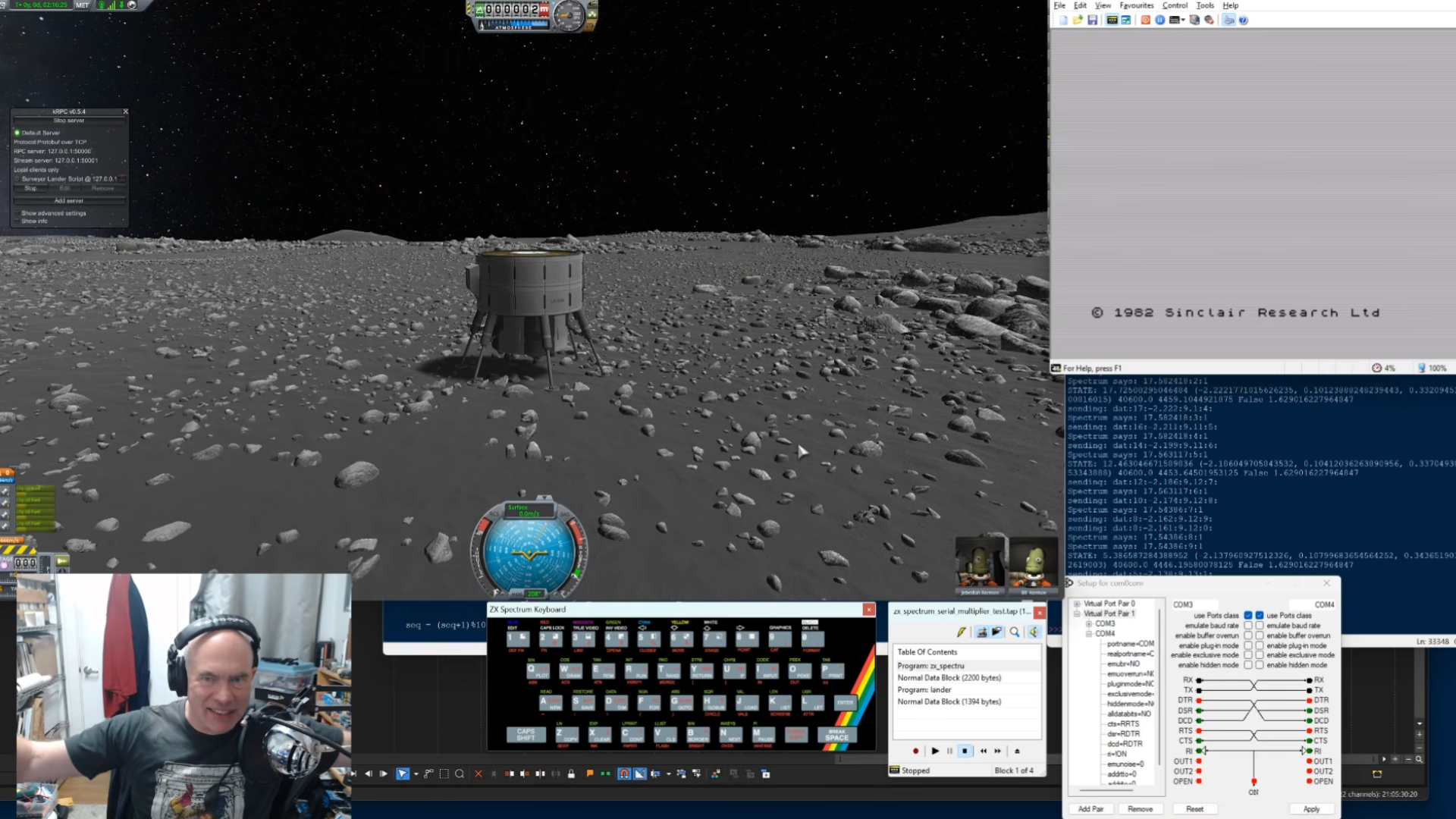
This hardware is nothing compared to what billions of people have in their pockets today, but it's still enough to get on the moon (at least virtually).
When you purchase through links on our site, we may earn an affiliate commission. Here’s how it works .
Watch On This 8-bit device had a Z80A CPU that ran at 3.5 MHz with either 16, 48, or 128 KB of memory. It ran on the Sinclair BASIC operating system and was known for introducing kids to gaming and programming in the 80s because of its relatively low price. This might seem sorely underpowered compared to today’s computers, with Manley saying that some phone chargers are much more powerful than this device. However, we must note that the ZX Spectrum launched 13 years after Apollo 11 actually landed on the moon. The Apollo Guidance Computer (AGC), which was in charge of the spacecraft’s guidance, navigation, and control, was far less powerful with its 2.048 MHz processor and 15-bit word length and 1-bit parity, capable of storing 2,048 words.
Because of this, programmers had to be extra creative when writing code, ensuring that they used as little data as possible to achieve what they wanted. Even though the ZX Spectrum had so much more memory than the original AGC, that is still a challenge that Manley had to go through, programming the virtual PC with the variables it needed to operate the virtual spacecraft and computing the attitude and acceleration required to maneuver and land on the moon.
You may like ZX Spectrum flies simulated spacecraft using BASIC, Python, and serial Commodore 64 floppy drive has the power to be a computer Erroneously assembled 1974 Altair 8800 computer gets fixed and enjoys first run in 2026 The challenge does not end there, though, as he also needed to virtually connect the ZX Spectrum to the simulator. Since the device is so old, it does not have any modern I/O ports like USB. Thankfully, Sinclair Research also produced Interface 1, the proprietary storage system for the ZX Spectrum, which included an RS232 Serial port, allowing the ZX Spectrum to talk to a Windows PC. But because Kerbal Space Program does not support Serial input, he had to install the Kerbal RPC mod, which lets users control the ship remotely using Python or whatever language you like.
With everything set up, Scott fires up the program, and his virtual lunar lander starts to slowly descend. As the spacecraft approached the surface of the moon, Manley talked about how slow the system is, saying that it sometimes had a lag of about two seconds. Nevertheless, he also said that the AGC “ran on a 2-second cycle, where it would compute some values at that rate and it would be able to land on the moon like that.”
NASA is planning to get back on the moon before the end of the decade, and it will certainly use hardware that’s 100,000 times more powerful than the ones that first landed there nearly 60 years ago. Still, that should not take away from the ingenuity of the scientists and engineers who worked on the original program and were able to land Neil Armstrong on computers that had less power than the device you use to recharge the phone you have in your hand today.
Follow Tom's Hardware on Google News , or add us as a preferred source , to get our latest news, analysis, & reviews in your feeds.
Get Tom's Hardware's best news and in-depth reviews, straight to your inbox.
Key considerations
- Investor positioning can change fast
- Volatility remains possible near catalysts
- Macro rates and liquidity can dominate flows
Reference reading
- https://www.tomshardware.com/video-games/retro-gaming/SPONSORED_LINK_URL
- https://www.tomshardware.com/video-games/retro-gaming/enthusiast-lands-on-the-moon-using-hardware-from-the-1980s-zx-spectrum-home-computer-with-3-5-mhz-cpu-and-48kb-of-memory-power-kerbal-space-flight#main
- https://www.tomshardware.com/subscription
- GTC Spotlights NVIDIA RTX PCs and DGX Sparks Running Latest Open Models and AI Agents Locally
- Smooth Moves: 90 Frames-Per-Second Virtual Reality Arrives on GeForce NOW
- Game On: Five New Titles Now Streaming on GeForce NOW
- Micron's $24 billion Singapore fab could need 500 transformers, more than double the output of any single manufacturer — heavy electrical infrastructure the lat
- CanisterWorm malware wipes Iranian machines for no apparent reason — sophisticated attack spreads through npm packages and uses ICP canister as control surface
Informational only. No financial advice. Do your own research.