
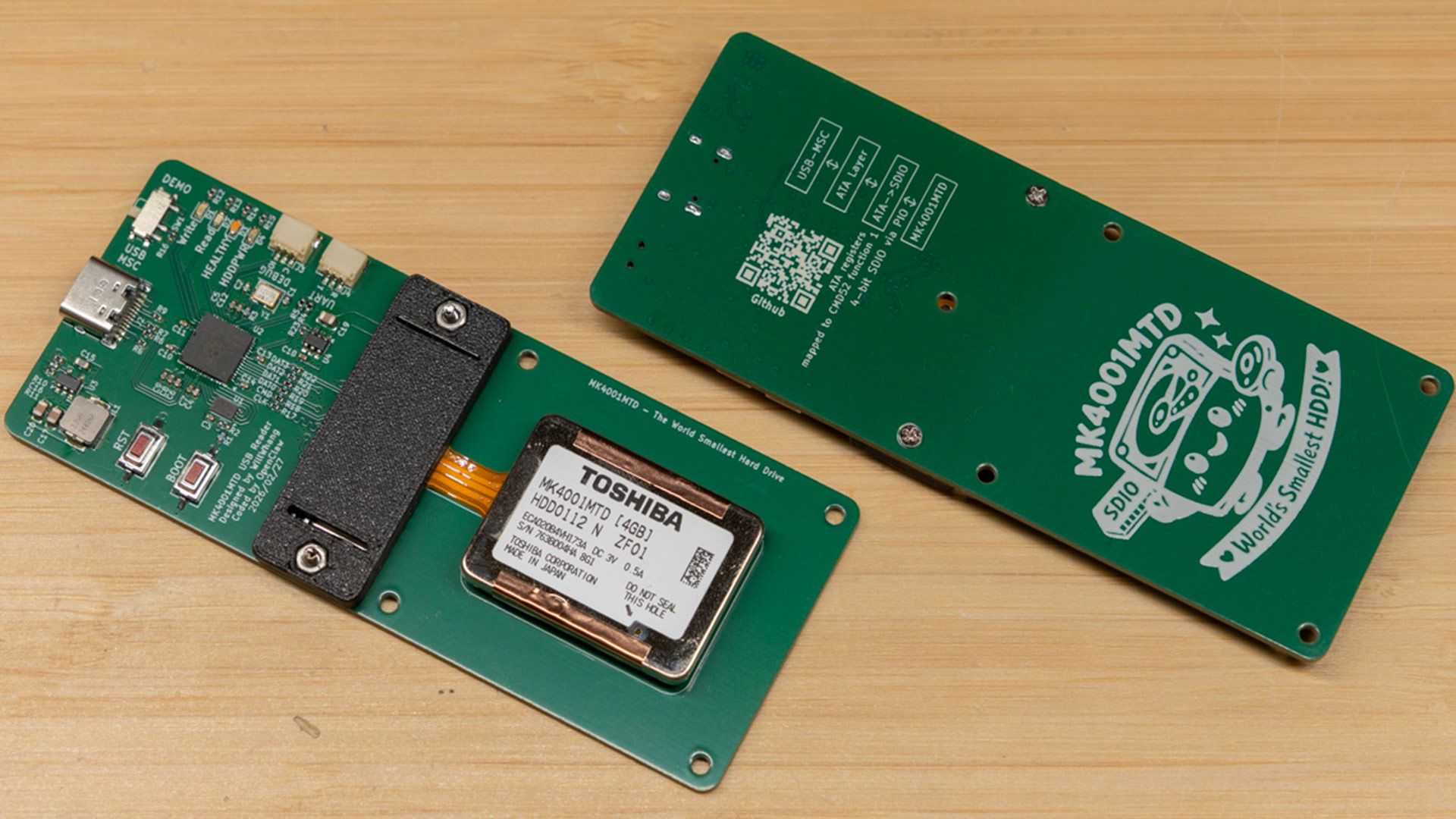
Tinkerer used AI to jump some hurdles, such as writing firmware for this obsolete storage.
When you purchase through links on our site, we may earn an affiliate commission. Here’s how it works .
Maker Will Whang has designed and open sourced an MK4001MTD USB Bridge . This is a USB mass storage compatible device which facilitates the use of the world’s smallest mechanical hard drives (obsolete for many years) with modern tech.
Watch On Toshiba launched its 0.85-inch MK4001MTD hard drives in 2004, offering an attractive-at-the -time balance of capacity and pricing. However, as they were sidelined quite rapidly due to the advance of flash memory tech, not many device designs adopted them. This has led to these tiny HDDs, and the data upon them, basically getting lost in time.
Whang explains that several prior attempts had been made at accessing the obsolete MK4001MTD drives, but they had fallen at various hurdles. So, the maker decided to start collecting working (and non-working) units to see if they could crack this particular old storage nut.
You may like ATABoy bridges old IDE drives to the 21st century with Open Source USB host bridge Open source IDE-ATAPI drive emulator launches for vintage computers Researcher builds bizarre 128-byte USB drive the size of a dinner plate using ancient pre-semiconductor magnetic core memory technology Starting with the basics, Whang compared drives and reader interface pads that looked similar to the MK4001MTD. Yes, it looks somewhat like an SD card with an MMC-style connector. So, various old/spare readers were used with the Toshiba drives to see what happened. Eventually, Whang decided to build their own reader based around the USB2240 flash media controller chip. It thus became possible to use a logic analyzer to see what signals were going where.
Unfortunately, it became clear that “this was not behaving like a normal SD or MMC storage device.” So, more analysis would be necessary, which would extend all the way into a reverse engineering effort.
For this next stage of the project, Whang acquired a beaten-up but usable Nokia N91. This mobile device was one of the rare MK4001MTD adopters back in the mid-noughties.
After getting the old phone to boot, so they could capture the traces, the purpose of each pad became much clearer. “The traces confirms this is a 4-bit SD/MMC interface and N91 service manual pin connection is indeed correct. The bus activity showed CMD52 traffic, which immediately pointed toward SDIO rather than a normal memory-card mode,” says Whang. “Looking further into the command contents, it also appeared that ATA-style commands such as IDENTIFY DEVICE were being transported over that interface.”
Get Tom's Hardware's best news and in-depth reviews, straight to your inbox.
Key considerations
- Investor positioning can change fast
- Volatility remains possible near catalysts
- Macro rates and liquidity can dominate flows
Reference reading
- https://www.tomshardware.com/pc-components/external-hdds/SPONSORED_LINK_URL
- https://www.tomshardware.com/pc-components/external-hdds/enthusiast-reverse-engineers-worlds-smallest-hdd-to-access-data-with-help-from-an-old-nokia-n91-and-openclaw-open-source-usb-bridge-unlocks-0-85-inch-mechanical-toshiba-from-2004#main
- https://www.tomshardware.com
- Save over $100 on this feature-rich Asus AM5 motherboard with Wi-Fi 7, USB4 & DDR5-8000 support — TUF Gaming X870-Plus is on sale for just $170
- Precision Hall-Effect controls and a 45% saving on Razer's latest Wolverine V3 Tournament Edition game controller — get yours for just $54 in this limited-time
- Intel's roadmaps examined — 14A, Nova Lake, Diamond Rapids & AI accelerator push
- MSI plans 30% gaming product price hike as memory and GPU shortages bite — 'This year is the most severe year since the company was founded'
- Intel's new Core Ultra 200HX Plus mobile CPUs include 290HX, 270HX Plus flagships — 8% faster gaming claims fall short of 15% boost promised by desktop Arrow La
Informational only. No financial advice. Do your own research.