
When you purchase through links on our site, we may earn an affiliate commission. Here’s how it works .
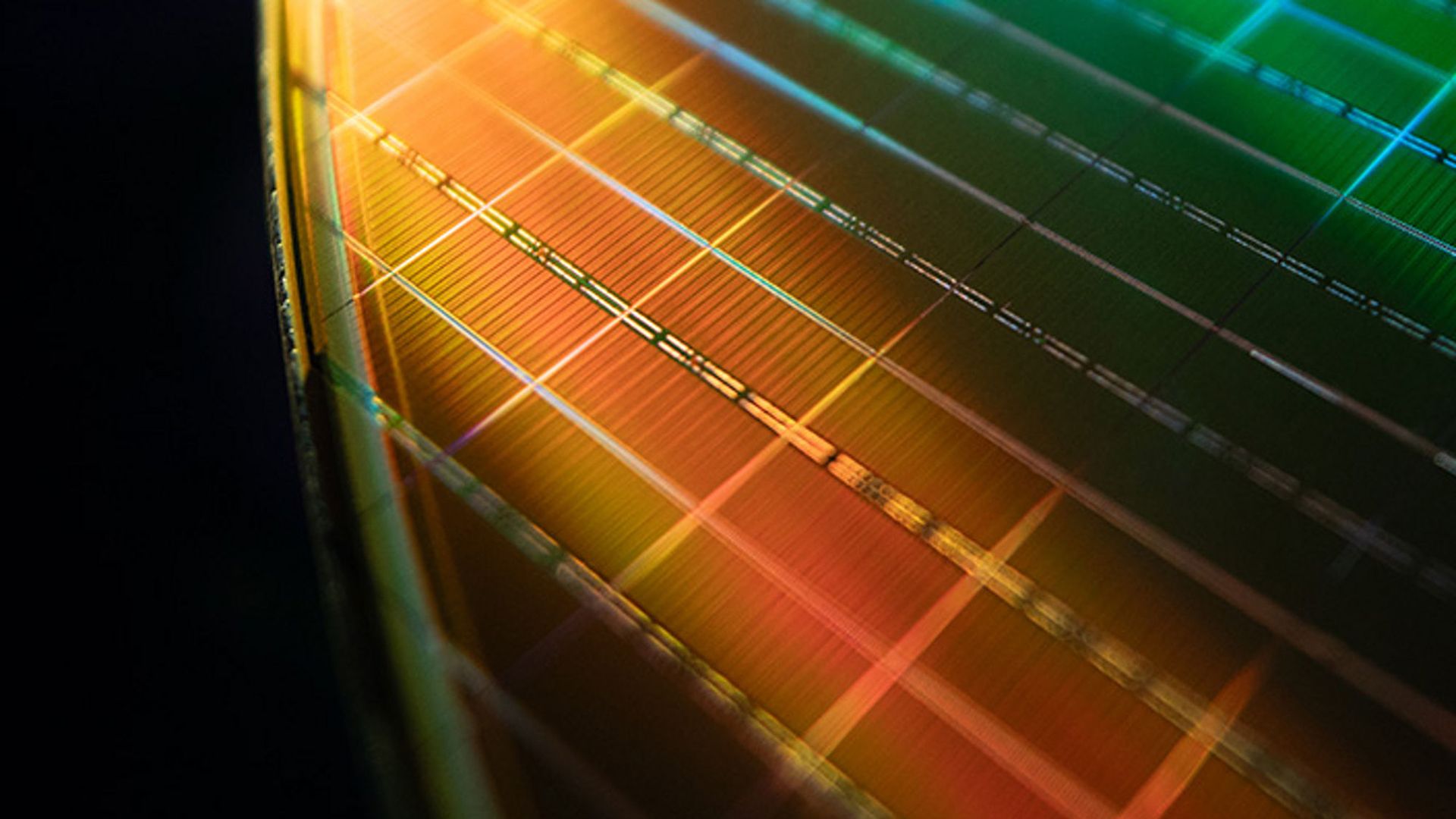
(Image credit: Micron) Trumpf, the manufacturer of the lasers used in ASML's EUV chipmaking tools, is turning to quantum computing to explore new ways to optimize its lasers. Trumpf is teaming up with its partners from Fraunhofer ILT and the Dahlem Center at Freie Universität Berlin to explore whether modern quantum computers can indeed be used more effectively than today's classical supercomputers. If quantum computers prove to be more efficient, they could improve next-generation CO2 laser systems.
CO2-based laser units are widely deployed in semiconductor production (specifically in light sources for DUV and EUV lithography tools, such as those developed by Cymer for ASML's NXE and EXE tools), the broader non-semiconductor industry, and silicon photonics used for connectivity. Hence, the group will explore two vectors of technology: typical industrial applications of CO2 lasers and the scientific direction of microscopic explorations. The initiative is supported with roughly €1.8 million from Germany's Federal Ministry of Education and Research.
Quantum computers may outperform classical supercomputers in modeling CO2 lasers because the physics of these lasers — vibrational and rotational energy exchanges, molecular collisions, and population-inversion dynamics — are inherently quantum-mechanical. Classic supercomputers tend to approximate these processes, since fully representing a many-state quantum system requires storing an exponentially growing number of amplitudes, which is becoming difficult for existing supercomputers that companies like Trumpf can access.
New Chinese optical quantum chip allegedly 1,000x faster than Nvidia GPUs for processing AI workloads
'Beyond EUV' chipmaking tech pushes Soft X-Ray lithography closer to challenging Hyper-NA EUV
American startup Substrate promises 2nm-class chipmaking with particle accelerators, at a tenth of the cost of EUV
Meanwhile, a quantum computer can represent quantum states natively: n qubits can encode a 2ⁿ-dimensional state space without using amounts of DRAM that limit classical simulations. This makes quantum hardware much better suited to simulate decoupled, many-body interactions that order gain, losses, and energy-transfer behavior inside CO2 lasers. As quantum machines mature in general, they could enable far more accurate predictions and faster optimization of industrial laser designs.
The main task of the first task force is to determine whether quantum hardware can handle complicated quantum-mechanical interactions that command how particles generate and amplify light. Fraunhofer ILT contributes its experience in simulating semiconductor devices, while the Dahlem Center provides expertise in describing molecular collision dynamics.
A major technical component of the work involves translating established descriptions of energy-transfer behavior into forms suitable for quantum algorithms. Trumpf is developing the first versions of these quantum algorithms and coordinating their testing. One of the early targets is the set of processes governing CO₂-laser amplification, where accurate prediction of how energy moves between different molecular states is crucial for optimizing optical output and overall system performance.
The researchers have started by reviewing current simulation methods and benchmarking early quantum approaches to see where they may offer advantages. Since today’s quantum computers are essentially prototypes and lack the robustness needed for large industrial workloads, the emphasis is on building the know-how required to exploit more capable quantum machines once they arrive. This includes validating whether certain parts of the laser-physics models can run more efficiently on quantum hardware than on conventional supercomputers.
Get Tom's Hardware's best news and in-depth reviews, straight to your inbox.
Key considerations
- Investor positioning can change fast
- Volatility remains possible near catalysts
- Macro rates and liquidity can dominate flows
Reference reading
- https://www.tomshardware.com/tech-industry/semiconductors/SPONSORED_LINK_URL
- https://www.tomshardware.com/tech-industry/semiconductors/euv-laser-maker-trumpf-explores-quantum-computing-to-improve-laser-tech#main
- https://www.tomshardware.com
- Major insurers move to avoid liability for AI lawsuits as multi-billion dollar risks emerge — Recent public incidents have lead to costly repercussions
- Major insurers move to avoid liability for AI lawsuits as multi-billion dollar risks emerge — Recent public incidents have lead to costly repercussions
- An entire PS5 now costs less than 64GB of DDR5 memory, even after a discount — simple memory kit jumps to $600 due to DRAM shortage, and it's expected to get wo
- Rapidus to start construction on 1.4nm fab in 2027 — research and development on node to begin next year
- Grab these vital 3D printer maintenance tools in these Back Friday 2025 deals — up to 40% off HOTO, Creality, Wera
Informational only. No financial advice. Do your own research.