
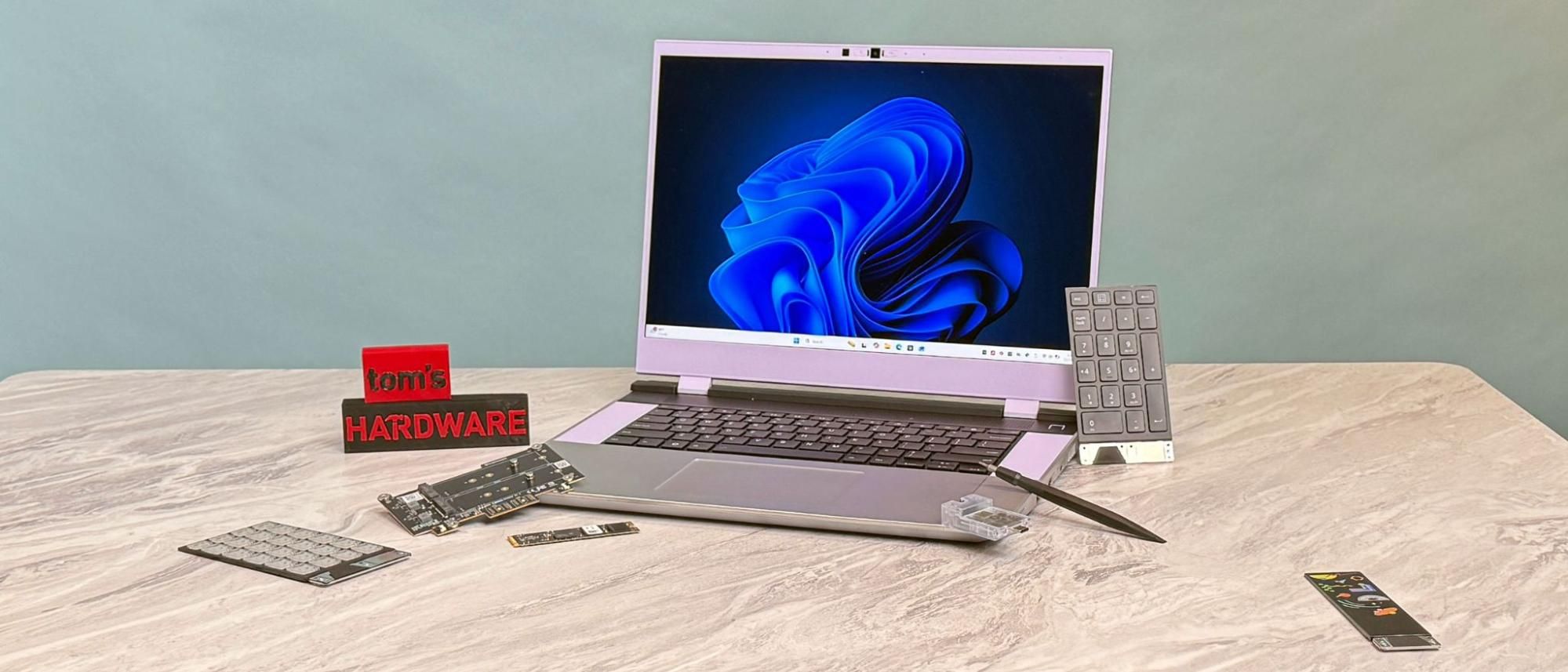
Framework is touting a second-generation webcam with an upgraded image sensor. The 1080p webcam, which records at 30 frames per second, is fine but not mind-blowing, particularly at this price.
While I found it to look good enough for most use cases, I did note some graininess, especially in the background. Colors appeared slightly cool, though the camera did have to contend with a window right next to my desk.
Of course, if you buy the DIY edition, you don't need to start with Windows 11. Framework also supports a ton of Linux distributions, if that's your thing.
Framework sells the Laptop 16 with a one-year warranty in the United States and Canada.
Framework sells the Laptop 16 in three different prebuilt configurations that are ready to use with Windows 11, or a DIY model in which you bring your own RAM, storage, and operating system (though Framework will happily sell those to you, if you would like).
The prebuilt options start at $1,499 with an AMD Ryzen AI 7 350, 16GB of RAM, and 512GB of storage. An extra $200 bumps you up to 32GB of RAM and a 1TB SSD, while the top-end $2,549 option has a Ryzen AI 9 HX 370, 64GB of RAM, and 2TB of storage. That's all without a discrete GPU; if you want to add the Nvidia GeForce RTX 5070, you have to add $650 more. On the bright side, these systems include a power adapter.
You'll also have to buy expansion cards for ports. Framework recommends six (one for each port), which is a minimum of $66, assuming you get all USB Type-C and Type-A ports, but prices vary depending on the port.
The DIY Edition, which we tested, is a bit more free-flowing. You start with either a $1,499 model with the Ryzen AI 7 350 or a $1,799 option with a Ryzen AI 9 HX 370. From there, you can add the RTX 5070 ($650) or Radeon RX 7700S ($350) if you want discrete graphics. Framework sells memory and storage separately, and also doesn't include a power adapter on DIY models — you have to shell out $109 for the 240W GaN adapter, or bring your own. Framework recommends a minimum of 100W without the graphics module or 180W with it, though it says 240W will "provide the best experience."
Our review laptop, with the Ryzen AI 7 350, 16GB of RAM, 1TB of storage, an RTX 5070, and a number pad is $2,396, though it would be more if we counted the RGB macropad ($79). That doesn't include the money necessary for the expansion cards, which will differ heavily depending on which ones you want.
Black bezels and a basic keyboard come included, though if you want special colors, layouts, or RGB, those cost extra. You also have to pay for spacers or input modules to finish out the laptop. At a minimum, two spacers are a total of $20. The numberpad is $39, while the RGB macropad is $79.
Framework did it. It made a laptop that supports multiple generations of GPUs. You can remove the module, replace it, and upgrade from a Radeon RX 7700S to an RTX 5070. It's a remarkable technical achievement, though I wish there were more GPU options.
And beyond that, the Framework Laptop 16 remains the most customizable laptop I've ever seen, though that does mean some unsightly seams and gaps that cheapen the experience.
The matte display is vivid and is great at avoiding reflections, and it's cool to see one of the first systems to come with a 240W GaN USB-C charger, assuming you pay for it.
But this system is more expensive than other RTX 5070 gaming laptops, so if you're just using it for gaming, you may want to consider other options. The MSI Katana we compared it to was $1,300 when we tested it.
But if you prioritize repairability above all else, and want the ability to change out GPUs, there's no other way to go. The Framework Laptop 16 is still one of a kind. You just have to be willing to deal with the hitches (and the high price) that can come with that.
Andrew E. Freedman Social Links Navigation Andrew E. Freedman is a senior editor at Tom's Hardware focusing on laptops, desktops and gaming. He also keeps up with the latest news. A lover of all things gaming and tech, his previous work has shown up in Tom's Guide, Laptop Mag, Kotaku, PCMag and Complex, among others. Follow him on Threads @FreedmanAE and BlueSky @andrewfreedman.net . You can send him tips on Signal: andrewfreedman.01
cameronbosch Let me start by saying that I agree that it's finally good to have replaceable GPUs in a laptop. That was really upsetting me. I will say that none of the things you mentioned are major issues, especially because look is very subjective, as I'm tired of all of the flashy RGB light strip gaming laptops 🤢🤮 that so many brands seem to think are popular with aggressive vents. And the price is actually not terrible; it is a bit high for what you get, but understandable for a smaller OEM that is also an ODM. And you're also paying for one for the few OEMs to officially support Linux AND make their own laptop hardware without repurposing Tongfang or Clevo chassis which are often WORSE in many ways that other ODMs, especially with Clevo. That being said, there is one issue that Framework has caused that honestly caused me, as a person who fully bought into their hardware, to leave. That is the promotion and then funding of a certain problematic individual who has seriously inappropriate views. When confronted about this, each time, the CEO kept denying this was an issue and even tried to quash the dissent by merging all of the negative responses into one threat, and even shutting down their Discord channel. I can deal with high prices. I can deal with slightly worse specs than other brands that are still better than Clevo repackages. I can even deal with their refusal to offer dGPUs with more than 8 GB of vRAM leading to not as good performance in games with ray-tracing or at 2560×1600. But funding an insecure problematic Linux "distro" (if you can even call Omarchy a Linux distro, more like a bunch of scripts on top of Arch Linux), defending it, and going so far as to keep funding the projects as they bleed former users? Now that's a serious issue, and why I can no longer defend them. And it's a real loss for us Linux and right to repair users. Reply
bennyg55 It's just so expensive! Here in Australia it's 4300 AUD for the 12 core HX + 5070 kit preorder, without ram, storage, ports or even a charger! I could have equivalent performance for half as much or for ~5K I could have my pick of any of the R9 or U9 + 5070Ti-M and many 5080M laptops… So the premium of being able to shift ports around with easier part-swapping makes for a very expensive luxury. As a high end 2010s era Clevo modder & upgrader I remain disappointed by Framework. Reply
Crazyy8 God I would love to have a Framework laptop, but the cost compared to similar spec'ed laptops really kills it for me. I could get a base or slightly upgraded Mac mini for the price of the skeleton model, I could even go full LAN party and get a desktop in a portable case. Granted, that isn't taking into account the cost of a monitor, mouse, et cetera. All that's just fantasies, though, as I can't afford tech right now. Reply
Key considerations
- Investor positioning can change fast
- Volatility remains possible near catalysts
- Macro rates and liquidity can dominate flows
Reference reading
- https://www.tomshardware.com/laptops/gaming-laptops/SPONSORED_LINK_URL
- https://www.tomshardware.com/laptops/gaming-laptops/framework-laptop-16-2025-rtx-5070-review#main
- https://www.tomshardware.com
- Secretlab's UK Black Friday gaming chair sale has started, up to £200 off select products — sale includes desks and recliners
- Save £200 on this MSI QD-OLED gaming monitor — just £399 for a vibrant 1440p display with a 240Hz refresh rate
- Secretlab's UK Black Friday gaming chair sale has started, up to £200 off select products — sale includes desks and recliners
- DARPA invests $1.4 billion to build experimental Texas foundry for next-generation 3D chips — Austin plant to buck standard fab models to focus on high-mix, low
- PC hardware vendor PNY suspends Black Friday storage deals — cites rising NAND costs
Informational only. No financial advice. Do your own research.