
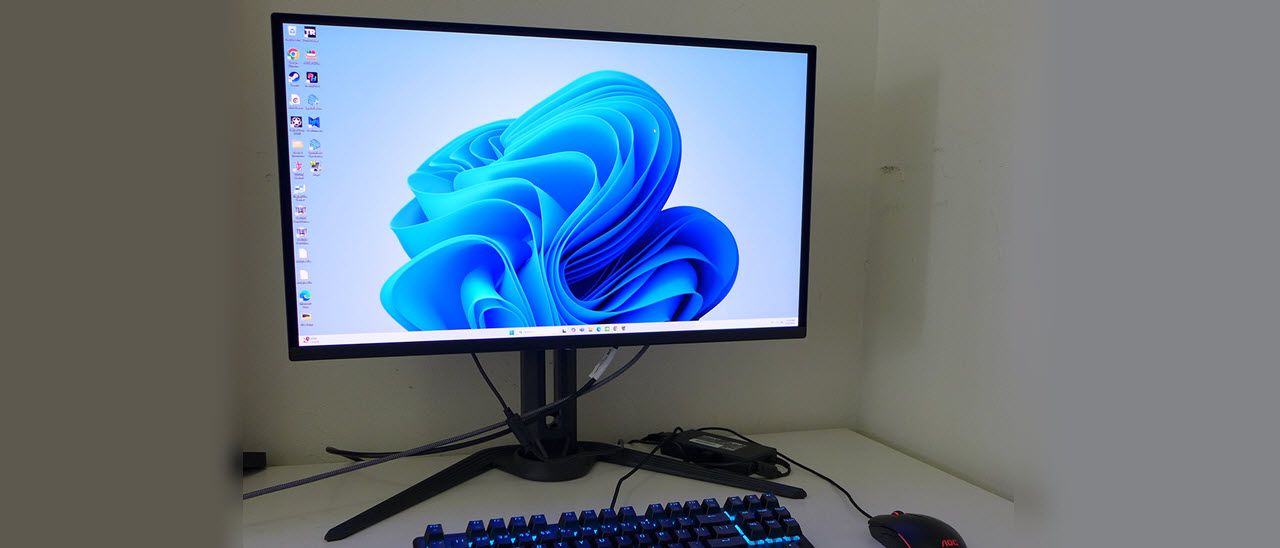
(Image credit: Gigabyte) (Image credit: Gigabyte) (Image credit: Gigabyte) (Image credit: Gigabyte) (Image credit: Gigabyte) The FO27Q5P sticks to the two-piece version of OLED style, with the screen surrounded by a metal backing and a large component bulge attached to its backside. The bulge isn’t too thick and is nicely accented up top by a backlit Aorus logo whose colors and effects can be controlled from the OSD. This separate panel approach makes cooling easier since air can flow through freely. There’s a graphene layer behind the OLED, and no fans are required.
The stand is solid and substantial with a slender but wide base made from cast aluminum and finished in a fine crinkle powder coat. Adjustments include 5/20 degrees tilt, 20 degrees swivel and a 5.1-inch height adjustment. You also get a 90-degree portrait mode. Movements are firm with no wobble or play, which befits this premium display.
In the back, you can see a fine grill pattern offset by the LED lighting. There’s an Aorus logo and two small accents underneath the stand attachment point. It doesn’t draw too much attention to itself, but still adds a nice touch of visual flair. The stand has a cutout running its full length, and there’s a cable clip to keep your wiring tidy.
The potential for lots of wiring is here thanks to the FO27Q5P’s extensive connectivity. There are two DisplayPort 2.1 inputs, one standard and one mini, and the USB-C input supports DisplayPort. You also get two HDMI 2.1 inputs, and there’s a DisplayPort output , something I rarely see. This means you can daisy chain multiple monitors with a single cable connection to the PC. USB is version 3.2 and has one upstream and two downstream ports. Full KVM functionality with a setup wizard is included in the OSD. Finally, there is a 3.5mm headphone jack and a 3.5mm microphone input. I’m surprised there isn’t DVI and VGA back there too!
The FO27Q5P’s OSD is packed with features for video processing and image adjustment. There are gaming aids, KVM switching, and even quick-change resolution options. Literally nothing has been left out here.
(Image credit: Tom's Hardware) (Image credit: Tom's Hardware) (Image credit: Tom's Hardware) (Image credit: Tom's Hardware) (Image credit: Tom's Hardware) (Image credit: Tom's Hardware) (Image credit: Tom's Hardware) (Image credit: Tom's Hardware) (Image credit: Tom's Hardware) Gaming is first with VRR (Adaptive-Sync), which includes an anti-flicker function with two levels of correction. It is intended to prevent flicker during rapid changes in refresh rate. I ran several tests and never saw flickering, whether it was on or off. You also get Ultra Clear, which is a black frame insertion feature. It works at speeds below 250 Hz with VRR turned off. It cuts brightness by about 50% but it will eliminate blur at low frame rates. The magic number in my observation is 200fps. Anything above that doesn’t need help, but below that, Ultra Clear is effective at keeping motion resolution high.
Each of the 10 picture modes has either all the image controls or a subset of them. Standard lets you change the important things like color temp and gamma. You also get gamut selection though to use sRGB, you must select the sRGB picture mode, which only allows brightness changes. The Native color space option covers just over 108% of the DCI-P3 color space.
Gigabyte includes its full suite of Game Assist options with timers, a stopwatch, refresh rate indicator, and the ability to move the information around the screen. There are four different aiming points, and you get a sniper mode and night vision. Tactical Switch is a resolution toggle for changing screen aspect ratio and sizing on the fly.
Calibrating the FO27Q5P is purely optional if you pick the Standard picture mode. The default is Eco, and it limits brightness, so I recommend avoiding that one. With a few changes to the RGB sliders, I took grayscale tracking from good to great and tightened up the gamut chart in the process. Gamma tracks closely to the reference, so all detail is crisply rendered at all brightness levels. My SDR settings are below, with APL Stabilize set to Low. If you use Middle or High, you’ll likely need a lower brightness value to keep the picture from being too harsh.
When an HDR signal is present, the FO27Q5P offers five specific modes, all but one of which are adjustable for brightness and contrast. The best choice there is HDR Peak 1000 because it has the most accurate luminance and color tracking. The FO27Q5P delivers some superb HDR with bright highlights and richly saturated color.
The FO27Q5P has several video processing options, so I’ll take them one by one. Playing Doom Eternal and other similar titles at max detail on a GeForce RTX 4090 -equipped PC, I saw framerates between 350 and 450 frames per second (fps). Though there was constant and wide fluctuation, I never needed to employ the anti-flicker setting. That’s just as well because it doesn’t work in HDR mode.
To use Ultra Clear, I had to disable Adaptive-Sync and reduce the refresh rate to 250 Hz. The only difference I noticed was the 50% reduction in brightness. It wasn’t any smoother because motion was already perfect without help. It was obvious, though that this would be an effective tool to maintain high motion resolution at speeds below 200fps. There are no visible artifacts to spoil gameplay.
To explore the variable brightness feature, I had to play in SDR mode. With HDR content, the setting is grayed out and it’s locked to the most aggressive level. That provides excellent HDR with brightly detailed highlights and deeply detailed shadow areas. Speaking of, the best HDR mode was Peak 1000. It delivers the best detail rendering and the most accurate color. Game and Cinema are very good too, but with a little less impact. Vivid should be avoided as it made the image look garish and cartoonlike.
Though a GeForce RTX 4090 provides very high frame rates, a 5090 would be the way to the FO27Q5P’s full potential of 500fps. Black frame insertion (Ultra Clear) is something few OLEDs have, so if you have a slower card, it can adapt better than other displays.
Color and contrast were superb regardless of other settings as long as I stuck with HDR Peak 1000 or Standard for SDR content. I’m used to the larger DCI-P3 gamut for SDR even though it isn’t strictly correct. The FO27Q5P has an sRGB mode which is accurate enough for critical work, but I noted slightly light gamma that could not be corrected. In Standard, there are gamut options but sRGB isn’t among them.
For other tasks and media, the FO27Q5P is a great desktop tool. The pixel density of a 27-inch QHD screen provides a sharp image with no pixel structure visible at normal viewing distances. It certainly gave nothing away to Ultra HD screens when gaming. Smooth motion and high frame rates are always preferred over sheer pixel density.
I noted the FO27Q5P’s large list of extras like USB ports, KVM, clear speakers with four audio modes, and its premium build quality and user experience. The speakers play clearly at decent volumes and the modes sound different from one another, with my favorite being Game for its broad and deep sound stage. Online players will appreciate the inclusion of both headphone and microphone jacks. That’s something almost no monitors offer.
Takeaway: The FO27Q5P is a premium display in every way. It includes absolutely every feature under the sun for gaming, entertainment and productivity. The picture is gorgeous with rich color and contrast only an OLED can deliver. It exudes excellent build quality and solid feel. In the 27-inch QHD OLED category, it’s hard to imagine better.
Current page: Features and Specifictions
Key considerations
- Investor positioning can change fast
- Volatility remains possible near catalysts
- Macro rates and liquidity can dominate flows
Reference reading
- https://www.tomshardware.com/monitors/gaming-monitors/SPONSORED_LINK_URL
- https://www.tomshardware.com/monitors/gaming-monitors/gigabyte-aorus-fo27q5p-27-inch-500-hz-qd-oled-gaming-monitor-review#main
- https://www.tomshardware.com
- NVIDIA Founder and CEO Jensen Huang and Chief Scientist Bill Dally Awarded Prestigious Queen Elizabeth Prize for Engineering
- 500 disposable vapes recycled into a powerwall to power a house and workshop — enough juice for up to eight hours of home usage or three days of work
- Nvidia's Jensen Huang upstaged at TSMC annual Sports Day by TSMC-branded sneakers — CEO's 'Made In Taiwan' footwear is the talk of the town
- Seasonic G12 GC-750 750W power supply review
- Elgato Facecam Neo Review: Versatile and cheap
Informational only. No financial advice. Do your own research.