
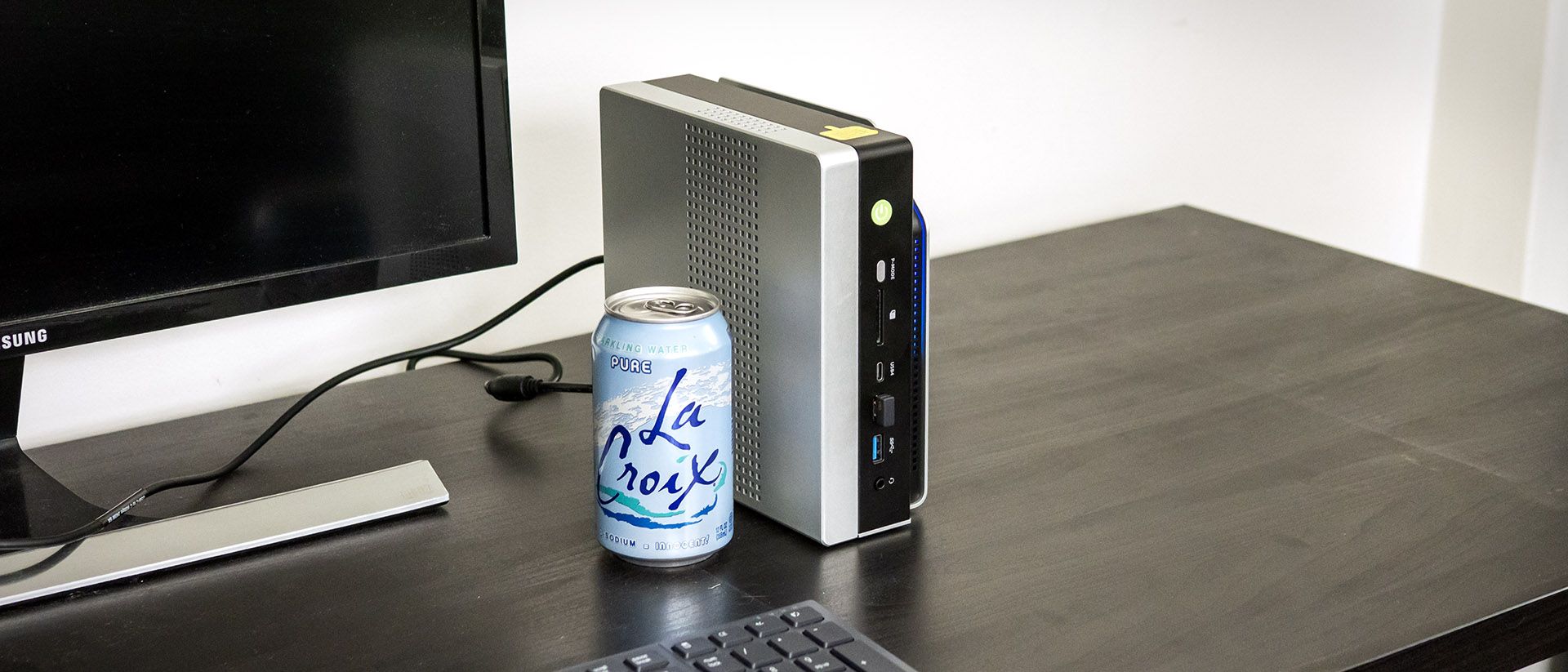
For wireless, the system supports the latest Wi-Fi 7 and Bluetooth 5.4 standards courtesy of a MediaTek MT7925 networking card. The wireless antennas are built into the case, so there are no external protrusions.
Upgrading the Evo X2 AI Mini PC is tricky. With the CPU/GPU and RAM soldered, only the two M.2 drives can be upgraded. Accessing these requires peeling off the rubber feet and removing the Philips-head screws underneath. This allows the smaller top half of the chassis to come free, revealing the two M.2 slots.
(Image credit: Tom's Hardware) (Image credit: Tom's Hardware) Removing the rubber feet is difficult since they’re secured with adhesive. I used a plastic toothpick to get under them, then slowly pulled them free with my fingers. The adhesive becomes much less effective once the feet are taken off, though it remained sticky enough for the one time I reapplied them.
Our Evo X2 review unit features a Ryzen AI Max+ 395 processor, Radeon 8060S graphics, and 64GB of LPDDR5X-8000 memory. Though integrated, the Radeon chip is more than powerful enough for 1080p gaming.
For my game testing, I used Star Wars Jedi: Fallen Order at 1920 x 1080 with Epic visual quality settings. I saw 90-110 frames per second in most instances, with occasional dips into the 70 FPS range for complex scenes, and spikes over 120 FPS in cutscenes. The game always seemed fluid.
For comparison, we’re using the Framework Desktop, which features the same hardware. We are testing at a 1920 x 1080 resolution since modern 4K gaming still isn’t practical on integrated graphics.
(Image credit: Tom's Hardware) (Image credit: Tom's Hardware) (Image credit: Tom's Hardware) (Image credit: Tom's Hardware) (Image credit: Tom's Hardware) These mini-PCs are evenly matched for the most part, with the edge going to the Evo X2 in Shadow of the Tomb Raider (91 versus 87 FPS), Cyberpunk 2077 (28 versus 22 FPS), and Red Dead Redemption 2 (62 versus 57 FPS). The pair was within one FPS in Far Cry 6 , but the Evo X2 produced far lower numbers in Borderlands 3 (78 versus 103 FPS), which may have been an anomaly.
Our tests are run at demanding settings, particularly in Cyberpunk ; reducing the settings a notch or two can yield much higher FPS. We would expect any modern game to be playable on the Evo X2 at a 1920 x 1080 resolution.
To stress test gaming PCs, we run the Metro Exodus benchmark 15 times sequentially at RTX settings to simulate half an hour of gaming. During the test, the Evo X2 averaged 57 FPS across all runs with less than 1 FPS variation between tests, indicating stable thermal performance. The Ryzen AI Max+ 395 ran at an average temperature of 61 C.
Fan noise proved louder than expected on this mini PC, with the fans becoming audible across my living room while running our CPU benchmarks . However, during gaming, the fans were much more controlled since the CPU was not being fully stressed.
We tested the Evo X2 featuring AMD’s Ryzen AI Max+ 395 processor, 64GB of memory, and a 1TB SSD. Despite being a mobile chip, the 395 has no trouble powering through demanding workloads, from heavy multitasking to AI‑accelerated tasks.
Unified memory sets Strix Halo apart. Because the GPU draws from system RAM, the 64GB model can allocate up to 32GB for graphics, while the 128GB configuration can expose a massive 96GB to the GPU. That’s an extraordinary amount of GPU-addressable memory for any PC, let alone one this compact.
(Image credit: Tom's Hardware) (Image credit: Tom's Hardware) (Image credit: Tom's Hardware) The Evo X2 and the Framework Desktop produced almost indistinguishable results in our Handbrake and Geekbench CPU tests, an unsurprising result considering both use the same CPU. The Evo X2 disappointed in our 25GB file transfer test, though; we’d forgive that on a barebones PC where you supply your own drive, but the Evo X2 arrives fully equipped.
Almost nothing is installed on the Evo X2 beyond an “AIPC” app, which requires a login but doesn’t provide a way to create one. I did so by going to GMKtec’s online store and registering there. It took several minutes to receive a verification code, which went to my spam folder.
All GMKtec Evo X2 AI Mini PCs feature the Ryzen AI Max+ 395 processor with integrated Radeon 8060S graphics. MicroCenter offered our review model with 64GB of RAM and a 1TB SSD for $1,499, with a 128GB/2TB model for $2,299. Amazon has our review model listed at $1,699.99, but it is listed as "temporarily out of stock" as of this writing.
GMKtec also sells the system directly, starting with our review model for $1,499, a 96GB/2TB model for $1,799.99, and a 128GB/2TB system for $2,199.
GMKtec undercuts the Framework Desktop on price, which starts at $1,639 with the Ryzen AI Max+ 395 and 64GB of RAM, but before adding storage, an OS, and its required add-ons to get it up and running.
GMKtec’s Evo X2 is an appealing mini‑PC for anyone who wants strong CPU performance, abundant GPU‑addressable memory, and respectable 1080p gaming in a small footprint. While it's not as compact as the Framework Desktop because of its external power brick, it’s still dramatically smaller than a mid‑tower and easily fits on a desk. We also noted its excellent connectivity, Wi-Fi 7, and ability to drive four displays.
Its value hinges on your workload. The 128GB configuration delivers a massive 96GB of GPU‑addressable memory, making it a standout option for local AI development at a price far below traditional workstations (assuming you're willing to use AMD's software), and considerably cheaper than the Framework Desktop.
For pure gaming, though, it's not as appealing – a mid‑tower will deliver far better performance per dollar. But for creators, tinkerers, and anyone who can exploit its memory and AI capabilities, the Evo X2 is one of the strongest deals in the mini‑PC space.
Editor's Note, February 4: This review was originally published with the wrong gaming charts. This has been rectified. We regret the error.
Charles Jefferies is a freelance reviewer for Tom\u2019s Hardware US. He covers laptop and desktop PCs, especially gaming models. ","collapsible":{"enabled":true,"maxHeight":250,"readMoreText":"Read more","readLessText":"Read less"}}), "https://slice.vanilla.futurecdn.net/13-4-13/js/authorBio.js"); } else { console.error('%c FTE ','background: #9306F9; color: #ffffff','no lazy slice hydration function available'); } Charles Jefferies Freelance Reviewer Charles Jefferies is a freelance reviewer for Tom’s Hardware US. He covers laptop and desktop PCs, especially gaming models.
cknobman If you dont have to have high refresh gaming then Strix Halo is actually decent for 1440p gaming in a lot of titles. Reply
Gururu cknobman said: If you dont have to have high refresh gaming then Strix Halo is actually decent for 1440p gaming in a lot of titles. They have certainly been trying to do interesting things with it. Today I see they stuck it in a monitor. Not sure it works as a PC in desktop or laptop form and the handhelds have a gigantor battery on the back. Reply
call101010 Just release the ITX motherboard and let us make our own StrixHaloes. Asus. Gigabyte , Asrock ??? Reply
Notton call101010 said: Just release the ITX motherboard and let us make our own StrixHaloes. Asus. Gigabyte , Asrock ??? That already exists. Framework sells it. Have Asus/Gigabyte/Asrock/MSI sold Mobile on Desktop before? I was under the assumption it's a somewhat niche produce filled by smaller companies like Minisforum, Framework, etc. Reply
Key considerations
- Investor positioning can change fast
- Volatility remains possible near catalysts
- Macro rates and liquidity can dominate flows
Reference reading
- https://www.tomshardware.com/desktops/mini-pcs/SPONSORED_LINK_URL
- https://www.tomshardware.com/desktops/mini-pcs/gmktec-evo-x2-ai-mini-pc-review#main
- https://www.tomshardware.com
- Researchers use agentic AI to monitor and correct 3D prints — system catches errors in real time, uses modular design to work on different makes and models
- AMD adopts FRED together with Intel for Zen 6 architecture — replacement for decades-old IDT can improve performance and stability
- Save nearly 50% off on this thin-and-light laptop on Best Buy — Snapdragon X-powered Asus Vivobook 14 now on sale for just $379.99
- Trump administration plans $12bn critical minerals stockpile to offset China supply risk — initiative to create 60-day reserve of rare earths for electronics ma
- Walmart slices $200 off the price of MSI's RTX 5070-powered Katana 15 HX — get crisp visuals and a 165Hz QHD display for just $1299
Informational only. No financial advice. Do your own research.