
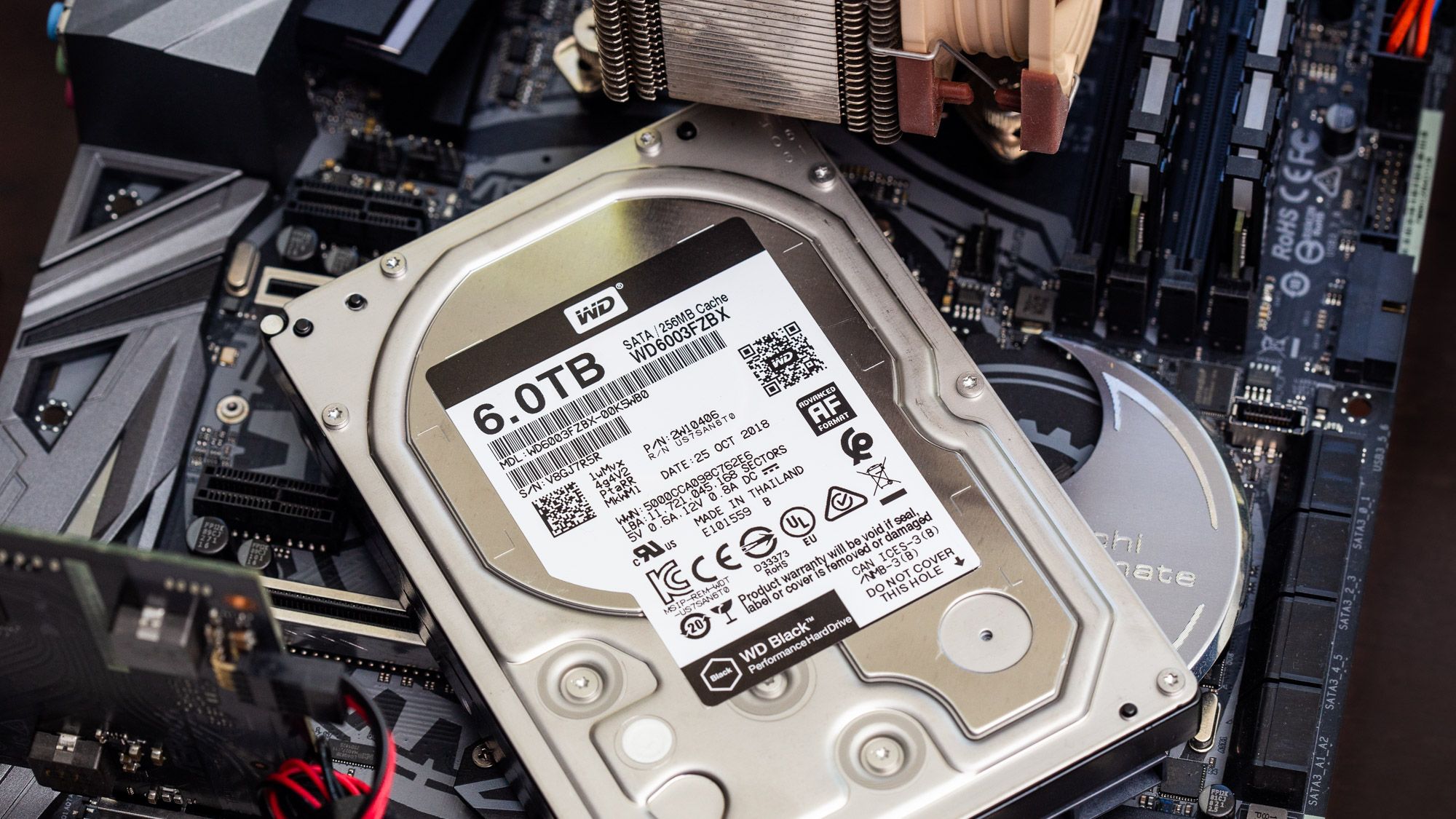
Hard drives, often treated as a legacy technology, are once again being pulled into the spotlight.
When you purchase through links on our site, we may earn an affiliate commission. Here’s how it works .
(Image credit: Tom's Hardware) After nearly two years of relative calm, the hard disk drive (HDD) market is showing signs of stress again. According to a report from Digitimes Asia (quoting Nikkei ), HDD contract prices jumped roughly 4% quarter over quarter in Q4 2025. That's the sharpest increase seen in eight quarters, and suppliers expect this upward pressure to persist. That might sound like a niche storage story, but in reality, it's a symptom of much larger forces reshaping the entire computing supply chain, from Chinese PC procurement policies to the rapid AI-driven expansion of U.S. data centers.
The report identifies two primary demand drivers. The first is a sudden resurgence of HDD demand in China's PC market, driven by government procurement policies that favor domestically produced CPUs and operating systems. That policy shift has accelerated local PC production, and in an unexpected twist, has also boosted HDD adoption. A big part of the reason is trust, or rather, the lack of it. Sources cited in the report point to concerns around long-term data retention in SSDs, whose critical components rely on NAND flash memory that is vulnerable to "bit rot" over time spent in storage. The result has been a renewed push toward HDDs for certain use cases, reversing what had long looked like an inexorable transition toward solid-state storage.
The second major pressure point is the U.S. data center sector, where demand for high-capacity nearline HDDs continues to grow. Despite years of predictions that flash storage would displace spinning disks entirely, hyperscale operators still rely heavily on HDDs for bulk storage, backups, and cold or warm data tiers. As AI workloads scale, so does the volume of data they generate, store, and move—much of which ends up on large, relatively cost-efficient hard drives .
AI data centers are swallowing the world's memory and storage supply, setting the stage for a pricing apocalypse that could last a decade
Adata chairman says AI datacenters are gobbling up hard drives, SSDs, and DRAM alike
TrendForce data cited in the report suggests that HDD manufacturers are already running at full utilization, yet still can't keep pace with demand from cloud service providers. Prices for nearline HDDs rose by a similar 4% quarter over quarter, underscoring that this isn't a localized PC phenomenon but a broader capacity problem.
What makes this moment especially interesting is how it intersects with the wider AI infrastructure boom . AI data centers aren't just consuming GPUs and accelerators; they're devouring memory, storage, power equipment, and even physical construction capacity at a historic pace. High-bandwidth memory and enterprise DRAM are already in short supply, and elevated DRAM pricing has made it harder for HDD makers to control manufacturing costs, even as demand surges. After all, hard drives use lots of DRAM for cache memory.
In that sense, HDD pricing pressure isn't an anomaly so much as it is collateral damage. Capital expenditure on AI infrastructure has ballooned so rapidly that it's begun showing up in macroeconomic data. Analysts have pointed out that a disproportionate share of recent U.S. GDP growth has come from investment spending tied to data centers , servers, and related infrastructure rather than consumer demand. HDDs, humble as they may seem, are part of that same CapEx wave.
Unlike flash memory, which can ramp with new fabs and process shrinks, HDD production is constrained by specialized components such as read/write heads and precision media. Scaling output isn't fast or cheap, and manufacturers have been cautious about expanding capacity after years of pricing pressure and consolidation. The result is a market that can tighten quickly when demand rebounds from multiple directions at once.
Get Tom's Hardware's best news and in-depth reviews, straight to your inbox.
Key considerations
- Investor positioning can change fast
- Volatility remains possible near catalysts
- Macro rates and liquidity can dominate flows
Reference reading
- https://www.tomshardware.com/pc-components/hdds/SPONSORED_LINK_URL
- https://www.tomshardware.com/pc-components/hdds/hdd-prices-spike-as-ai-infrastructure-and-chinas-pc-push-collide-hard-drives-record-biggest-price-increase-in-eight-quarters-suppliers-warn-pressure-will-continue#main
- https://www.tomshardware.com
- Industry preps new 'cheap' HBM4 memory spec with narrow interface, but it isn't a GDDR killer — JEDEC's new SPHBM4 spec weds HBM4 performance and lower costs to
- First truly 3D chip fabbed at US foundry, features carbon nanotube transistors and RAM on a single die — future devices could have up to 1000x improvement in en
- Dell preps massive price hikes up to 30% citing memory pricing 'out of our control' — company reminds commercial customers that placing an order today for futur
- Get a Creality 3D printer at an all-time low pricing until Christmas — up to $300 off K2 series with CFS bundle
- Robots’ Holiday Wishes Come True: NVIDIA Jetson Platform Offers High-Performance Edge AI at Festive Prices
Informational only. No financial advice. Do your own research.