
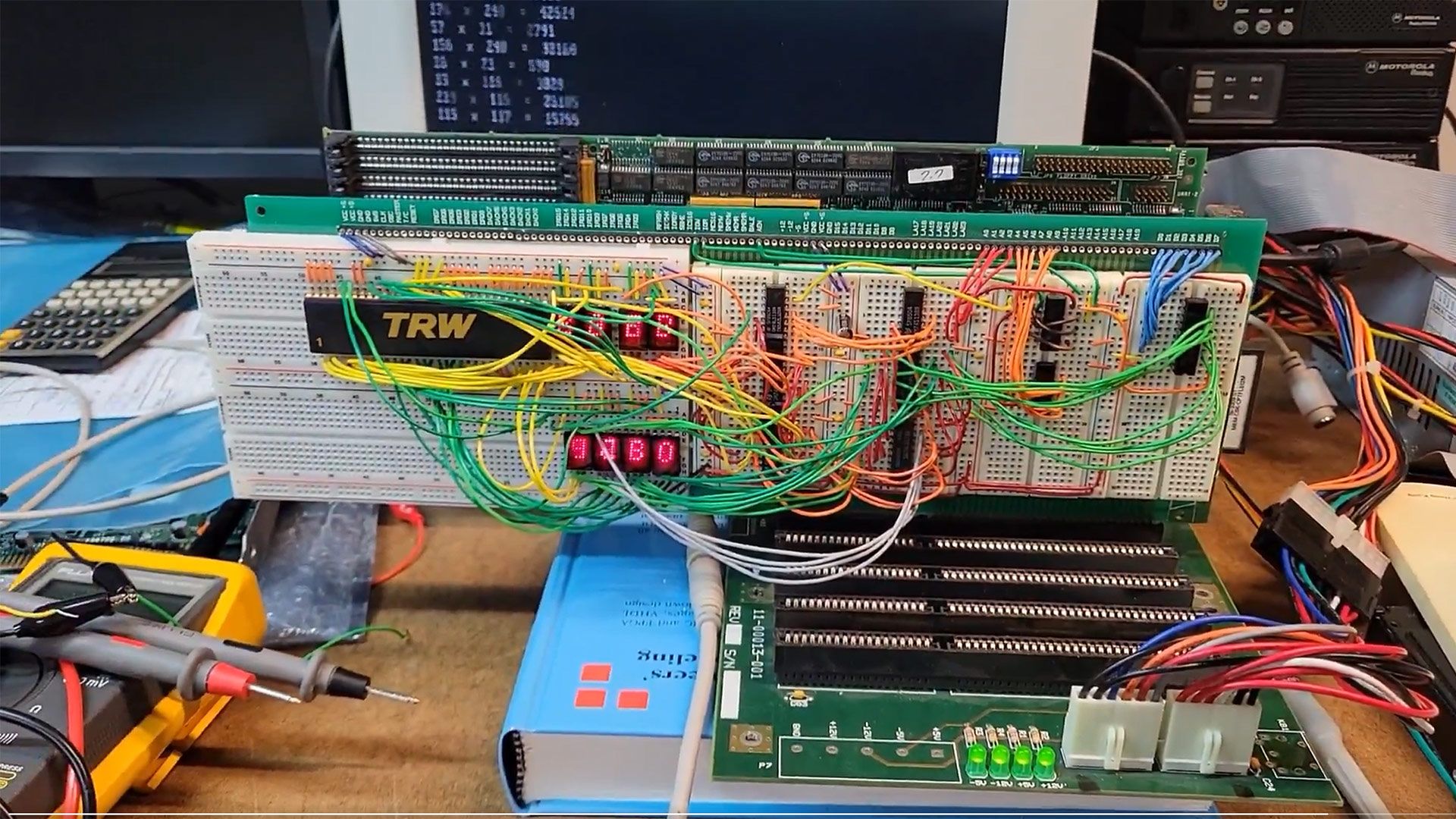
As cool as the Intel 8086 ISA accelerator card project is, it won’t work its magic on the classic old apps you might already have in your library – unless you wrote them or have access to the source code.
Brad explains to other X users that “for anything that I build, I can use my own subroutine that uses this hardware multiplier instead of the internal x86 MUL instruction.” But when it comes to pre-compiled apps, they aren’t aware of, and will not make use of, the ISA accelerator card.
Follow Tom's Hardware on Google News , or add us as a preferred source , to get our latest news, analysis, & reviews in your feeds.
Mark Tyson is a news editor at Tom's Hardware. He enjoys covering the full breadth of PC tech; from business and semiconductor design to products approaching the edge of reason. ","collapsible":{"enabled":true,"maxHeight":250,"readMoreText":"Read more","readLessText":"Read less"}}), "https://slice.vanilla.futurecdn.net/13-4-19/js/authorBio.js"); } else { console.error('%c FTE ','background: #9306F9; color: #ffffff','no lazy slice hydration function available'); } Mark Tyson Social Links Navigation News Editor Mark Tyson is a news editor at Tom's Hardware. He enjoys covering the full breadth of PC tech; from business and semiconductor design to products approaching the edge of reason.
bit_user The article said: when it comes to pre-compiled apps, they aren’t aware of, and will not make use of, the ISA accelerator card. Now, make one that fits in a 8087 socket and hack the 8086 microcode to forward imul instructions to it. Then , I'll be impressed. Reply
Ameisenn bit_user said: Now, make one that fits in a 8087 socket and hack the 8086 microcode to forward imul instructions to it. Then , I'll be impressed. I don't believe that's possible. The μcode doesn't have an instruction for forwarding to the coprocessor. Rather, the instruction decoder, IIRC, determines whether an instruction should be handled by it by whether its first byte has high bits matching 11011… Technically, IIRC, both the CPU and FPU decode all instructions – the FPU reads the data bus. The CPU ignores (mostly) ones starting with that pattern, the FPU ignores ones not matching it. So, handling it this way wouldn't be possible – there's no mechanism to "forward" instructions. That's not how the 8086/8087 interact. Even if you could do this, as said the FPU cannot operate on general purpose registers directly – it doesn't directly interact with the CPU like that. You'd need to call FISTP or such afterwards – you'd be better off doing this by adding new FPU instructions. That should work seamlessly, though would still require those instructions to be used. However… x87 already has FIMUL. You could replace IMUL's μcode with an improved version, providing you can fit it into 16 instructions (jumps included)… except that I don't think that the 8086's μcode is mutable. The better question is: what's the advantage of this board over using an 8087 and FIMUL? I suppose that this can run in parallel so you can use 8087 instructions at the same time, but that only seems marginally useful. Reply
Key considerations
- Investor positioning can change fast
- Volatility remains possible near catalysts
- Macro rates and liquidity can dominate flows
Reference reading
- https://www.tomshardware.com/pc-components/cpus/SPONSORED_LINK_URL
- https://www.tomshardware.com/pc-components/cpus/hobbyist-builds-a-homebrew-intel-8086-isa-accelerator-card-makers-project-improves-integer-multiplication-on-these-retro-systems-by-250-percent#main
- https://www.tomshardware.com
- Crypto platform Drift suffers from hack suspected to total $270 million — firm goes into damage control mode, suspends deposits and withdrawals
- Modder creates hybrid PlayStation, combining the guts of two original PS1 consoles into one custom PCB — system features native microSD card & HDMI support
- Enthusiast installs Win 3.1X on bare metal Ryzen 9 9900X and RTX 5060 Ti system using floppy disk drive, OS from 1992 running on 2025 hardware — Asus motherboar
- Efficiency at Scale: NVIDIA, Energy Leaders Accelerating Power‑Flexible AI Factories to Fortify the Grid
- Level up your gaming setup with this Core Ultra 5 250K Plus bundle for $299 — save $60 with ASRock's rock-solid B860 motherboard
Informational only. No financial advice. Do your own research.