
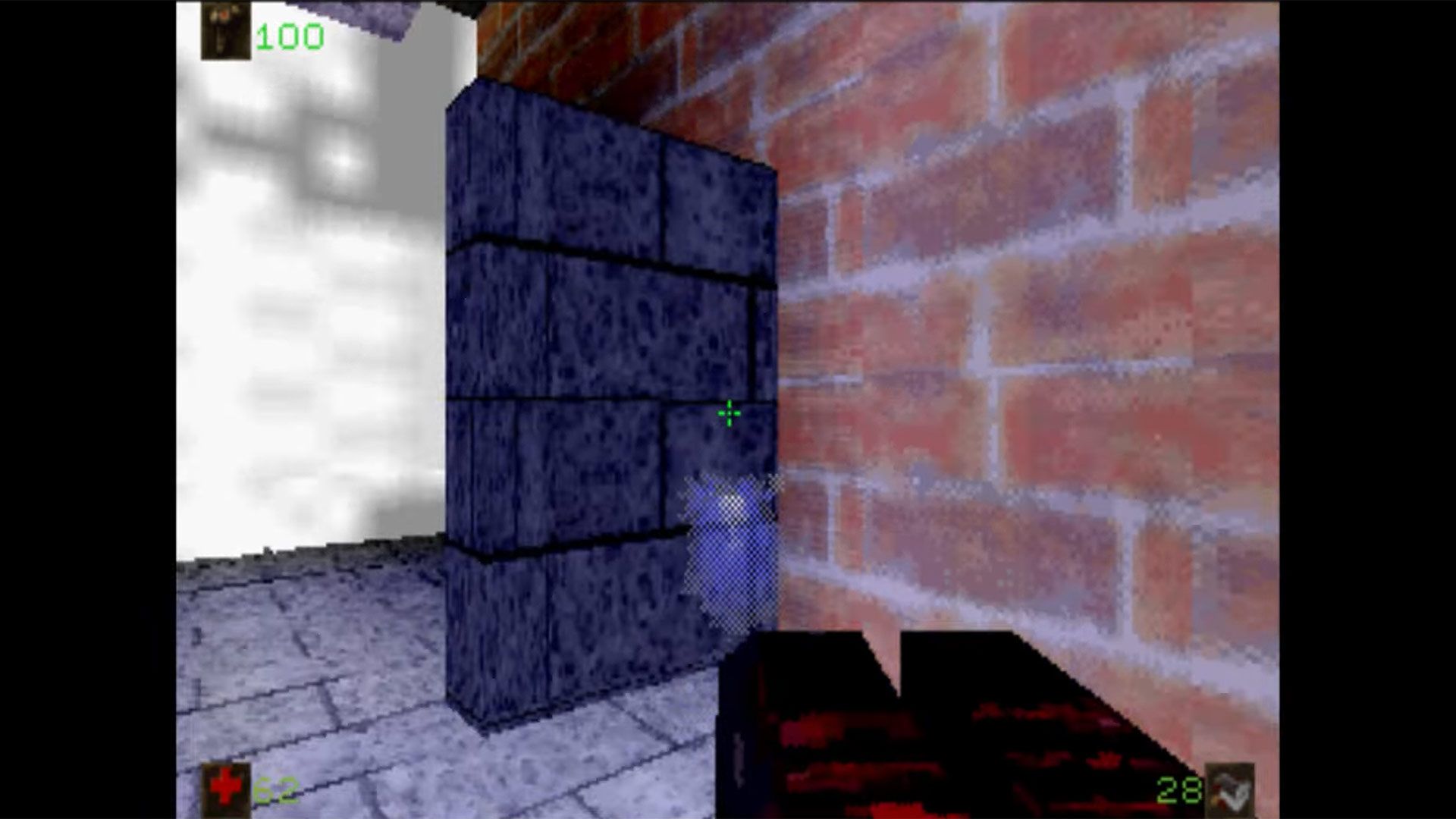
bit_user People have been using ray tracing for hit-detection for ages. This isn't much different. It's so low resolution that it's really not comparable to any form of modern ray tracing. Furthermore, it's happening in a very small demo environment with very simple geometry, and yet you can see a serious lag, as it gradually updates all of the vertices. Definitely doesn't seem like it would scale up well to an entire game. Reply
Lamarr the Strelok Jabberwocky79 said: But can it run Crysis? (sorry, someone had to say it). Never apologize for quoting elegant prose of old. Reply
Drunk Ukrainian Lamarr the Strelok said: Never apologize for quoting elegant prose of old. I was there, Gandalf, 3000 years ago. Reply
Lamarr the Strelok bit_user said: People have been using ray tracing for hit-detection for ages. This isn't much different. It's so low resolution that it's really not comparable to any form of modern ray tracing. Furthermore, it's happening in a very small demo environment with very simple geometry, and yet you can see a serious lag, as it gradually updates all of the vertices. Definitely doesn't seem like it would scale up well to an entire game. Just to remind people Nvidia didn't invent ray tracing. They put a lotta money into it and dumb amounts of marketing for it but that's about it for me,thankfully. RT is the equivalent of paying $200 extra for a gpu card for anti aliasing or any number of the other settings we already have on gpu's. Reply
bit_user Lamarr the Strelok said: Just to remind people Nvidia didn't invent ray tracing. I first dabbled with POV-Ray back in the early 1990's, on a 386 (plus Cyrix FasMath math coprocessor). Reply
bit_user call101010 said: H-ftFdH7heU It's misleading to post that clip with no explanation. That is not an example of realtime ray tracing. It was a clip rendered non-realtime using Lightwave 3D. It is simply the lead-in to the same creator's Lightwave 3D tutorial, which explains how to model & render such content. -xcREWLPhsM View: https://www.youtube.com/watch?v=-xcREWLPhsM I realize the clip could've explained itself a bit better, but you also might've exercised a bit of skepticism, if you thought any Amiga could actually render stuff like that in realtime. Reply
JamesJones44 I'm curious what output resolution was used. The Saturn had a range of output resolutions that could be used for NTSC and PAL Reply
bit_user JamesJones44 said: I'm curious what output resolution was used. The Saturn had a range of output resolutions that could be used for NTSC and PAL Well, just eyeballing it, I'd guess something like 320×240: p8rQ47YRbFs View: https://www.youtube.com/watch?v=p8rQ47YRbFs However, the ray tracing isn't happening in screen space. Apparently, not even in texture space, either. According to the description, the demo is computing the lighting coefficient for 1/4th of the vertices, in each frame. So, ray intersection tests are only being performed between these vertices and the light source(s). Then gouraud shading is being used to interpolate the lighting coefficients between vertices. Remember, this was back in the days of fixed-function rendering pipelines. It might not even have been possible to dynamically compute a shadow map. But you could do per-vertex lighting. Reply
Key considerations
- Investor positioning can change fast
- Volatility remains possible near catalysts
- Macro rates and liquidity can dominate flows
Reference reading
- https://www.tomshardware.com/video-games/console-gaming/SPONSORED_LINK_URL
- https://www.tomshardware.com/video-games/console-gaming/homebrew-developer-runs-real-time-ray-tracing-test-on-1994-sega-saturn-ancient-hardwares-untapped-power-revealed-more-refinements-to-come#main
- https://www.tomshardware.com
- More Ways to Play, More Games to Love — GeForce NOW Wraps CES With Linux Support, Fire TV App, Flight Stick Controls
- Jensen Huang warns TSMC needs to 'work very hard' to meet AI demand — Nvidia CEO says its demand alone may force doubling its capacity over the next decade
- SpaceX formalizes plan to build 1 million satellite Orbital Data Center System — FCC filing sketches out plans, but over-packed orbits could be limiting factor
- Binning results from 13 Ryzen 7 9850X3Ds prove that the CPU is purely an overclocked 9800X3D from the factory — 9850X3D looks similar to 9800X3D, just with high
- Still using or redeploying an older PC during today’s RAM crisis? A new power supply could save you from an insane repair bill
Informational only. No financial advice. Do your own research.