
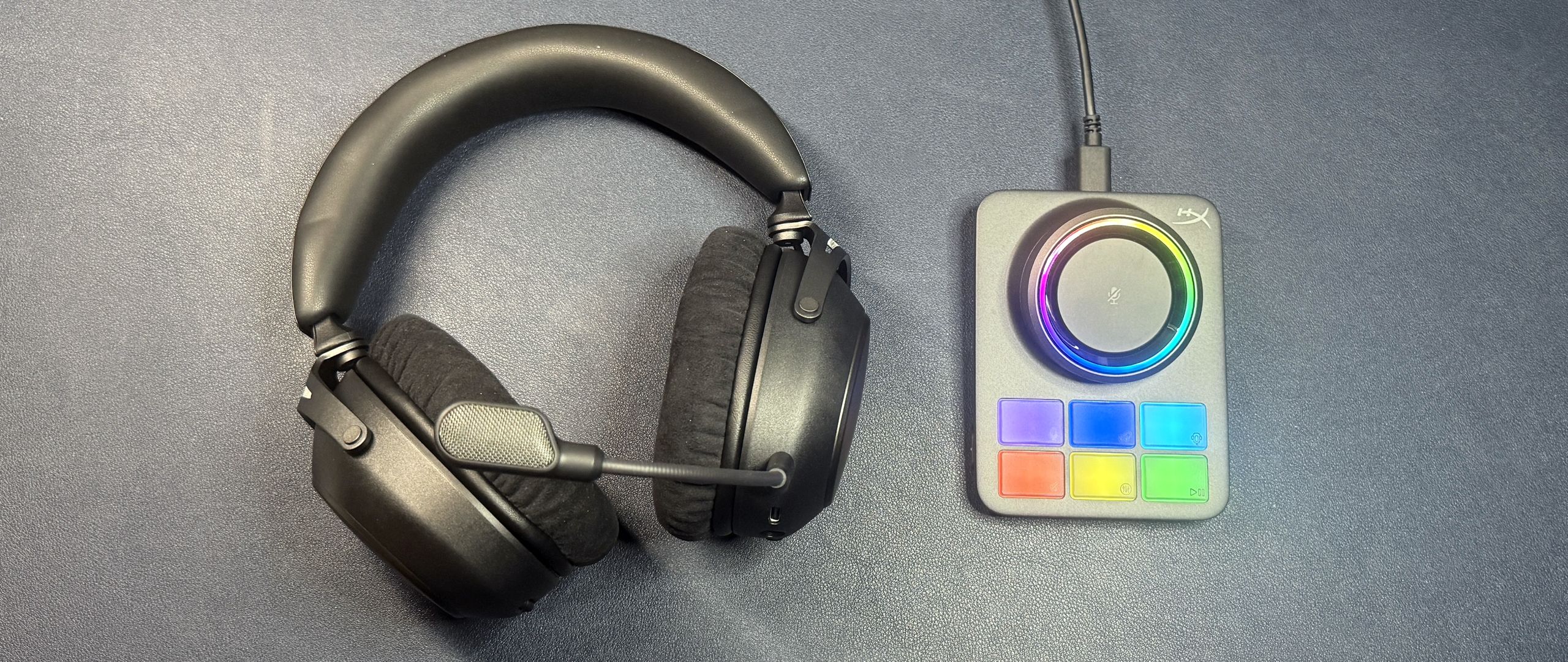
The Cloud Alpha 2 features multi-layer, dual-chamber 53mm angled dynamic drivers with a frequency response range of 20 – 20,000 Hz — the standard for most gaming headsets, though we've seen quite a few premium gaming headsets outside that range recently. Audio on the Cloud Alpha 2 is quite good — it's better than the audio you'll get from the Cloud III / Cloud III Wireless / Cloud III S Wireless' 53mm drivers, but I'm not sure it's $300 good.
I've been playing a lot of Where Winds Meet lately, so I started my testing with that. The details and layers were certainly there — I got all the atmosphere and background conversations as I walked through the streets of Kaifeng, but the soundstage was a little closed in general, which isn't surprising for a closed-back headset. The headset's bass was more powerful than I've noticed in the Cloud III series, but it still wasn't that deep, resonating power I've gotten from headsets like Audeze's Maxwell .
Virtual surround on the Cloud Alpha 2 did sound very good, however, and I was able to pinpoint exactly where sounds were coming from — whether they were voices, gunshots, or footsteps — without needing to second-guess the accuracy. The headset is also well-tuned for first-person shooters in general, as gunshots and footsteps are especially discernible.
Music on the Cloud Alpha 2 is good, but not great; I'd definitely pick a headset like the Maxwell or even Razer's BlackShark V3 Pro over the Cloud Alpha 2 for pure listening. Bass is present but not particularly impressive overall — the sound profile is pretty mid-heavy and there's a lot of sibilance even in the upper mids. While I could hear all the details in songs like Beyonce's Single Ladies and Enya's Orinoco Flow , everything sounded a little too compressed for what I expect from a $300 headset. Overall, the Cloud Alpha 2 does sound better than the Cloud III series, but not much better. And the Cloud III series is significantly cheaper.
The Cloud Alpha 2 has a detachable boom mic that sits at the end of a flexible gooseneck arm, as well as built-in microphones in the earcups, so you can use the headset for chatting on the go. The detachable boom mic is a 10mm omnidirectional mic that's very similar (possibly the same?) as the mic that comes with the Cloud III series. It's a solid headset mic, but it's still a headset mic — vocals are moderately full and warm, and nobody I spoke with had any issues hearing or understanding me, but nobody was particularly impressed with how I sounded, either.
(Image credit: Tom's Hardware) (Image credit: Tom's Hardware) I did appreciate having the tap-to-mute button on the base station, though — while I haven't had the mute button blip issue I had with the Cloud III on any of HyperX's recent headsets, I just really love this whole tap-to-mute thing. The built-in mics are about what you'd expect — not great (my voice sounded a bit thin to listeners), but (probably) better than nothing.
The Cloud Alpha 2 is customizable with HyperX's Ngenuity Beta software — not to be confused with HyperX's non-beta Ngenuity software. You can use the Ngenuity Beta software to customize both the headset and the base station — you can adjust a handful of standard controls on the headset (volume, mic volume, mic monitoring, and game/chat balance), play with the equalizer, and add mic effects and presets such as AI noise reduction, compressor, limiter, and low/mid/high boosts. You can also tweak the headset's virtual spatial audio (direction, distance, etc.), which is already pretty impressive.
(Image credit: Tom's Hardware) (Image credit: Tom's Hardware) (Image credit: Tom's Hardware) (Image credit: Tom's Hardware) (Image credit: Tom's Hardware) You can also use the Ngenuity Beta software to customize the base station. You can customize the light ring with various effects (and layer them), and you can change the colors of the buttons.
The buttons are also fully programmable, though they do come preset with the indicated functions: mic volume, game/chat mix, mic monitoring, mute, EQ settings, and play/pause. You can adjust the mic volume, game/chat mix, and mic monitoring levels by pressing the corresponding button and turning the multi-function wheel (press the button again to exit). Hitting the EQ settings button lets you switch between music, gaming, and voice chat EQ settings (fully customizable), and the mute and play/pause buttons perform as you would expect. But, as I said, the buttons are fully programmable — you can rearrange the preset functions however you like, and you can also map keyboard functions, media keys, and macros.
I will point out that Ngenuity Beta is still in beta — while it's better than it was when the headset launched, the software still leaves quite a bit to be desired. None of the changes you make in the software seem to save directly to the headset or to the base station, so you'll need to be running the software in order to use most of the features. This probably won't be an issue if you're using the headset solely for gaming, but it's definitely a little frustrating if you're hoping this can double as a lifestyle or travel headset.
The original Cloud Alpha boasted a genuinely unmatched battery life of 300 hours over 2.4GHz wireless. The Cloud Alpha 2 is rated for up to 250 hours — which is less than 300, but still more than twice what you'll get from almost any other wireless gaming headset. However, there is a catch: The Cloud Alpha 2 gets 250 hours over 2.4GHz wireless in "adapter mode" — that is, when you're connected to 2.4GHz wireless only . If you're in "dual mode," connected to 2.4GHz wireless and Bluetooth simultaneously, that figure drops to around half of that (125 hours). Don't get me wrong — 125 hours is still excellent, and would be even without simultaneous dual-wireless connectivity, so there's not much to complain about here.
The HyperX Cloud Alpha 2 Wireless is a pretty solid successor to the original HyperX Cloud Alpha Wireless, but there's more competition these days. The Cloud Alpha 2's 250- or 125-hour battery life is very impressive, and the headset itself is very well-built and comfortable. Audio quality isn't nearly as good as you'll find in other similarly-priced headsets, however — the Audeze Maxwell (and the Audeze Maxwell 2 , which we're currently testing) both offer much better audio quality. Of course, gamers don't necessarily need or want pure, perfect audiophile-level quality, and the Cloud Alpha 2 does do a great job with details — especially high-pitched details like footsteps and gunshots — and virtual surround and spatial sound. So the Cloud Alpha 2 Wireless is still a great gaming headset, even if it's not my favorite music-listening headset.
Sarah Jacobsson Purewal is a senior editor at Tom's Hardware covering peripherals, software, and custom builds. You can find more of her work in PCWorld, Macworld, TechHive, CNET, Gizmodo, Tom's Guide, PC Gamer, Men's Health, Men's Fitness, SHAPE, Cosmopolitan, and just about everywhere else. ","collapsible":{"enabled":true,"maxHeight":250,"readMoreText":"Read more","readLessText":"Read less"}}), "https://slice.vanilla.futurecdn.net/13-4-11/js/authorBio.js"); } else { console.error('%c FTE ','background: #9306F9; color: #ffffff','no lazy slice hydration function available'); } Sarah Jacobsson Purewal Social Links Navigation Senior Editor, Peripherals Sarah Jacobsson Purewal is a senior editor at Tom's Hardware covering peripherals, software, and custom builds. You can find more of her work in PCWorld, Macworld, TechHive, CNET, Gizmodo, Tom's Guide, PC Gamer, Men's Health, Men's Fitness, SHAPE, Cosmopolitan, and just about everywhere else.
Key considerations
- Investor positioning can change fast
- Volatility remains possible near catalysts
- Macro rates and liquidity can dominate flows
Reference reading
- https://www.tomshardware.com/peripherals/gaming-headsets/SPONSORED_LINK_URL
- https://www.tomshardware.com/peripherals/gaming-headsets/hyperx-cloud-alpha-2-wireless-review#main
- https://www.tomshardware.com
- Intel Q4 earnings reveal rocky path to recovery following weakest full-year revenue since 2010 — Intel Foundry losses continue as 18A begins ramp, but supply ch
- DDR5 RAM is actually discounted for the first time in months — Corsair's 32GB Vengeance kit at Amazon is now one of the cheapest available options
- Combat insane price rises with this Newegg 9800X3D, RAM, and X870 motherboard bundle — save $269.99 over buying the parts individually
- From Pilot to Profit: Survey Reveals the Financial Services Industry Is Doubling Down on AI Investment and Open Source
- Screen-ripping 300 Hz gaming monitor crashes to just $229, touts 1440p resolution and 1ms response time — save $220 on the LG 27-inch UltraGear 27G640A-B
Informational only. No financial advice. Do your own research.