
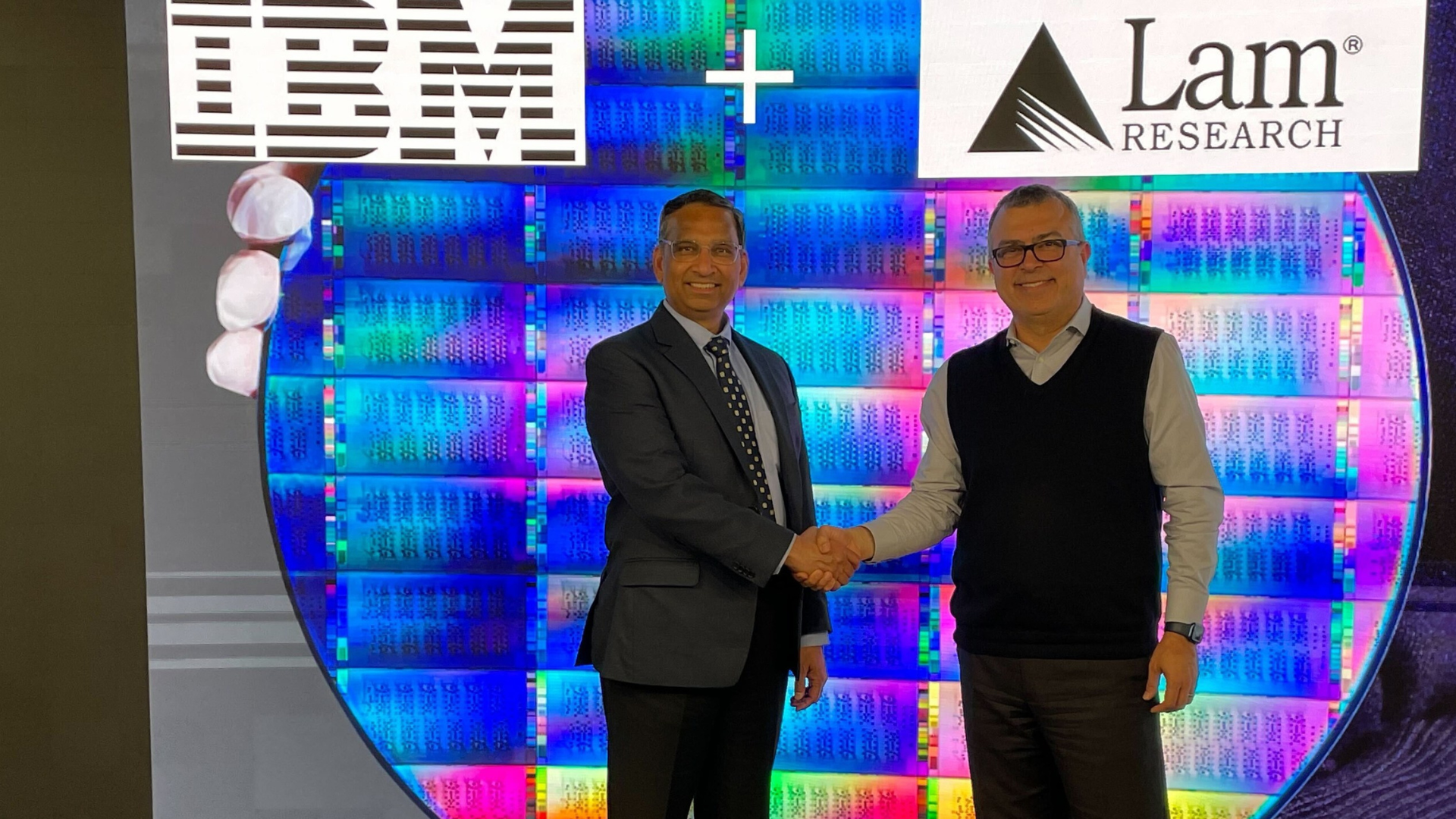
Five-year collaboration targets nanostack devices and backside power delivery at sub-1nm nodes.
When you purchase through links on our site, we may earn an affiliate commission. Here’s how it works .
IBM and Lam Research have announced a five-year collaboration to develop the materials and fabrication processes needed to scale logic chips beyond 1nm using High NA EUV lithography and Lam's Aether dry resist technology. The work will take place at IBM Research's facilities at the NY Creates Albany NanoTech Complex in Albany, New York.
The two companies have worked together for more than a decade, contributing to 7nm process development, nanosheet transistor architecture, and early EUV process integration, with IBM unveiling what it described as the world's first 2nm node chip in 2021 as part of that ongoing partnership. Under the new agreement, the focus will shift to validating full process flows for nanosheet and nanostack device architectures and backside power delivery, using Lam's Kiyo and Akara etch platforms, Striker and ALTUS Halo deposition systems, and Aether dry resist.
Conventional EUV lithography relies on chemically amplified resists, wet-process materials that struggle with the tighter tolerances demanded by high-NA EUV scanners . Meanwhile, Lam's Aether technology is a dry resist, deposited via vapor-phase precursors rather than spin-coating, and developed using plasma-based dry processes.
You may like Intel installs industry's first commercial High-NA EUV lithography tool New 1.4nm nanoimprint lithography template could reduce the need for EUV steps in advanced process nodes ASML makes breakthrough in EUV chipmaking tech, plans to increase speed by 50% by 2030 Aether’s metal-organic compounds absorb three to five times more EUV light than traditional carbon-based resist materials, which reduces the exposure dose needed per wafer pass and helps maintain single-print patterning at advanced nodes without resorting to more expensive multi-patterning. In January, Lam announced Aether had been selected by a leading memory manufacturer as the production tool of record for its most advanced DRAM processes, though it did not name the manufacturer.
According to the joint announcement, the collaboration seeks to enable High NA EUV patterns to be reliably transferred into real device layers at high yield, and to accelerate industry adoption of High NA EUV for next-generation interconnect and device patterning. That yield-at-transfer problem is where Lam's Aether dry resist technology has an edge over conventional wet processes, because fewer steps between exposure and etch mean less opportunity for pattern degradation at tighter geometries.
Meanwhile, nanosheet transistors stack multiple thin sheets of silicon to increase drive current without widening the device footprint. The press release confirms the teams will build and validate full process flows for both nanosheet and nanostack devices, alongside backside power delivery, which routes power through the back of the wafer to free up front-side interconnect layers for signal routing.
“Together, these capabilities are aimed at allowing High‑NA EUV patterns to be reliably transferred into real device layers with high yield and enabling continued scaling, improved performance, and viable paths to production for future logic devices,” says the press release.
Get Tom's Hardware's best news and in-depth reviews, straight to your inbox.
Key considerations
- Investor positioning can change fast
- Volatility remains possible near catalysts
- Macro rates and liquidity can dominate flows
Reference reading
- https://www.tomshardware.com/tech-industry/semiconductors/SPONSORED_LINK_URL
- https://www.tomshardware.com/tech-industry/semiconductors/ibm-and-lam-research-team-up-on-high-na-euv#main
- https://www.tomshardware.com
- EA lays off staff across Battlefield-related studios in "alignment" move as game bleeds players — billions in revenue and record sales figures not enough to sav
- SK hynix introduces turbocharged LPDDR6, 33% faster and 20% more power efficient than LPDDR5X — 16Gb chips deliver 10.7 Gbps, uses 10nm node
- New NVIDIA Nemotron 3 Super Delivers 5x Higher Throughput for Agentic AI
- Get an X870 Motherboard, 32GB of RAM, a 1050W Power supply, and a Montech King 95 Pro case for only $774 — save over $220 on this 4-item combo from Newegg
- Dynamic MFG comes to RTX 50-series GPUs to push monitor refresh rates to the max — more flexible mode with 5x and 6x multipliers arrives March 31
Informational only. No financial advice. Do your own research.