
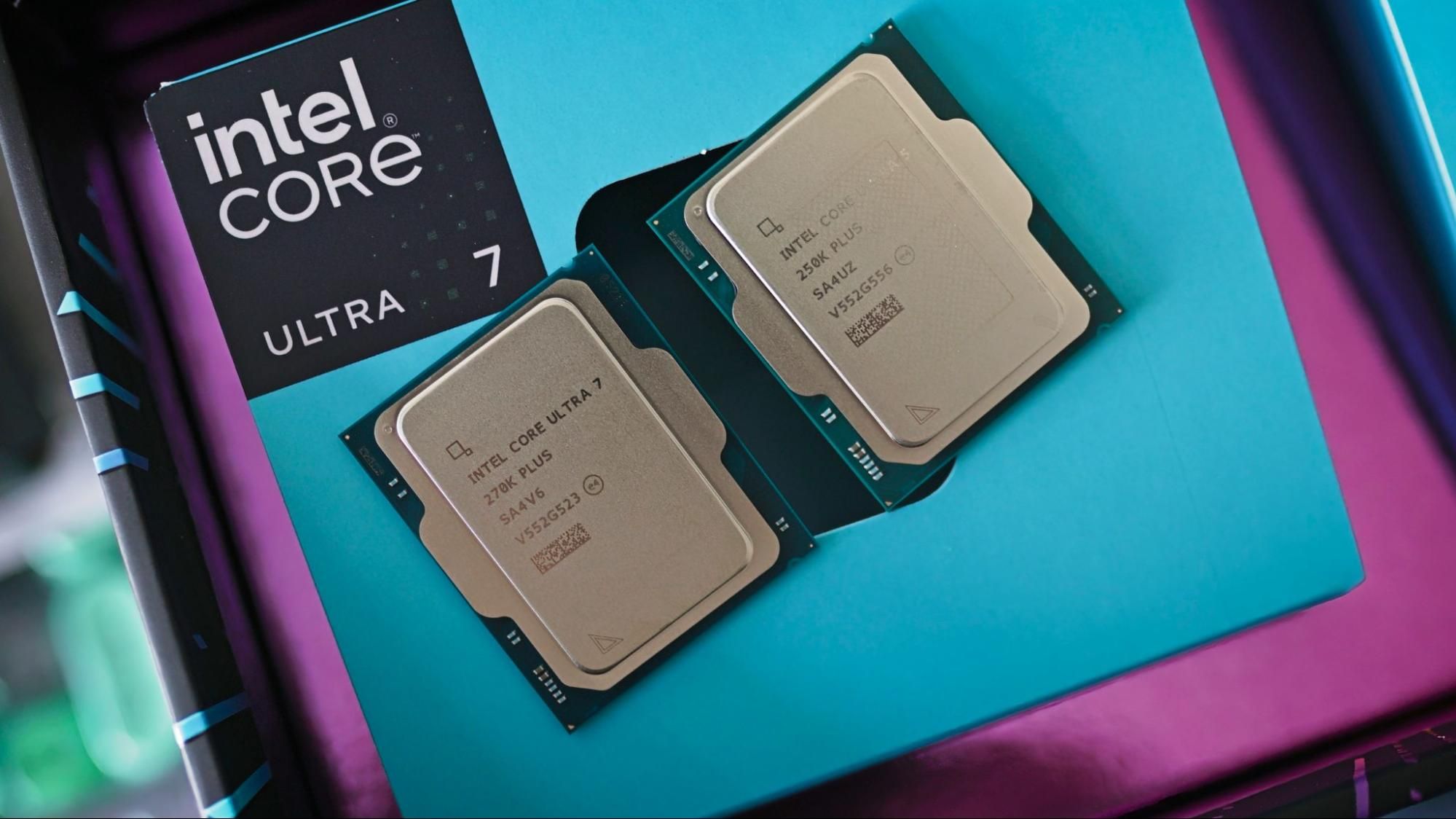
Outside of the chips themselves, Intel is bringing faster memory speeds and early support for 4R CUDIMMs on select 800-series motherboards. For standard DDR5 DIMMs, Intel is upping the officially supported speeds to 7,200MT/s, which is a speed that even standard Arrow Lake chips can maintain, though it isn’t officially supported. With the Boost BIOS profile, warrantied speeds go up to 8,000MT/s.
4R CUDIMM support (four-rank) allows much higher memory capacities on consumer-grade motherboards, offering up to 128GB of capacity per DIMM. MSI and ADATA were the first to demonstrate stability of 4R CUDIMMs in November of last year, and Intel says it’s opening up support for them on new 800-series motherboards launching throughout 2026.
(Image credit: Intel) (Image credit: Intel) (Image credit: Intel) (Image credit: Intel) (Image credit: Intel) On average, Intel claims the Core Ultra 7 270K Plus is 15% faster than the Core Ultra 7 265K, with a peak as high as up to 39% in Shadow of the Tomb Raider, according to Intel’s testing . This title, along with Hitman 3, where the 270K showed a 22% uplift, use iBOT. Elsewhere, the gains are less pronounced but still present. The 270K posted up to a 12% boost in F1 25 and up to 9% in Star Wars Outlaws, neither of which use iBOT.
Intel Core Ultra 7 270K Plus and Core Ultra 9 290K Plus spotted at Indian retailer
Intel's upcoming Core Ultra 9 290K Plus posts ~10% better Geekbench scores than current flagship
Intel’s comeback weapon to fight AMD reportedly drops this spring — Core Ultra 200K Plus and 200HX Plus CPUs set for March or April launch
The Core Ultra 5 250K Plus is 13% faster than the Core Ultra 5 245K on average, according to Intel. Once again, the largest gains come from games with iBOT; Borderlands 3 at 20% and Far Cry 6 at 24%. Outside of iBOT, the gains are still solid, with Battlefield 6 showing a 10% uplift and Star Wars Outlaws climbing by 8%. For all game testing, Intel used a 1080p resolution at High settings and took the median result of three runs. You can see the system configurations in the slides above.
In applications, Intel claims up to a 2x performance improvement compared to AMD’s Zen 5 competition, but it’s not exactly a fair battle. Intel’s newest CPUs come with massive core arrays compared to the homogenous architecture of Zen 5. It’s a battle that Intel is always going to win. However, there is something to be said about getting a CPU with 24 cores for $300, especially if you plan on running heavily-threaded workloads like Blender or Handbrake.
That might be the most important takeaway about Arrow Lake Refresh: the price. Intel has drastically cut the list price of these chips compared to their Arrow Lake counterparts. The Core Ultra 5 250K Plus starts at $199, while the Core Ultra 7 270K Plus starts at $299, putting the CPUs in direct competition with AMD’s Ryzen 5 9600X and Ryzen 7 9700X, respectively. The Core Ultra 5 245K originally launched for over $300, while the Core Ultra 7 265K launched at $400.
The price cuts are a reflection of what we can see in the market right now — the Core Ultra 5 245K sells for about $200, while the 265K is available for anywhere from $280 to $310. These prices make Arrow Lake Refresh significantly more competitive for gamers at budget price points. Although AMD holds a clear lead in gaming performance with the Ryzen 7 9850X3D , Arrow Lake Refresh comes in at a much lower price.
Extrapolating out the performance claims, the Core Ultra 7 270K Plus bodes particularly well. Based on our own testing, the Ryzen 7 9700X is about 4% faster than the Core Ultra 7 265K at 1080p in games. If Intel’s 15% claim holds up, Arrow Lake Refresh takes the lead in this price bracket. More importantly, Intel’s Core i7-14700K is around 11% faster than the Core Ultra 7 265K. Once again, that 15% jump would put Intel on top in this price bracket, and finally give Intel a faster gaming CPU than its 14th-Gen offerings.
For now, that’s just speculation. Thankfully, we won’t have to wait long to see Arrow Lake Refresh CPUs in action. Intel says you’ll be able to find Core Ultra 200S Plus CPUs at retailers starting on March 26. Our test benches are already running at full tilt with Intel’s latest, so we’ll have more to share on performance in full reviews shortly.
Follow Tom's Hardware on Google News , or add us as a preferred source , to get our latest news, analysis, & reviews in your feeds.
Jake Roach is the Senior CPU Analyst at Tom\u2019s Hardware, writing reviews, news, and features about the latest consumer and workstation processors. ","collapsible":{"enabled":true,"maxHeight":250,"readMoreText":"Read more","readLessText":"Read less"}}), "https://slice.vanilla.futurecdn.net/13-4-18/js/authorBio.js"); } else { console.error('%c FTE ','background: #9306F9; color: #ffffff','no lazy slice hydration function available'); } Jake Roach Social Links Navigation Senior Analyst, CPUs Jake Roach is the Senior CPU Analyst at Tom’s Hardware, writing reviews, news, and features about the latest consumer and workstation processors.
Gururu All they need to do is get these chips faster than Raptor Lake and they can call it a temporary success. Reply
wussupi83 Hmm where does this leave the 285k? Will it be worth the premium over the 270k? Reply
Pierce2623 Are they giving a free one to the beta testers who bought the first Arrow Lake? Reply
philged Seems impossible to get to a 15% boost in gaming performance by adding 4 E-cores and going from 5.2Ghz to 5.3Ghz with zero underlying architecture changes. Reply
thesyndrome So they are going to release faster products at lower prices? That's great for the consumers…..who didn't already support Intel by being early adopters to Arrow-Lake At that point, I would never buy a newly-released Intel product, because odds are you are going to be left in the lurch when everyone else gets a better deal Reply
helper800 philged said: Seems impossible to get to a 15% boost in gaming performance by adding 4 E-cores and going from 5.2Ghz to 5.3Ghz with zero underlying architecture changes. Faster memory access definitely can get you into the low ~10% performance gains. We shall see when they release if they are at where they claimed to be. I expect them to be within margin of error of the 14X00K CPUs now, and anything less is an L. Reply
hotaru251 The headline claim is 15% higher gaming performance at 1080p compared to stock Arrow Lake chips How about using a game that is heavily CPU intensive to test these out as i HIGHLY doubt its actually 15% apples to apples as stock can vary based on MB vendors "stock". Reply
usertests wussupi83 said: Hmm where does this leave the 285k? Will it be worth the premium over the 270k? If the results are not outliers and it's because of this: In addition to higher core counts, Intel boosted the speed of the memory controller by up to 900MHz. Memory (and core-to-core) latency was one of the weaker aspects of the Arrow Lake architecture initially, and Intel claims this boost will help drive “system latency down and gaming performance up.” Then no, the 285K is now worth less than the 270K at $300. Some multithreading workloads that aren't memory/latency sensitive could be a little faster than than the 270K, since the 285K can clock 200 MHz higher, but it's probably less than +5%, or even +2%. If I'm overhyping this, please correct me. Reply
-Fran- philged said: Seems impossible to get to a 15% boost in gaming performance by adding 4 E-cores and going from 5.2Ghz to 5.3Ghz with zero underlying architecture changes. There's a few internal tweaks they can do in terms of interconnect speeds which aren't usually in the marketing material, but this is as far as I would be giving Intel the benefit of the doubt there. Also, doing that would only see that massive jump on heavily low threaded games that share the BUS with the ecores in Failure Arrow Lake; think Civ games and such. On the flipside, if they did get such massive improvements, then it could also mean they're treating these as fireworks, much like they did with Raptor Lake and their refresh. Regards. Reply
User of Computers philged said: Seems impossible to get to a 15% boost in gaming performance by adding 4 E-cores and going from 5.2Ghz to 5.3Ghz with zero underlying architecture changes. it's like 14th gen with APO, it's mostly/entirely due to software tweaks. With that being said, this does have a nice boost to D2D clocks which should help with improved memory performance. Also, these thingsa are an absolute steal of a deal. $300 for a 9950X? Yes please! Reply
Key considerations
- Investor positioning can change fast
- Volatility remains possible near catalysts
- Macro rates and liquidity can dominate flows
Reference reading
- https://www.tomshardware.com/pc-components/cpus/SPONSORED_LINK_URL
- https://www.tomshardware.com/pc-components/cpus/intel-claims-arrow-lake-refresh-cpus-deliver-15-percent-higher-gaming-performance-and-multi-threaded-boost-core-ultra-7-270k-and-core-ultra-5-250k-come-with-more-cores-faster-memory-and-a-price-cut#main
- https://www.tomshardware.com
- This brilliant Hoto electric screwdriver is down to a record-low £28.48 right now — 12-bit precision kit with USB-C charging is great for PC builds and DIY proj
- America and Japan may join forces to manufacture displays in the US — New $13 billion fab proposed by Japan Display Inc. to counter Chinese dominance
- Intel shares XeSS 3.0 SDK for game devs with 3x and 4x MFG modes — but it still hasn't followed through on its open-source promise
- US RAM crisis hits boiling point as AI mania wipes out all 32GB DDR5 kits under $359 — cheaper kits vanish from shelves within seconds of listing
- From Radiology to Drug Discovery, Survey Reveals AI Is Delivering Clear Return on Investment in Healthcare
Informational only. No financial advice. Do your own research.