
When you purchase through links on our site, we may earn an affiliate commission. Here’s how it works .
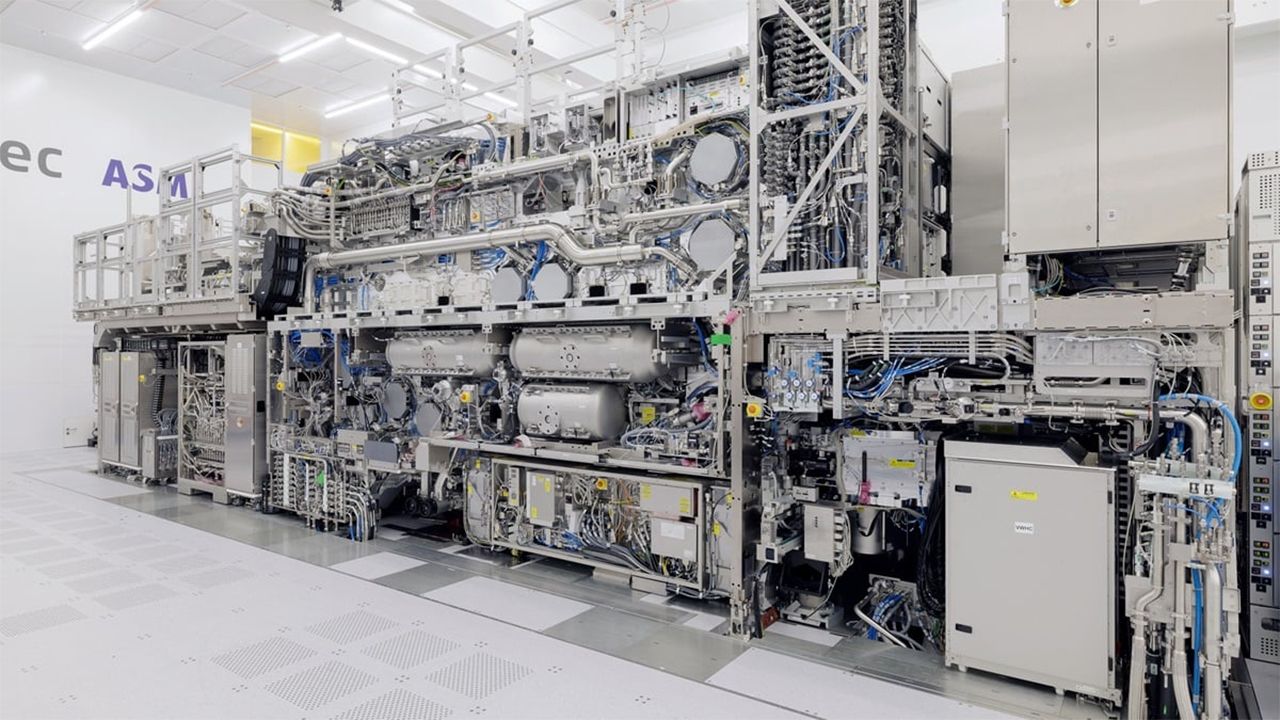
(Image credit: ASML) Share Share by: Copy link Facebook X Whatsapp Reddit Flipboard Share this article Join the conversation Follow us Add us as a preferred source on Google Intel announced that it had installed ASML's Twinscan EXE:5200B, the industry's first High-NA lithography tool with 0.55 numerical aperture projection optics made for commercial chip production. The tool has passed acceptance testing and will be used for development of Intel's 14A fabrication process, which will be the world's first node to rely on High-NA EUV scanners for its most critical layers. The achievement indicates that High-NA EUV lithography is moving beyond early experimentation toward high-volume manufacturing (HVM).
ASML's Twinscan EXE:5200B builds on the 1st Generation EXE:5000 platform that Intel received in 2023 for its Oregon R&D fab. The new tool can 'print' chips with an 8nm resolution, enabling scaling beyond which is currently possible with Low-NA EUV tools that offer a 13nm resolution without using multi-patterning. Unlike the EXE:5000, the EXE:5200B is capable of processing 175 wafers per hour at a 50 mJ/cm² dose (up from 185 wafers per hour at at a 20 mJ/cm² dose) and achieves overlay accuracy of 0.7 nanometers, a critical parameter as feature dimensions continue to shrink.
To boost performance, the scanner integrates a higher-power EUV light source to enable faster wafer exposures at a 50 mJ/cm² dose. This in turn supports workable resist/process windows with strong image contrast while minimizing line-edge roughness (LER) and line-width roughness (LWR), which tend to be challenging with modern production nodes.
ASML launches revolutionary lithography scanner for advanced 3D chip packaging — Twinscan XT:260 machine quadruples throughput
New 1.4nm nanoimprint lithography template could reduce the need for EUV steps in advanced process nodes
American startup Substrate promises 2nm-class chipmaking with particle accelerators, at a tenth of the cost of EUV
ASML and Intel did not limit their work to the optics and light source. They also reworked the wafer stocker system, which is responsible for how wafers are stored, queued, and moved in and out of the scanner. For next-generation tools, this component of the system has a direct impact on both productivity and patterning accuracy.
The updated stocker design improves lot flow and wafer handling to make sure that wafers arrive at the exposure stage in a more predictable state. At the same time, it provides tighter thermal control, keeping wafers and carriers at stable temperatures before and after exposure, an important factor as even tiny temperature variations can cause wafer expansion or contraction, leading to overlay errors, which in turn leads to an increase in defects and decrease of yields.
In addition, by reducing thermal and mechanical variation, the new architecture helps to minimize drift over long runs, thus enabling the scanner to maintain stable behavior and reducing the necessity for frequent recalibration. This stability will be particularly important for multi-pass and multi-exposure patterning, which will be inevitably used in the coming years for sub-1nm process technologies.
One of EXE:5200B's parameters that is hard to overestimate is its overlay performance of 0.7 nm, which was achieved by advancements of stage control, sensor calibration, and environmental isolation. Overlay performance is crucially important for next-generation process technologies as even tiny alignment errors can translate into yield losses.
Get Tom's Hardware's best news and in-depth reviews, straight to your inbox.
Key considerations
- Investor positioning can change fast
- Volatility remains possible near catalysts
- Macro rates and liquidity can dominate flows
Reference reading
- https://www.tomshardware.com/tech-industry/semiconductors/SPONSORED_LINK_URL
- https://www.tomshardware.com/tech-industry/semiconductors/intel-installs-industrys-first-commercial-high-na-euv-lithography-tool-asml-twinscan-exe-5200b-sets-the-stage-for-14a#main
- https://www.tomshardware.com
- Sales of chip production equipment to reach $156 billion by 2027 — China, Taiwan, and Korea lead intense demand
- Anycubic’s ‘Dual’ Resin Printer, Photon P1 is out — Supports double the color, double the material
- Corsair MP700 Pro XT 2TB SSD review: the fastest SSD ever has landed with a record 3.3 million IOPS and nearly 15 GB/s
- Don't wait if you're planning to upgrade your RAM or SSD, Kingston rep warns — says 'prices will continue to go up,' NAND costs up 246%
- Grab a punchy RTX 5060 Ti-powered iBuypower gaming PC for less than $900 — it even packs 32GB of DDR5 RGB RAM and an 8-core Ryzen processor
Informational only. No financial advice. Do your own research.