
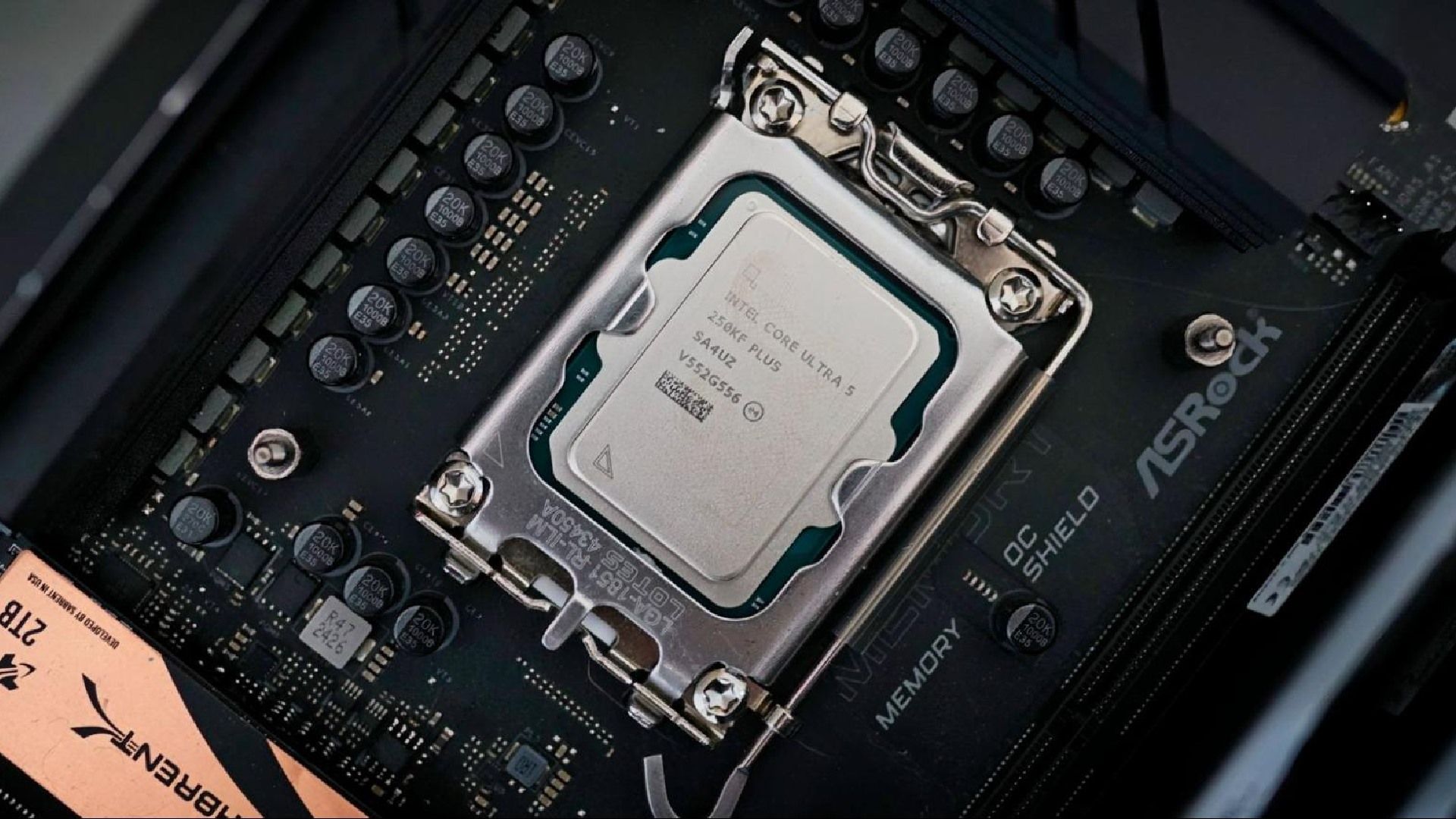
So it goes that we have the Core Ultra 5 250KF Plus, which is identical to the 250K, just without the integrated GPU. That's a very slight bummer even for those intending to use powerful discrete gaming GPUs, as it can be handy for troubleshooting (or allowing you to continue using your PC when that big GPU melts its power connector and needs an RMA), but ultimately, the integrated GPU is just inactive silicon in most PC gamers' rigs.
AMD does hold the gaming crown in some price bands, but the truth is, there are plenty of PC gamers out there who are all-around power users who make use of their PCs for a lot more than playing video games. You can buy a Core Ultra 5 250KF Plus for $199 and enjoy the multitasking horsepower of eighteen CPU cores cranking at 5.3 GHz, or for the same price, you can pick up a Ryzen 5 9600X , with a whopping six cores. The comparison isn't even salient for multi-core workloads and multi-tasking usage, and in fact, the Intel chip usually wins in gaming against the 9600X anyway.
That's right: AMD's Ryzen processors with 3D V-Cache are dominant in gaming workloads, and the Core Ultra 200S Plus series doesn't change that. However, 3D V-Cache processors basically start at $350 with the Ryzen 7 7800X3D outside of some Micro Center doorbusters . That's a brilliant processor, don't get me wrong, and the gaming performance is still a full step ahead of the Intel parts. If you're not gaming in a low resolution (like 1080p) with something like a GeForce RTX 4080 or Radeon RX 9070 XT, though, you'll likely never notice the difference anyway—certainly not the way you'll notice 65% faster render times in HandBrake or 57% faster code compiles.
(Image credit: Tom's Hardware) (Image credit: Tom's Hardware) (Image credit: Tom's Hardware) (Image credit: Tom's Hardware) (Image credit: Tom's Hardware) (Image credit: Tom's Hardware) (Image credit: Tom's Hardware) (Image credit: Tom's Hardware) (Image credit: Tom's Hardware) (Image credit: Tom's Hardware) (Image credit: Tom's Hardware) (Image credit: Tom's Hardware) (Image credit: Tom's Hardware) (Image credit: Tom's Hardware) (Image credit: Tom's Hardware) (Image credit: Tom's Hardware) (Image credit: Tom's Hardware) (Image credit: Tom's Hardware) (Image credit: Tom's Hardware) (Image credit: Tom's Hardware) (Image credit: Tom's Hardware) (Image credit: Tom's Hardware) (Image credit: Tom's Hardware) (Image credit: Tom's Hardware) (Image credit: Tom's Hardware) (Image credit: Tom's Hardware) (Image credit: Tom's Hardware) (Image credit: Tom's Hardware) (Image credit: Tom's Hardware) (Image credit: Tom's Hardware) (Image credit: Tom's Hardware) (Image credit: Tom's Hardware) (Image credit: Tom's Hardware) (Image credit: Tom's Hardware) (Image credit: Tom's Hardware) (Image credit: Tom's Hardware) (Image credit: Tom's Hardware) (Image credit: Tom's Hardware) (Image credit: Tom's Hardware) (Image credit: Tom's Hardware) (Image credit: Tom's Hardware) (Image credit: Tom's Hardware) (Image credit: Tom's Hardware) (Image credit: Tom's Hardware) (Image credit: Tom's Hardware) (Image credit: Tom's Hardware) (Image credit: Tom's Hardware) There are a few caveats with the newer chips; you'll want the fastest RAM you can afford to throw at the chip (ideally 7200 MT/s or better, although anything will work), and you'll also need to install Intel's Platform Performance Package to get the Application Performance Optimization and Binary Optimization Tool . Fortunately, Intel has made that latter part a one-step process with an all-in-one package instead of requiring users to separately install packages for DTT, PTT, APO, and various other three-letter acronyms.
We can't imagine the new Arrow Lake Refresh processors are any less expensive for Intel to fabricate and package, so the company is likely taking a bath on its margins to move these chips. That doesn't matter much to the end-users, though; thanks to Intel's generosity (or desperation), you can pick up a seriously potent 18-core processor for just two-hundred bucks . It's a whole different world from just a few years ago, when Intel's top-end CPU for $539 had a measly eight cores while AMD was shipping 16-core behemoths.
Get Tom's Hardware's best news and in-depth reviews, straight to your inbox.
Key considerations
- Investor positioning can change fast
- Volatility remains possible near catalysts
- Macro rates and liquidity can dominate flows
Reference reading
- https://www.tomshardware.com/pc-components/cpus/SPONSORED_LINK_URL
- https://www.tomshardware.com/pc-components/cpus/intels-potent-18-core-core-ultra-5-250kf-plus-cpu-lands-at-retail-for-under-usd200#main
- https://www.tomshardware.com
- Report claims Arm chips will power 90% of AI servers based on custom processors in 2029 — x86 and RISC-V on the outside looking in
- Report claims Arm chips will power 90% of AI servers based on custom processors in 2029 — x86 and RISC-V on the outside looking in
- Hands-on with Modos Tech 13.3-inch e-paper monitors — we tried the current Dev Kit model and the next-gen Modos Flow touch
- Sequoia Capital shares founder’s 1977 memo for investing in Apple — initial $600,000 investment is worth $26.4 billion today, firm said it was ‘tough to do this
- Smooth Moves: 90 Frames-Per-Second Virtual Reality Arrives on GeForce NOW
Informational only. No financial advice. Do your own research.