
Hassam Nasir is a die-hard hardware enthusiast with years of experience as a tech editor and writer, focusing on detailed CPU comparisons and general hardware news. When he\u2019s not working, you\u2019ll find him bending tubes for his ever-evolving custom water-loop gaming rig or benchmarking the latest CPUs and GPUs just for fun. ","collapsible":{"enabled":true,"maxHeight":250,"readMoreText":"Read more","readLessText":"Read less"}}), "https://slice.vanilla.futurecdn.net/13-4-19/js/authorBio.js"); } else { console.error('%c FTE ','background: #9306F9; color: #ffffff','no lazy slice hydration function available'); } Hassam Nasir Social Links Navigation Contributing Writer Hassam Nasir is a die-hard hardware enthusiast with years of experience as a tech editor and writer, focusing on detailed CPU comparisons and general hardware news. When he’s not working, you’ll find him bending tubes for his ever-evolving custom water-loop gaming rig or benchmarking the latest CPUs and GPUs just for fun.
usertests At least the detail about dual-channel memory is clearly wrong. However, this new leak could be pointing to a 10W cTDP for all Wildcat Lake SKUs, which could be good enough for fanless/low-power devices. The Alder Lake-N/Twin Lake minimum was 6-7W depending on SKU. The prevalence of 304/305 with half the graphics remains to be seen. Alder Lake-N quad-cores with reduced graphics were the most popular and affordable SKUs. Reply
Gururu Too many SKUs giving me a headache. I guess if you are buying one of these pre-builts, may not care what is in it. Reply
usertests Gururu said: Too many SKUs giving me a headache. I guess if you are buying one of these pre-builts, may not care what is in it. If you're reading Tom's, you already know too much. But if it's not enough, you just look up the SKUs for that generation to find out that the Ryzen AI 7 445 is a hidden disgrace with 8 MiB of L3 cache, or the Core 7 360 is a lowly Cat. Reply
usertests Now, to be clear, prior reports have already revealed the full Wildcat Lake family — we're expecting six SKUs in total As of today, we're up to eight so far. Here they are: Intel Core 7 360: 2P + 4LPE + 2Xe3, 4.8 GHz P-core turbo, SIPP Intel Core 7 350: 2P + 4LPE + 2Xe3, 4.8 GHz Intel Core 5 330: 2P + 4LPE + 2Xe3, 4.6 GHz, SIPP Intel Core 5 320: 2P + 4LPE + 2Xe3, 4.6 GHz Intel Core 5 315: 2P + 4LPE + 2Xe3, 4.4 GHz Intel Core 3 310: 2P + 4LPE Intel Core 3 305: 2P + 4LPE + 1Xe3, 4.4 GHz Intel Core 3 304: 1P + 4LPE + 1Xe3, 4.3 GHz SIPP is an enterprise feature package, so you could regard those as the "Pro" SKUs. Not much is known about the Core 3 310 yet, but it's probably similar to the 315 or 305. Intel is using the single-threaded performance to justify their naming scheme. For Wildcat Lake, they've dropped "Ultra", but the P-core turbo aligns with similarly named Panther Lake parts: Core Ultra 7 365 = 4.8 GHz Core Ultra 7 355 = 4.7 GHz Core Ultra 5 335 = 4.6 GHz Core Ultra 5 332 = 4.4 GHz Core Ultra 5 325 = 4.5 GHz Core Ultra 5 322 = 4.4 GHz Theoretically, you can get better single-threaded performance from a Core 7 360 than a Core Ultra 5 322. But Wildcat Lake has half the L3 cache of these parts, less memory bandwidth, etc. so it's not always a direct comparison. Reply
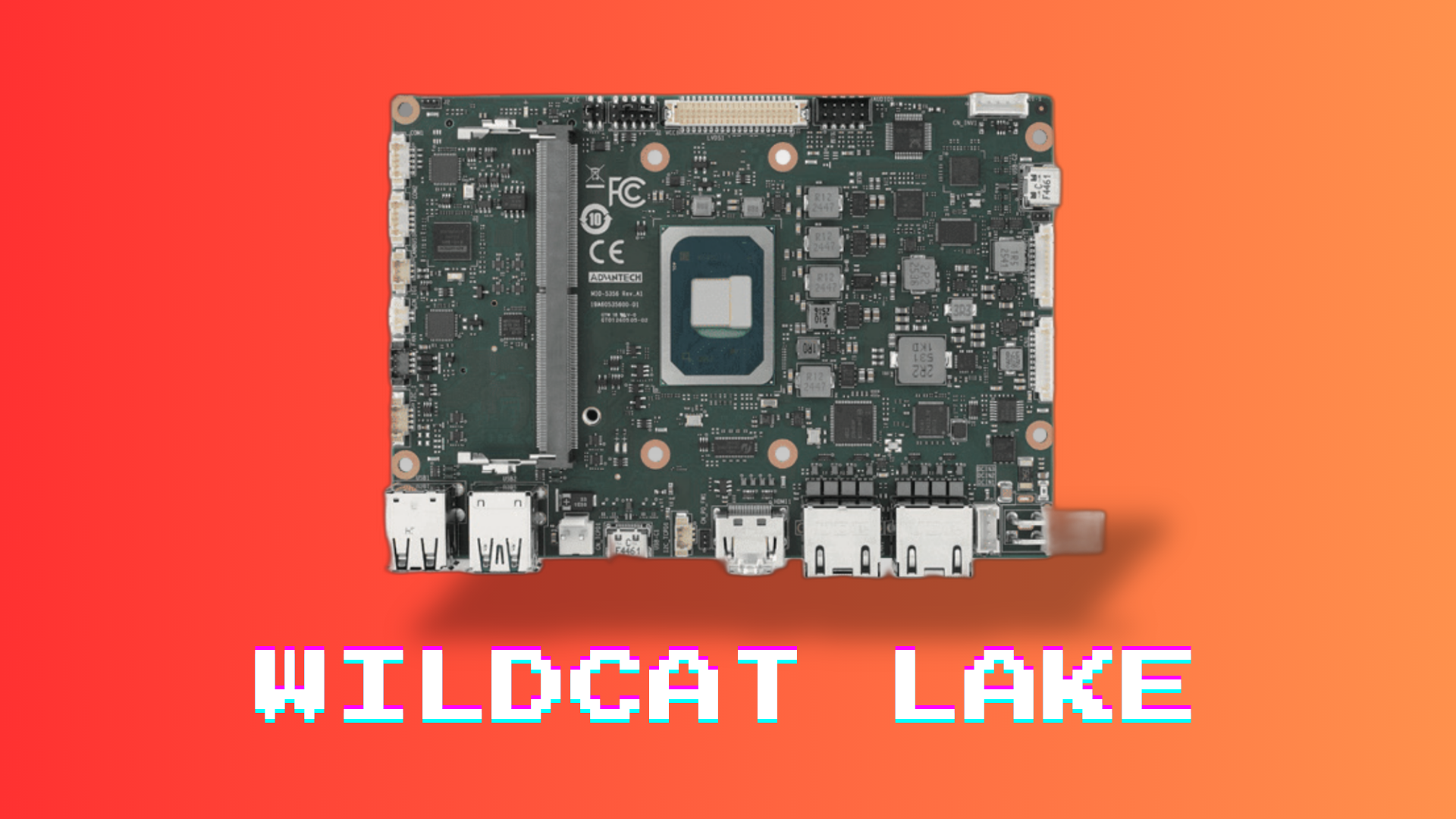
bit_user Block diagram shows M-key M.2 slot connectivity is just x2. 🤮 I guess it's not too bad, if it's PCIe 4.0. Alder Lake-N had only PCIe 3.0, but it could do x4, depending on the implementation. I hope it can do in-band ECC. Reply
usertests bit_user said: Block diagram shows M-key M.2 slot connectivity is just x2. 🤮 Is the block diagram showing us what Wildcat Lake is capable of, or how Advantech has chosen to allocate the available lanes for its product line? Going from 9x PCIe 3.0 lanes to 6x PCIe 4.0 lanes means that Wildcat Lake has 33% more bandwidth to spare, but tough choices will need to be made about how to use the lanes. Switching from PCIe 3.0 x4 to PCIe 4.0 x2 is an obvious way to claw back 2 lanes without changing the maximum storage speed from the previous generation. But I assume other products could be using PCIe 4.0 x4 for an SSD. Laptops in particular probably don't need to support the variety of I/O that an industrial board does. Reply
abufrejoval Just how 'bad' are these LPE cores? Or how meaningful is the differentiation between E and LP-E when both use Darkmont designs? Does that imply any functional differentiation or is it just about clocks (or marketing)? On the bigger Panther Lake designs, I guess it determines which chiplet holds them, here I'm guessing Intel is using a monolithic "CCD" and an "IOD" (two visible chips on the carrier). From an Atom point of view, it's nice to have P cores added. From an APU point of view, it seems very meagre, while I'm sure it will carry an Intel price tag, which makes it more expensive than entry level notebook variants. My cheapest (less than €200 last June) Topton Zen3 5825U (6nm TSMC) Mini-ITX board with 8 SMT P cores likely will lose single core races against this one, but as soon as a few more cores need to turn 15 Watts into a maximum of compute, I'm less sure this will win, while the Ryzen APU also has plenty more in terms of I/O and PCIe lanes, two SO-DIMM sockets and most likely a much more powerful iGPU. On the flip side the AMD won't work on passive cooling, 15 Watts means something rather different for those two. As for Neo competition, mostly it might not be cheaper. But you really need to look towards mobile ARM chips for Neo competition, stuff used for making Android tablets. Reply
bit_user usertests said: Is the block diagram showing us what Wildcat Lake is capable of, or how Advantech has chosen to allocate the available lanes for its product line? Fair point. It does look more like the latter (i.e. Adantech's implementation) than the former (i.e. the SoC's capabilities). usertests said: Going from 9x PCIe 3.0 lanes to 6x PCIe 4.0 lanes means that Wildcat Lake has 33% more bandwidth to spare, but tough choices will need to be made about how to use the lanes. Switching from PCIe 3.0 x4 to PCIe 4.0 x2 is an obvious way to claw back 2 lanes without changing the maximum storage speed from the previous generation. Very few boards that I looked at actually devoted x4 to the M.2 slot. ODROID's H4 did, but only if you weren't using the SATA ports. Those boards lacked other things, like support for Wifi/Bluetooth. To get that, you had to use a USB adapter. Reply
usertests abufrejoval said: Just how 'bad' are these LPE cores? Or how meaningful is the differentiation between E and LP-E when both use Darkmont designs? Does that imply any functional differentiation or is it just about clocks (or marketing)? I think the big difference is that the Darkmont LPE cores are unlikely to have any access to the L3 cache, so they will be accessing main memory often. This is not confirmed yet, but should be the case for all previous LPE cores as far as I know. So they will be very fast in some situations (better IPC than Raptor Lake, with turbo clocks comparable to Alder Lake-N and Twin Lake), but could fall flat in others. Chips and Cheese has done some testing of LPE cores, showing some of the effects of no L3 cache: Comparing Crestmonts: No L3 Hurts It appears that Wildcat Lake only has 6 MiB of L3 cache, which is half of the low power Panther Lake parts, but the same amount as Alder Lake-N. Alder Lake-N shared 6 MiB between up to 8 E-cores, but here we'll probably see that shared only between the 1-2 P-cores. abufrejoval said: On the flip side the AMD won't work on passive cooling, 15 Watts means something rather different for those two. The block diagram points to Wildcat Lake working at as low as 10 Watts. Which was necessary to even begin to consider this a drop-in replacement for Alder Lake-N. abufrejoval said: As for Neo competition, mostly it might not be cheaper. But you really need to look towards mobile ARM chips for Neo competition, stuff used for making Android tablets. MacBook Neo is currently a $600 product, or $500 with the education discount. My prediction is that Wildcat Lake laptops will start as high as $500-600 but be able to migrate to as low as $300-400 over time. High DRAM/NAND pricing will suppress the usual price cuts we would expect for Wildcat Lake, but it's a relatively cheap chip with single-channel memory that will be paired with other cheap components. It could be seen as a replacement for Alder Lake-U (+ Refresh) mobile parts that are frequently in a $200-400 price range. But those systems are often using 8 GB of cheaper DDR4 memory and 128-256 GB SSDs. Reply
Notton Is Intel going to keep N3xx around? Wildcat is faster, sure, but it loses PCIe lanes compared to its predecessor. Quite a few SSD NAS' from 2024 – 2025 manage to utilize all of those lanes without a PCIe switch. The Asustor model's that used PCIe switches were very expensive in comparison. Reply
Key considerations
- Investor positioning can change fast
- Volatility remains possible near catalysts
- Macro rates and liquidity can dominate flows
Reference reading
- https://www.tomshardware.com/pc-components/cpus/SPONSORED_LINK_URL
- https://www.tomshardware.com/pc-components/cpus/intels-upcoming-wildcat-lake-low-budget-cpus-leak-out-again-oem-confirms-specs-for-core-7-350-core-5-320-and-core-3-305-in-first-retail-product-datasheet#main
- https://www.tomshardware.com
- National Robotics Week — Latest Physical AI Research, Breakthroughs and Resources
- GitHub user creates open-source Nvidia GeForce Now client alternative — removes tracking, telemetry, and AFK limitations
- Advancing Open Source AI, NVIDIA Donates Dynamic Resource Allocation Driver for GPUs to Kubernetes Community
- Intel introduces its own Neural Compression technology with a fallback mode that works on GPUs without dedicated AI cores — early performance is on the level of
- Intel's OEM-only Bartlett Lake CPU modded to run on consumer Z790 motherboard beats AMD's Ryzen 9 9900X3D in Cinebench multi-core test — Core 9 273QPE has 12 co
Informational only. No financial advice. Do your own research.