
Editor’s note: This post is part of Into the Omniverse , a series focused on how developers, 3D practitioners and enterprises can transform their workflows using the latest advancements in OpenUSD and NVIDIA Omniverse .
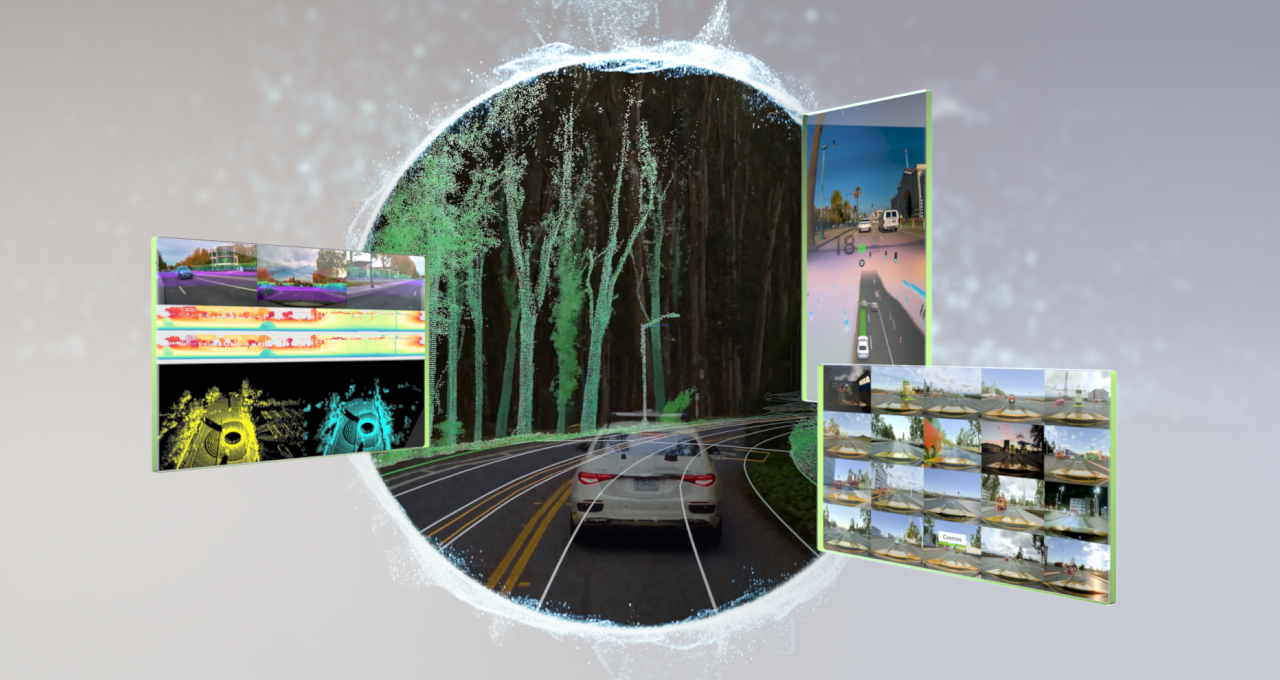
Physical AI is moving from research labs into the real world, powering intelligent robots and autonomous vehicles (AVs) — such as robotaxis — that must reliably sense, reason and act amid unpredictable conditions.
To safely scale these systems, developers need workflows that connect real-world data, high-fidelity simulation and robust AI models atop the common foundation provided by the OpenUSD framework.
The recently published OpenUSD Core Specification 1.0 , OpenUSD — aka Universal Scene Description — now defines standard data types, file formats and composition behaviors, giving developers predictable, interoperable USD pipelines as they scale autonomous systems.
Powered by OpenUSD, NVIDIA Omniverse libraries combine NVIDIA RTX rendering, physics simulation and efficient runtimes to create digital twins and simulation-ready ( SimReady ) assets that accurately reflect real-world environments for synthetic data generation and testing.
NVIDIA Cosmos world foundation models can run on top of these simulations to amplify data variation, generating new weather, lighting and terrain conditions from the same scenes so teams can safely cover rare and challenging edge cases.
Learn more by watching the OpenUSD livestream today at 11 a.m. PT or in replay, part of the NVIDIA Omniverse OpenUSD Insiders series:
In addition, advancements in synthetic data generation , multimodal datasets and SimReady workflows are now converging with the NVIDIA Halos framework for AV safety, creating a standards-based path to safer, faster, more cost-effective deployment of next-generation autonomous machines.
The OpenUSD Core Specification 1.0 establishes the standard data models and behaviors that underpin SimReady assets, enabling developers to build interoperable simulation pipelines for AI factories and robotics on OpenUSD .
Built on this foundation, SimReady 3D assets can be reused across tools and teams and loaded directly into NVIDIA Isaac Sim , where USDPhysics colliders, rigid body dynamics and composition-arc–based variants let teams test robots in virtual facilities that closely mirror real operations.
The Learn OpenUSD curriculum is now open source and available on GitHub, enabling contributors to localize and adapt templates, exercises and content for different audiences, languages and use cases. This gives educators a ready-made foundation to onboard new teams into OpenUSD-centric simulation workflows.
Gaussian splatting — a technique that uses editable 3D elements to render environments quickly and with high fidelity — and world models are accelerating simulation pipelines for safe robotics testing and validation.
At SIGGRAPH Asia, the NVIDIA Research team introduced Play4D , a streaming pipeline that enables 4D Gaussian splatting to accurately render dynamic scenes and improve realism.
Spatial intelligence company World Labs is using its Marble generative world model with NVIDIA Isaac Sim and Omniverse NuRec so researchers can turn text prompts and sample images into photorealistic, Gaussian-based physics-ready 3D environments in hours instead of weeks.
Those worlds can then be used for physical AI training, testing and sim-to-real transfer. This high-fidelity simulation workflow expands the range of scenarios robots can practice in while keeping experimentation safely in simulation.
Lightwheel Helps Teams Scale Robot Training With SimReady Assets
Key considerations
- Investor positioning can change fast
- Volatility remains possible near catalysts
- Macro rates and liquidity can dominate flows
Reference reading
- https://blogs.nvidia.com/blog/openusd-halos-safety-robotaxi-physical-ai/#content
- https://www.nvidia.com/en-us/
- https://blogs.nvidia.com/?s=
- Registry hack enables new performance-boosting native NVMe support on Windows 11 — Windows Server 2025 feature can be unlocked for consumer PCs, but at your own
- Logitech’s top-selling G502 Hero gaming mouse is half price at just $38 on Amazon — save up to 53% on this fan favorite
- Massive two-year project recovers 144 previously undumped Sega Genesis game ROMs from the mid-1990s — lost Garfield and Flintstones games among the notable find
- Google killed the 25-year-old Sega Dreamcast PlanetWeb 3.0 web browser this week — big G's services no longer respond to this quarter-century-old software
- 12 years ago, a whiskey-fuelled rant coined the iconic term HODL with a drunken mispelling — Bitcoin investment strategy would have turned $523 into over $87,00
Informational only. No financial advice. Do your own research.