
When you purchase through links on our site, we may earn an affiliate commission. Here’s how it works .
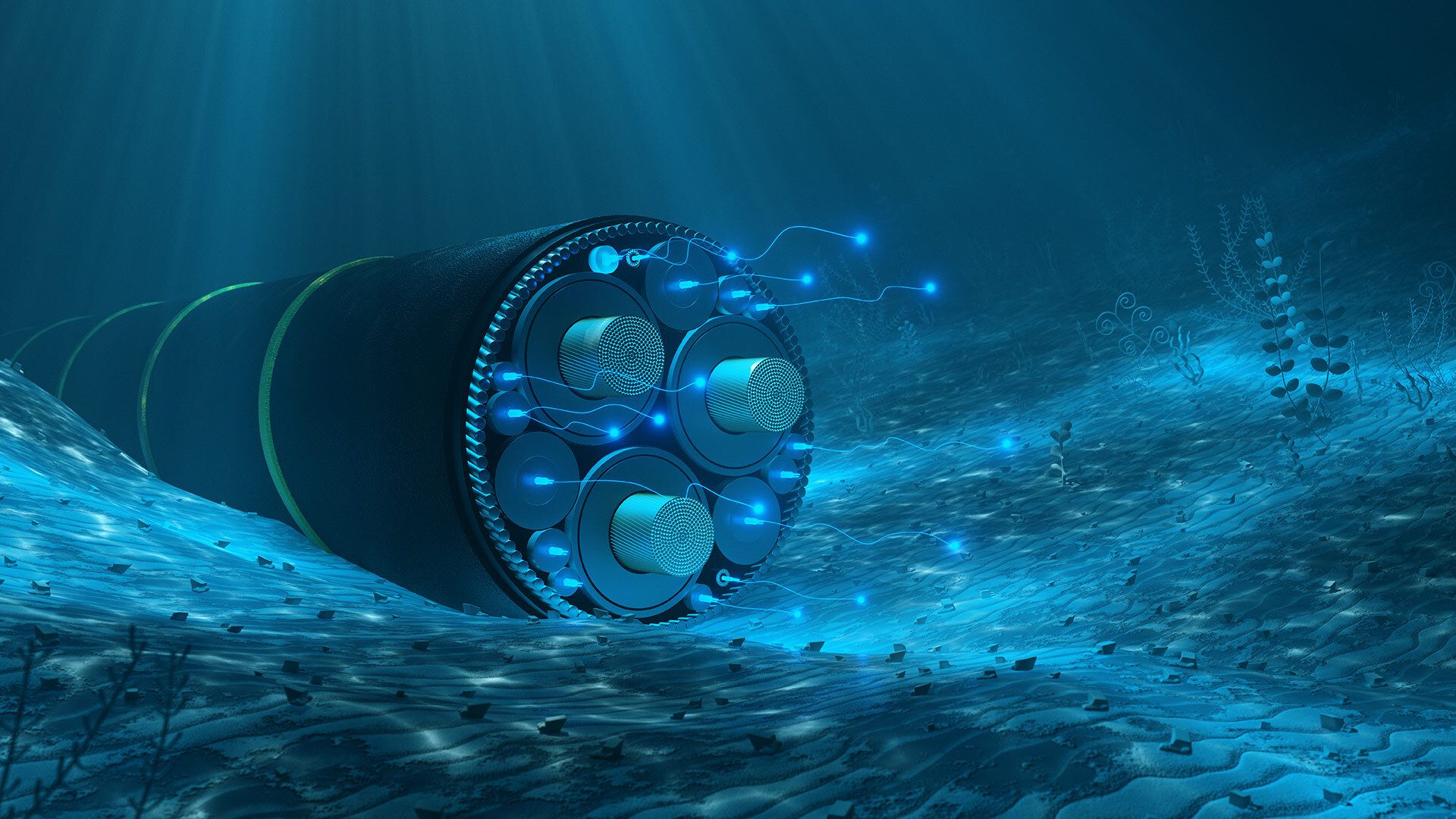
Nippon Telegraph and Telephone (NTT), a Japanese telecommunications giant, just announced the development of a four-core multicore optical fiber (MCF) that delivers quadruple the capacity of conventional fiber without increasing its thickness or diameter. The company says that maintaining the cable’s cross section is crucial to ensure compatibility with existing infrastructure — not just with cable-laying vessels, but with terrestrial interconnects and terminal racks as well.
As the development of 5G communications, AI models, and cloud services accelerates across the world, so does the demand for transferring massive amounts of data. Telecommunications companies can address this demand by laying more infrastructure, but this could be a costly endeavor requiring a lot of time and resources. So, NTT instead developed the MCF, which contains four different cores (instead of the usual single core) surrounded by glass cladding. Signals are then sent through the MCF through spatial multiplexing, essentially allowing a single cable to carry four independent optical paths inside it. Since more undersea cables bundle up to 48 fibers together, NTT’s technology means that just one cable run can now carry as many as 192 cores.
The company also developed technical accessories that make it easier for cable layers and telecommunications companies to integrate the MCF into existing infrastructure. This includes the submarine joint box, which allows conventional terrestrial fiber optic cables to connect to the four-core undersea cable, and the MCF cable terminal, which is crucial for connecting it to transmission equipment that uses single-core optical cables. There is also the factory joint box that lets cable layers connect two MCF cables to each other on the seabed.
You may like Start-up plans to use terahertz radio frequencies for communication between servers instead of copper or optical connections Tech titans team up to form optical interconnect alliance to solve the AI buildout's big data bottleneck Microsoft expects to commercialize MicroLED datacenter cables by late 2027 Multiple companies have been continuously laying new undersea connections despite the risks of cable cuts and regional conflicts , showing that the demand to connect the world together is steadily increasing. Meta is even said to be planning to create a new subsea cable route that avoids areas with high geopolitical tensions , such as northern Europe, the Middle East, and the Strait of Malacca.
This technology is expected to be rolled out in 2029, meaning telecom companies can start deploying it in their projects in just a few years’ time. Aside from accommodating increased traffic, the MCF could potentially reduce deployment times without the need to completely overhaul the existing system. This could make upgrades cheaper while simultaneously allowing new projects to be more competitive than existing networks.
Follow Tom's Hardware on Google News , or add us as a preferred source , to get our latest news, analysis, & reviews in your feeds.
Get Tom's Hardware's best news and in-depth reviews, straight to your inbox.
Key considerations
- Investor positioning can change fast
- Volatility remains possible near catalysts
- Macro rates and liquidity can dominate flows
Reference reading
- https://www.tomshardware.com/peripherals/cables-connectors/SPONSORED_LINK_URL
- https://www.tomshardware.com/peripherals/cables-connectors/japanese-firm-develops-optical-fiber-with-4x-traffic-capacity-could-be-used-for-undersea-cables-mcf-retains-the-same-diameter-and-works-with-existing-infrastructure#main
- https://www.tomshardware.com
- As Open Models Spark AI Boom, NVIDIA Jetson Brings It to Life at the Edge
- Sony freezes memory card orders in Japan amid growing storage crisis — the company attributes the cause to ‘shortage of semiconductors’
- AMD Ryzen 9 7900X 12-core CPU hits all-time low of $199 — Zen 4 chip brings unbeatable value at $16.58 per core
- Museum opens doors to ‘World’s largest collection of Apple products’ on April 1 to celebrate Apple’s 50th anniversary — 2,000 artifacts spread across 20,000 sq
- The Future of AI Is Open and Proprietary
Informational only. No financial advice. Do your own research.