
Anton Shilov is a contributing writer at Tom\u2019s Hardware. Over the past couple of decades, he has covered everything from CPUs and GPUs to supercomputers and from modern process technologies and latest fab tools to high-tech industry trends. ","collapsible":{"enabled":true,"maxHeight":250,"readMoreText":"Read more","readLessText":"Read less"}}), "https://slice.vanilla.futurecdn.net/13-4-18/js/authorBio.js"); } else { console.error('%c FTE ','background: #9306F9; color: #ffffff','no lazy slice hydration function available'); } Anton Shilov Social Links Navigation Contributing Writer Anton Shilov is a contributing writer at Tom’s Hardware. Over the past couple of decades, he has covered everything from CPUs and GPUs to supercomputers and from modern process technologies and latest fab tools to high-tech industry trends.
ttquantia This sounds very much like the biggest crash ever. Nobody knows what that way more one 1 trillion dollars worth of services those AI companies are going to be selling to cover the 1 trillion dollars Nvidia is going to earn from them. Walmart, Amazon and even Apple are selling tangible products that people need and use. The AI companies don't seem to be selling anything that hundreds of millions or billions of people would need and be happy to pay lots of real money for. This does not look good. At all. Reply
vanadiel007 Expect memory and storage pricing to go up. That is how they are making their real money, with hardware sales. Reply
timsSOFTWARE I don't believe AI is going away, but current hardware spending seems clearly unsustainable. At some point, investors will grow impatient and not want to put any more money in before they see results. And that's also when I think the shift toward local models will pick up steam. The big AI companies need to do more than deliver incremental improvements if they are ever going to see profitability. $20/month subscriptions are not going to cut it, and there is no moat around the API services, other than user familiarity. Most of the data used to train the models is in the public domain, and the algorithms used are generally open knowledge as well. (Just wait until people realize that all you need to provide an "agentic" environment to an LLM, is a prompt loop and piped access to a Linux shell.) When the prices are similar and the architecture is better understood, companies will likely decide they'd rather have control over their data with local AI and their own fine-tuning/LoRA rather than running in the cloud. I do think there are underlying learnings from LLMs that are invaluable – understanding the principles behind the math is akin to learning algebra or something like that – but I'm actually not certain that anybody is going to make any real money on it. The AI that everybody really wants, is one that tasks can be delegated to – and that requires taking responsibility and learning from mistakes; characteristics of a mind, not a tool. So maybe that turns out to be infeasible. Or maybe it is feasible, but the resulting entity doesn't want to be in a slave role, churning out CRUD apps for humans. Either way, it's hard to see the version of the future that investors are pouring trillions into, to buy rapidly depreciating computer hardware that will be effectively worthless from a performance-per-watt and datacenter space perspective 5-10 years from now. Reply
alrighty_then NemoClaw might change business in a big way. We'll see who adopts this agentic AI first and what they do with it, but I can see this causing a huge improvement in productivity in the enterprise. The way you can just talk to it and it achieves so much…it's really incredible. I think a huge percentage of the population still has no idea this is possible. Interesting to see some say it's a bubble and won't be profitable while others see trillion dollar buisnesses left and right, basically doing everything with the potential to put everyone out of a job. Pretty big difference in predictions there. An exciting time in tech, for sure! Reply
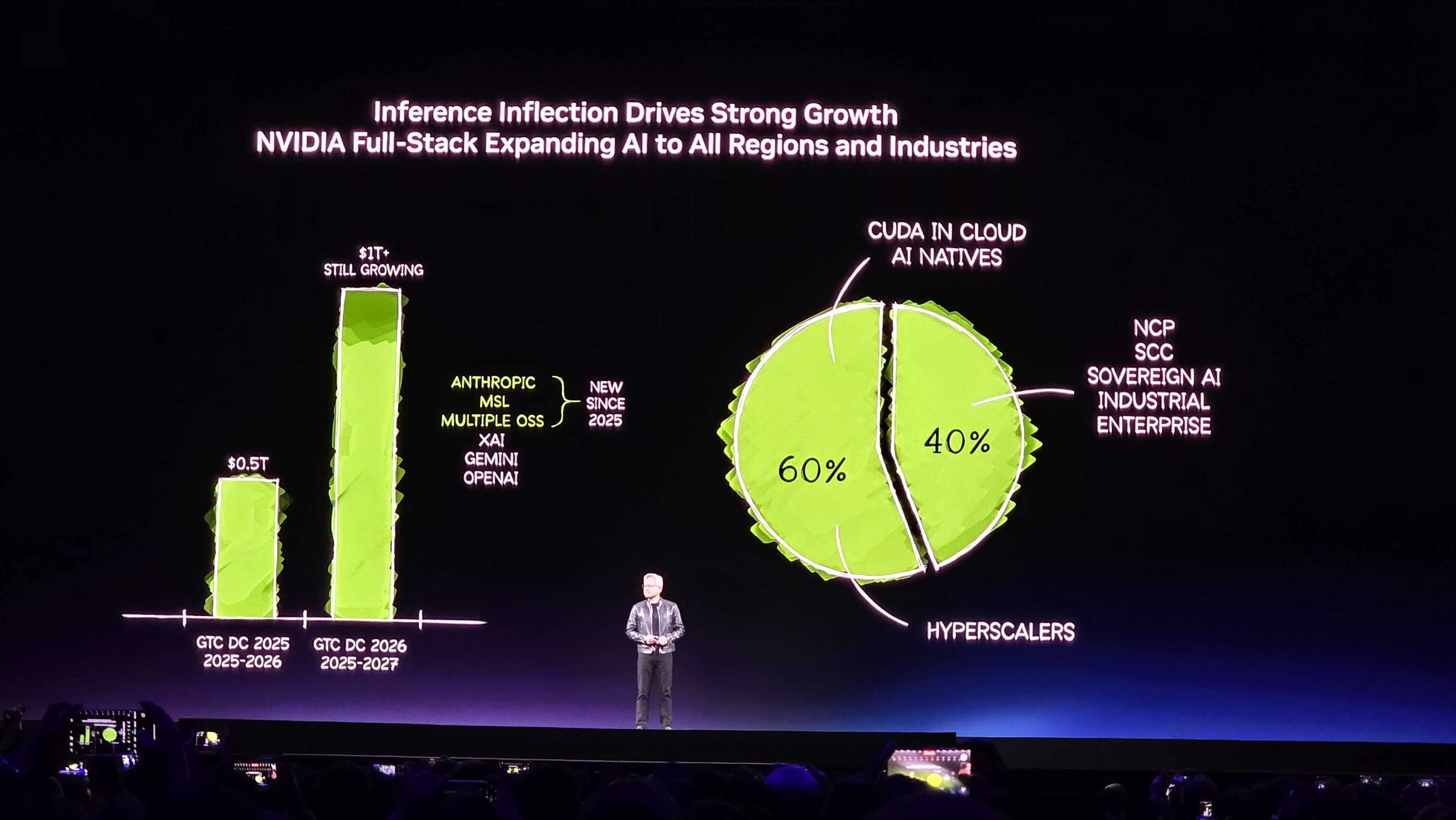
hotaru251 which will once again prove its strong position as an indisputable AI hardware market leader. except it will hit same issue it did w/ GPU's in that your gains start to stagnate & unlike graphics the way you do "ai" isn't as easily transitioned to get high jumps again. and thats even assuming the bubble lasts a few more years as there are already reports of 'ai" benefit for companies fabricating their benefit and actually losing em money (and time as they have to double check everything they had contact with) lack of supply of materials, growing cost of power to run em, still extremely little to no profit and it's going to collapse nearly overnight. alrighty_then said: Interesting to see some say it's a bubble and won't be profitable while others see trillion dollar buisnesses left and right, basically doing everything with the potential to put everyone out of a job. Pretty big difference in predictions there. because its both true. Those who sell the "ai" make profit (bottom of pyramid scheme and make $ as they dont spend anything outside material cost for it) those who have to buy it and then sell it make less and then you get to companies and stuff where tis just "ai" chatbot like stuff that has barely any real value and is making no $. The big corpo keep tossing $ to it becasue to them they are blinded by the $ of it when they can replace human workers. (a 1 time purchase & maybe a maintenance guy is much cheaper than having to pay a wage & benefits to your hundreds/thousands of human workforce) everyone knows its a bubble and ones who say it isn't are ones who are wanting to profit from it longer. The fact chipmakers aren't rushing to expand during this huge a boom (which they could easily rake in more $) is a sign they won't risk it popping before they ramped up production as it could pop prior to that and then they are down billions. (memory makers know this 1st hand as yrs ago there was so much ram it was dirt cheap and they literally all cut back just to get it back to normal prices and they wont risk it again) Reply
Key considerations
- Investor positioning can change fast
- Volatility remains possible near catalysts
- Macro rates and liquidity can dominate flows
Reference reading
- https://www.tomshardware.com/pc-components/gpus/SPONSORED_LINK_URL
- https://www.tomshardware.com/pc-components/gpus/jensen-huang-expects-nvidia-to-sell-usd1-trillion-of-ai-hardware-through-2027-ai-buildout-intensifies-as-agentic-ai-takes-hold#main
- https://www.tomshardware.com/subscription
- Seagate FireCuda X1070 2TB SSD review: Entry-level hardware meets premium support
- Flabbergasted GPU repair wizard highlights dangers of liquid metal after leak kills entire RTX 5070 Ti — user-applied TIM spread to every crevice of the PCB, ph
- Nvidia demonstrates Rubin Ultra tray, the world's first AI GPU with 1TB of HBM4E memory — new chips will slot into Kyber racks
- March Into the Cloud With 15 New Games Coming to GeForce NOW
- STMicro to deploy humanoid robots to its legacy fabs in Europe — over 100 humanoid robots to be used for routine and physically demanding tasks in fight for eff
Informational only. No financial advice. Do your own research.