
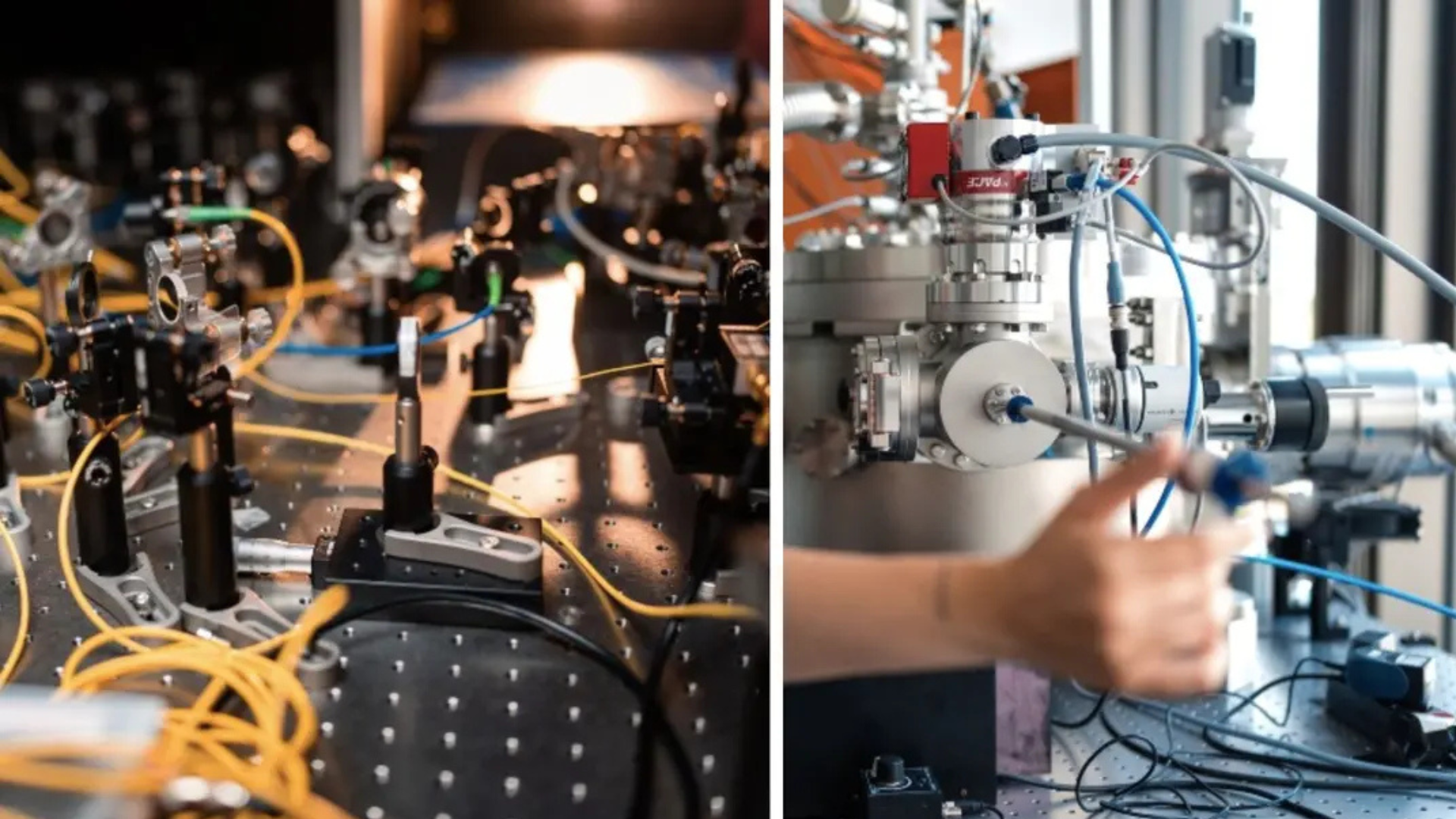
Super-moiré skyrmion states in layered chromium triiodide were seen across multiple moiré cells.
When you purchase through links on our site, we may earn an affiliate commission. Here’s how it works .
A team of researchers led by the University of Stuttgart has identified unusual magnetism in twisted, two-dimensional chromium triiodide, revealing long-range spin textures that extend beyond the material’s underlying moiré pattern. The findings, which were published in the journal Nature Nanotechnology on February 2, were observed in twisted double-bilayer chromium triiodide structures using nanoscale magnetic imaging at cryogenic temperatures. The research could have big implications for the creation of ultra-dense magnetic data storage.
Twisted van der Waals materials have become a major focus area for researchers over the past several years because small, angular offsets between atomically thin layers have been found to produce moiré superlattices that strongly modify electronic and magnetic behavior.
Using scanning nitrogen-vacancy magnetometry, the researchers directly imaged ordered, dot-like magnetic textures that span multiple moiré unit cells. As the twist angle increased within a narrow long-angle range, the characteristic size of these textures grew, reaching roughly 300 nanometers at around a 1.1-degree twist before vanishing at about two degrees. Individual features within those textures measured on the order of roughly 60 nanometers.
5D glass storage 'memory crystals' promise up to 13.8 billion years of data storage resilience, which is also the age of the universe
Western Digital details 14-platter 3.5-inch HAMR HDD designs with 140 TB and beyond
Researcher builds bizarre 128-byte USB drive the size of a dinner plate using ancient pre-semiconductor magnetic core memory technology
Unlike previously reported moiré-locked magnetic states in chromium triiodide, the researchers say that these textures aren’t confined to a single stacking configuration or local energy minimum within the moiré lattice. Instead, they form a higher-order “super-moiré” magnetic state that reorganizes magnetism on a larger length scale.
The researchers attribute this behavior to competition between exchange interactions, magnetic anisotropy, and interfacial Dzyaloshinskii-Moriya interaction — an antisymmetric exchange interaction that arises due to spin-orbit coupling — which becomes significant in twisted bilayer interfaces. Once the moiré period is sufficiently reduced, these competing energies favor magnetic ordering that decouples from the geometric moiré pattern, producing textures that span multiple cells.
Antiferromagnetic skyrmions are of particular interest to researchers because they are expected to suppress the skyrmion Hall effect, a property that could simplify motion control in future spintronic concepts by allowing straighter and more controllable motion than their ferromagnetic counterparts. In this work, the researchers show that twist angle can act as an effective tuning parameter for stabilizing such magnetic states in atomically thin materials, reshaping magnetic order without changing the composition layer count.
As always with studies such as these, it’s important to remember that the work is still in the earliest research stages. Measurements were performed at low temperatures, and chromium triiodide itself is air-sensitive and thus unsuitable for direct integration into any applications outside of the laboratory. However, the authors note that the underlying mechanism should be transferable to other layered magnetic materials, including systems with higher ordering temperatures.
Get Tom's Hardware's best news and in-depth reviews, straight to your inbox.
Key considerations
- Investor positioning can change fast
- Volatility remains possible near catalysts
- Macro rates and liquidity can dominate flows
Reference reading
- https://www.tomshardware.com/pc-components/storage/SPONSORED_LINK_URL
- https://www.tomshardware.com/pc-components/storage/german-researchers-uncover-long-range-magnetic-textures-in-twisted-2d-magnets#main
- https://www.tomshardware.com
- Retro Apple Mac mod implements thermal printer floppy swap — machine also benefits from a Mac Mini brain transplant
- Flight Controls Are Cleared for Takeoff on GeForce NOW
- Memory makers are set to earn $551 billion from the AI boom, twice as much as contract chip manufacturers — forecasts suggest that 2026 revenue will skyrocket t
- Don't miss this amazing XFX Mercury RX 9070XT GPU deal for just $649.99 — the cheapest AMD Radeon GPU in its class by $69
- Logitech's Pro X2 Superstrike gaming mouse introduces electromagnetic induction tech, cutting down on latency and adding new features — $179 mouse adds 'Haptic
Informational only. No financial advice. Do your own research.