
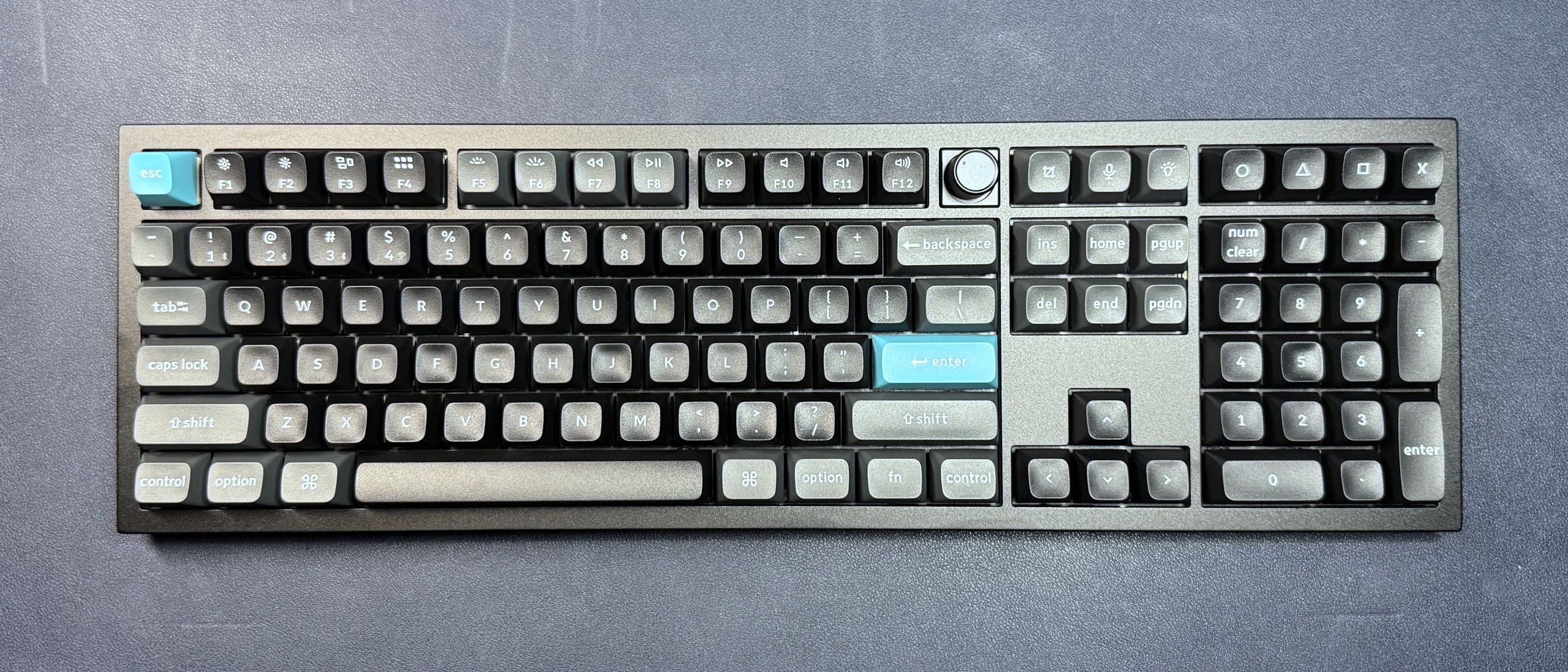
The Q6 Ultra 8K is a mechanical keyboard with a hot-swappable PCB. It comes with your choice of Keychron Silk POM switches, in Red (linear), Brown (tactile), or Banana (tactile). Our review unit came with Keychron Silk POM switches in Brown, which have an operating force of 55g, a pre-travel distance of 2mm, and an overall travel distance of 4mm. The switches are factory-lubed and tactile, which means they have a tactile bump — though it's a very soft tactile bump — but no audible click when pressed.
I didn't really like typing on the Q6 Ultra 8K for a couple of reasons. The combination of switches and keycaps just wasn't for me. I'm picky about tactile switches, and the Keychron Silk POM Browns were a little too heavy to actuate and the soft tactile bump made them feel more like sticky linear switches than actual tactile switches. The switches were relatively smooth and stable overall, but the higher keycap profile and heavier actuation meant I found myself missing a few keystrokes here and there. Moving my fingers across the board felt sluggish, even though typing tests suggested that my speed and accuracy didn't take a significant hit. I managed to consistently type at around 115 words per minute (wpm) at 98% accuracy on this board, which is worse than my typical speed of around 125 wpm, but not that much worse. However, it definitely felt worse, and I was still missing letters occasionally, even after a week of using the board.
The keyboard sounds pretty decent — the case is well-dampened, and the switches give you a slightly bright, clacky sound with each stroke. It's not my favorite sounding keyboard, but nothing stood out as problematic.
As far as gaming goes, the Q6 Ultra 8K is pretty solid. The higher-profile keycaps didn't bother me while I was gaming, as I'm not usually trying to hit quite as many different keys in quick succession — and travel distance between keys isn't as much of an issue. The keyboard doesn't have magnetic switches — though there is a magnetic switch version of this keyboard, the Keychron Q6 HE 8K — so it doesn't benefit from things like RapidTrigger, but it does have an 8 KHz polling rate and an impressive battery life (when the lighting is turned off), which means it might be worth a look if you want a high polling rate and you hate plugging things in.
The Q6 Ultra 8K can be configured via Keychron's web-based Keychron Launcher. While I agree that the trend of web apps can be frustrating for those who want to adjust their keyboard settings and don't have an internet connection, this is a large, full-size keyboard — I don't think most people are going to be traveling with it, and are likely to be connected to the internet whenever they want to go in and tweak settings.
(Image credit: Tom's Hardware) (Image credit: Tom's Hardware) (Image credit: Tom's Hardware) (Image credit: Tom's Hardware) (Image credit: Tom's Hardware) (Image credit: Tom's Hardware) (Image credit: Tom's Hardware) (Image credit: Tom's Hardware) (Image credit: Tom's Hardware) You can do several things in the web app, including remapping keys, setting up snap action, recording macros, adjusting the keyboard's backlighting, updating the firmware, and changing other settings. The keyboard does ship with an 8,000 Hz polling rate out of the box, so you don't need to connect the keyboard to the app (unlike most 8 KHz polling rate peripherals, which ship with 1,000 Hz polling rates and require you to go in and change the polling rate).
Perhaps the most impressive feature of the Q6 Ultra 8K is its battery life, which Keychron rates at up to 660 hours with an 8,000 Hz polling rate and the backlighting turned off. This does drop to just 200 hours with the backlighting turned on at its lowest level, but that's still pretty good considering the 8 KHz polling rate. The reason this keyboard is so much more efficient than most wireless 8 KHz polling peripherals is because it uses ZMK firmware (instead of QMK), which is optimized for wireless performance.
The Keychron Q6 Ultra 8K is a full-size wireless mechanical keyboard with a wildly impressive battery life. While most wireless peripherals with an 8,000 Hz battery life can barely last a full day without needing to be plugged in, the Q6 Ultra 8K can last months — even with the backlighting turned on. Which is great — however, perhaps not quite as necessary in a full-size keyboard like this. (Where are you going with it, that you can't plug it in every once in a while?)
While it wasn't my favorite keyboard for typing, it is hot-swappable and, with different keycaps, could be perfectly usable. Plus, there aren't that many full-size wireless gaming keyboards on the market, as many gamers prefer something more compact — like a TKL or a 75-percent, or even a 96-percent like the Asus ROG Strix Morph 96 Wireless we recently looked at.
Sarah Jacobsson Purewal is a senior editor at Tom's Hardware covering peripherals, software, and custom builds. You can find more of her work in PCWorld, Macworld, TechHive, CNET, Gizmodo, Tom's Guide, PC Gamer, Men's Health, Men's Fitness, SHAPE, Cosmopolitan, and just about everywhere else. ","collapsible":{"enabled":true,"maxHeight":250,"readMoreText":"Read more","readLessText":"Read less"}}), "https://slice.vanilla.futurecdn.net/13-4-20/js/authorBio.js"); } else { console.error('%c FTE ','background: #9306F9; color: #ffffff','no lazy slice hydration function available'); } Sarah Jacobsson Purewal Social Links Navigation Senior Editor, Peripherals Sarah Jacobsson Purewal is a senior editor at Tom's Hardware covering peripherals, software, and custom builds. You can find more of her work in PCWorld, Macworld, TechHive, CNET, Gizmodo, Tom's Guide, PC Gamer, Men's Health, Men's Fitness, SHAPE, Cosmopolitan, and just about everywhere else.
Key considerations
- Investor positioning can change fast
- Volatility remains possible near catalysts
- Macro rates and liquidity can dominate flows
Reference reading
- https://www.tomshardware.com/peripherals/gaming-keyboards/SPONSORED_LINK_URL
- https://www.tomshardware.com/peripherals/gaming-keyboards/keychron-q6-ultra-8k-review#main
- https://www.tomshardware.com
- Chinese Nvidia Cloud Partner procured 300 servers with banned AI GPUs worth $92 million — shares of data center supplier Sharetronic plummet following Super Mic
- Tests show $30,000 AI GPUs are terrible password crackers — RTX 5090 gaming GPU outperforms Nvidia H200 and AMD MI300X
- Blowing Off Steam: How Power-Flexible AI Factories Can Stabilize the Global Energy Grid
- Ambitious hacker reduces worst-case memory latency by up to 93%, but with severe downsides — 1960s bottleneck overcome by hedging memory accesses to avoid runni
- MacBook user explains why he files the sharp metal edges off his Apple laptops — unibody design facilitates a surprisingly deep roundover
Informational only. No financial advice. Do your own research.