
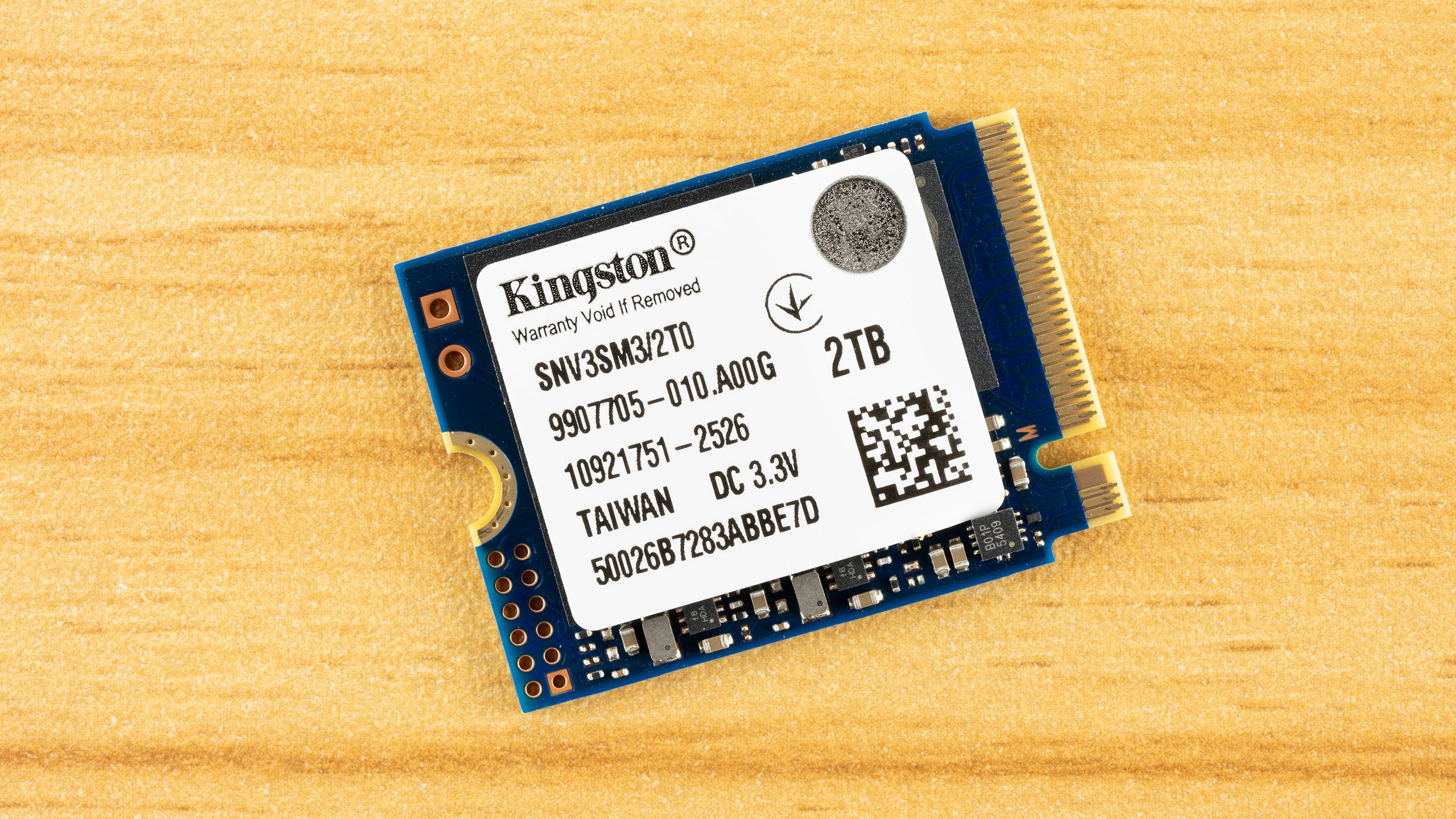
That brings one thing into question: Kingston has suggested a 4TB SKU is on the way for this drive, can it be single-sided? Currently, consumer flash is stacked at up to 16 dies per package, which, with 1Tb dies, means 2TB at the most.
32-stack technology is out there, but it's not reasonable for this type of device. Even 16-die packages can be challenging at higher speeds, as we saw with some 1TB TLC-based 2230 drives from Phison that had trouble in rare edge cases. The NV3 would have to either be double-sided or use 2Tb dies at 4TB. The latter is very possible – we may even see 2Tb dies at lower capacities – and it will be interesting to see what Kingston does.
(Image credit: Tom's Hardware) (Image credit: Tom's Hardware) (Image credit: Tom's Hardware) Here we can see the controller, the Silicon Motion SM2268XT2, and the single NAND flash package. The XT2 is very similar to the original XT, the main difference being that the XT2 can handle up to 3,600 MT/s flash, while the XT is designed for 3,200 MT/s. There aren’t too many drives with either controller variant, the Kioxia BG6 probably being the most well-known one with the XT. The subtle change is similar to Phison’s “upgrade” from the E27T to the E29T – with flash support going from ONFi/Toggle 5.0 to 5.1 – with the latter being found on Micron’s 2600 , a drive we may review in the near future. In practice, there’s no huge benefit to increasing the I/O rate as a four-channel PCIe 4.0 SSD controller can saturate the interface with just 2,400 MT/s, but enabling a higher rate can improve performance and/or efficiency in some cases.
The BiCS8 QLC flash is an upgrade over the regular NV3's BiCS6 QLC. There are improvements across the board as the newer architecture has better power efficiency and, in general, some of the best latency results we’ve seen. Specifically, the SanDisk WD Blue SN5100 is using this flash to very good effect, offering a TLC-like experience. It’s perfect for an M.2 2230 drive. One thing we can point out is that the 1TB and 2TB SKUs are slightly heavier than the 500GB SKU, which could mean heavier flash packages or more circuitry. It could also imply the use of 2Tb dies, now or in the future. However, it’s not uncommon for flash packages to maintain size and weight regardless of functional die count because fillers and dummy dies are used for uniformity.
None of that matters for the end user, but when looking at the weaker performance specifications for this drive and remembering that Kingston’s NV series of drives uses variable hardware, we must caution that the hardware might not remain what we’re reviewing today. Any new hardware must meet existing specifications, so even minor discrepancies can be a tell. Given the relatively low TBW and even lower DWPD than the 2280 variant, it’s likely this drive will only have QLC or lower-end TLC flash. The future 4TB SKU, if it comes, will be more standardized given the rarity. We think that, considering all these factors, the 500GB SKU should mostly be avoided unless it’s your only choice.
Current page: Kingston NV3 2230 Introduction
Key considerations
- Investor positioning can change fast
- Volatility remains possible near catalysts
- Macro rates and liquidity can dominate flows
Reference reading
- https://www.tomshardware.com/pc-components/ssds/SPONSORED_LINK_URL
- https://www.tomshardware.com/pc-components/ssds/kingston-nv3-2230-2tb-ssd-review#main
- https://www.tomshardware.com
- Quake was the only game to support DOS and Win95 with TCP/IP multiplayer in one executable—deep dive explains how id Software did it
- Microsoft unveils Azure Cobalt 200 CPU, in-house chip targets higher performance and deeper integration — Arm-based chip is equipped with 132 cores and manufact
- Tom's Hardware Premium is up to 50% off for Black Friday — get a wealth of in-depth industry content from as little as $5.99 a month
- Qualcomm refines Windows on Arm gaming with broad feature release — platform gets Snapdragon Control Panel, AVX2 emulation, improved anti-cheat support
- Wall Street warns of rising AI debt risk as stocks slide on wobbly investor confidence — analysts warn of 'systemic risk' as Nvidia share price creaks
Informational only. No financial advice. Do your own research.