
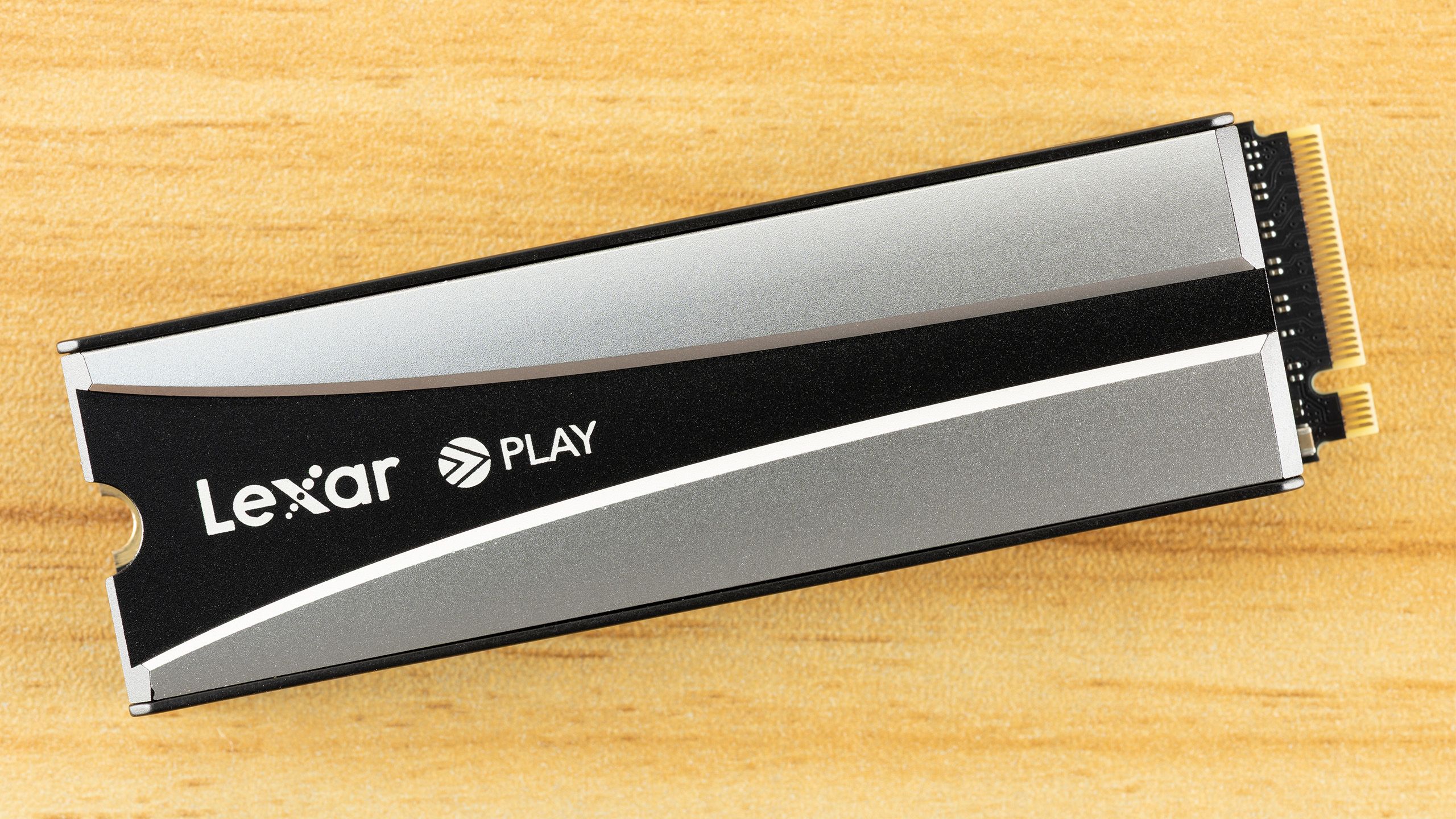
The Lexar Play SE, or Special Edition, is the follow-up to the original PS5-focused Lexar Play . This drive is special, all right, although perhaps not in the way you would expect. Second editions of drives are often a pathway towards getting away with a hardware swap, and the Play SE, on the surface, looks deceptively like its forebearer. Underneath the capable, PS5-compliant heatsink, there are some interesting changes at play. It’s worth an extra look since 4TB drives are becoming more expensive just as the sweet spot seemed to be moving above 2TB.
The good news is that this drive is perfectly suitable for your PS5, and it could work inside a desktop, too. It’s best as a secondary or games drive rather than your primary solution, given its budget status. It’s only available at 4TB, which, given its hardware, which we’ll get into more later, firmly places it in the “extra storage” category. Superficially and by TBW specification, it looks like the original Play, which used the excellent Maxio MAP1602 controller and 232-Layer YMTC TLC flash, but appearances can be deceiving. This is a DRAM-less, QLC-infused SSD that only makes sense as a low-cost solution. Its weak performance and power efficiency keep it from being anything greater than that, as we’ll see.
The Lexar Play SE is only available at 4TB. This is a good thing, as this drive doesn’t really make sense at other capacities. It needs at least 2TB to hit peak performance, and with the competition that exists, it has the most realistic chance of success at 4TB. It can achieve up to 7,000 / 6,000 MB/s for sequential reads and writes with no IOPS given. This is satisfactory as a drive like this is not meant to be used for heavy workloads, although this controller can manage up to 700K IOPS. The warranty is for a full five years and, in addition, 800TB of writes per TB capacity. This last bit is interesting as 800TBW per TB is above the standard and is at least double what we would expect for a QLC-based drive. It’s at TLC flash levels of endurance, which is a bonus.
Lexar has two downloads for its SSDs: Lexar DiskMaster and Lexar DataShield. The first is Lexar’s SSD toolbox, which has all of the expected functions. You can check system and drive information, drive health, and for firmware updates. Drives can also be scanned for errors and performance-tested, and the application also allows for secure erase and data transfer. DataShield additionally offers encryption for data protection.
(Image credit: Tom's Hardware) (Image credit: Tom's Hardware) (Image credit: Tom's Hardware) (Image credit: Tom's Hardware) The Lexar Play SE is single-sided and adorned with a very capable heatsink. This heatsink is PS5-compatible, as is the case with the original Lexar Play . The single-sided nature of the drive helps anticipate what we’ll be looking at hardware-wise. Knowing nothing else about the drive, we would normally expect a DRAM-less controller with denser flash. Both of these expectations are proven valid, but there is more going on here than meets the eye.
(Image credit: Tom's Hardware) (Image credit: Tom's Hardware) (Image credit: Tom's Hardware) Under the label, we see the InnoGrit IG5236 controller, one that we found to be quite good back in the day – see our Adata XPG Gammix S70 review . This controller is a competitor for SMI’s SM2264, see the Adata Legend 960 and Legend 960 Max , the legendary Phison E18, and proprietary options found in the most popular drives, such as the WD Black SN850X . It’s an eight-channel controller with double the channel count of budget controllers, and as a bonus, it comes with DRAM.
Well, we always reviewed it with DRAM, at least until today. This is the first hardware oddity of the drive. It’s nothing new for controllers to optionally support the host memory buffer, or HMB, feature in addition to hosting DRAM. HMB uses a small amount of system memory to assist in metadata caching. Often, the HMB-only controllers are cut-down versions of higher-end ones with fewer channels and no need for the full DRAM controller logic on the chip. Likewise, the higher-end drives usually have DRAM, and if HMB is for some reason enabled – this is true of some Realtek controllers we’ve seen – it is either not utilized or is used for something different than simple metadata caching.
Get Tom's Hardware's best news and in-depth reviews, straight to your inbox.
Key considerations
- Investor positioning can change fast
- Volatility remains possible near catalysts
- Macro rates and liquidity can dominate flows
Reference reading
- https://www.tomshardware.com/pc-components/ssds/SPONSORED_LINK_URL
- https://www.tomshardware.com/pc-components/ssds/lexar-play-se-4tb-ssd-review#main
- https://www.tomshardware.com
- AMD adopts FRED together with Intel for Zen 6 architecture — replacement for decades-old IDT can improve performance and stability
- Intel's upcoming Core Ultra 9 290K Plus appears on Geekbench with chart-topping scores — Arrow Lake refresh beats the 285K by ~10% across single- and multithrea
- Western Digital unveils massive 40TB HDD with energy-assisted recording tech — plans 100TB HAMR hard drives by 2029
- How to Get Started With Visual Generative AI on NVIDIA RTX PCs
- SpaceX acquires xAI in a bid to make orbiting data centers a reality — Musk plans to launch a million tons of satellites annually, targets 1TW/year of space-bas
Informational only. No financial advice. Do your own research.