
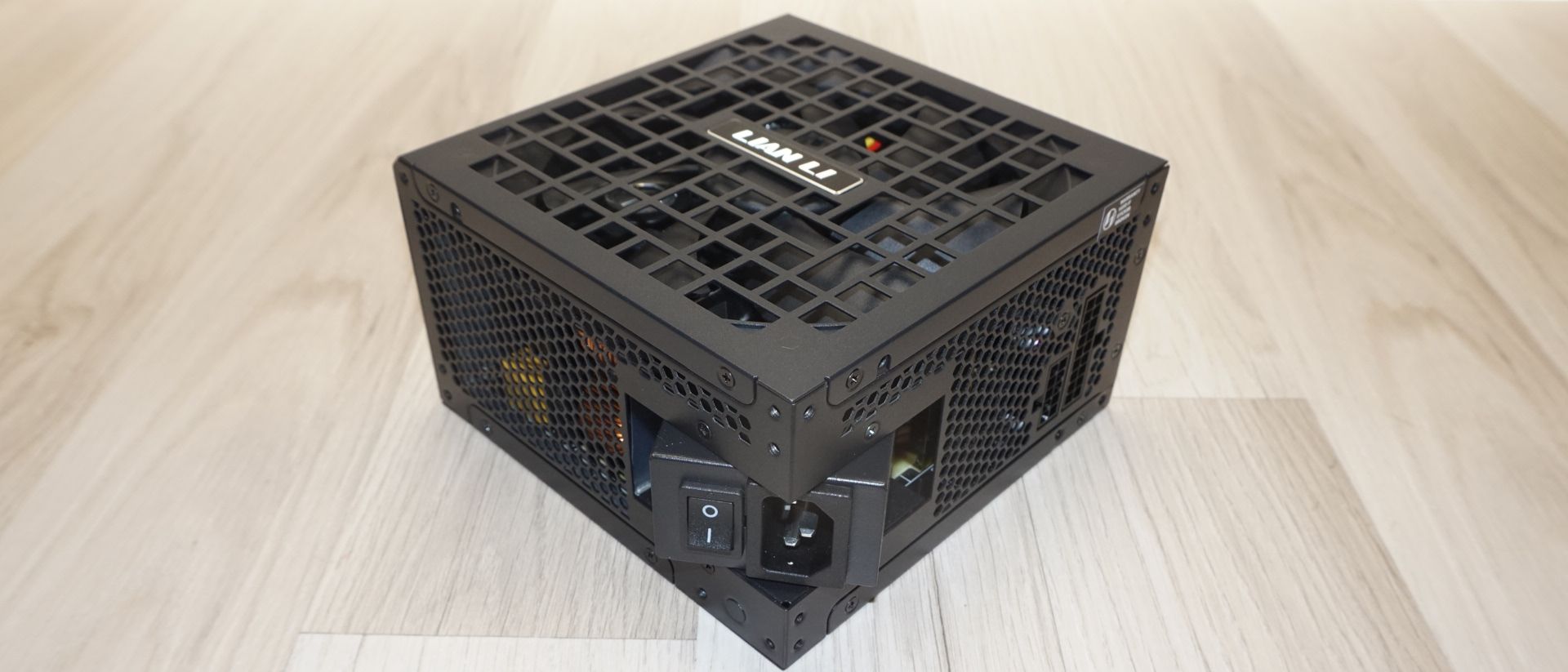
A significant limitation exists. The 24-pin connector location inverses relative to other connectors depending on AC receptacle orientation. When standard connectors exit rearward, the 24-pin exits left. When standard connectors exit left, the 24-pin exits rearward. This necessitates cases always accommodate at least the 24-pin connector routing behind the motherboard, effectively eliminating universal compatibility.
The right side is perforated, as rotational capability means this surface can become the front depending on AC receptacle positioning. The fan finger guard integrates directly into the chassis, displaying a unique geometric cutout pattern mixing squares and rectangles. The rear side, which alternates with the left depending on inlet orientation, incorporates a specialized slot for the USB hub. When positioned here, the USB hub draws power directly from the PSU without requiring a SATA connector.
The Lian Li RS1200G ATX 3.1 PSU employs a Hong Hua 135mm fan utilizing a fluid dynamic bearing engine. FDB designs represent optimal acoustic-to-reliability balance, maintaining low operational noise at elevated speeds while delivering strong mean time between failure figures. The fan specification includes a high 2300 RPM maximum speed, though the unit's zero-RPM mode means extended periods of fanless operation while the system is idling.
The PSU originates from Sirfa, a Chinese OEM whose designs have graced numerous mid-to-top tier power supplies over the past two decades. Sirfa's experience shows in the platform's assembly quality and component selection, though some choices reflect cost optimization rather than absolute premium positioning.
(Image credit: Tom's Hardware) (Image credit: Tom's Hardware) The input filtering stage provides adequate protection with four Y capacitors, two X capacitors, and two filtering inductors. Most filtering components mount on a vertical daughterboard, optimizing spatial efficiency and freeing the AC receptacle for movement. Two rectifying bridges are installed on a substantial heatsink immediately following the filtration stage.
The APFC circuitry employs two SRC60R608BS MOSFETs and a diode, positioned on a large heatsink spanning the PCB edge. One encased inductor and two EPCOS (TDK) capacitors totaling 1210 μF comprise the passive components. The total capacitance is massive and EPCOS component quality is top-tier. These German-manufactured capacitors offer superior thermal and mechanical stress resistance compared to most alternatives but are very costly and we rarely see their products even in top-tier units.
In the primary stage, two SRC60R095BS MOSFETs form a half-bridge primary inversion topology. These components are on a separate heatsink positioned after the APFC bulk capacitors. Heatsink dimensions are generous, providing substantial surface area for heat dissipation even under sustained high-power operation.
The secondary stage utilizes eight Infineon 10N04NM6 MOSFETs distributed across two vertical daughterboards, generating the primary 12V rail through synchronous rectification. The absence of dedicated heatsinks for these components hints their exceptional efficiency characteristics. DC-to-DC converter circuits on another vertical daughterboard generate the 3.3V and 5V rails from the primary 12V output.
Secondary side capacitors originate entirely from Teapo, a reputable Taiwanese manufacturer. While Teapo lacks the prestige of premium Japanese manufacturers like Nippon Chemi-Con or Rubycon, they maintain solid reliability records and appropriate specifications for this application. This represents a pragmatic compromise between cost and quality for a unit with a 10-year warranty.
For the testing of PSUs, we are using high precision electronic loads with a maximum power draw of 2700 Watts, a Rigol DS5042M 40 MHz oscilloscope, an Extech 380803 power analyzer, two high precision UNI-T UT-325 digital thermometers, an Extech HD600 SPL meter, a self-designed hotbox and various other bits and parts.
(Image credit: Tom's Hardware) (Image credit: Tom's Hardware) (Image credit: Tom's Hardware) (Image credit: Tom's Hardware) (Image credit: Tom's Hardware) The Lian Li RS1200G PSU achieves average nominal load efficiency of 90.0% with 115 VAC input and 92.0% with 230 VAC input, measured across the 10% to 100% load range. These results comfortably satisfy 80 Plus Gold and CLEAResult Gold certification requirements. The unit received Cybenetics Platinum certification based on average efficiency calculations, though efficiency dips at maximum load prevented higher certifications from the other two certifying bodies. Lian Li markets this as Gold-certified, likely avoiding internal competition with their premium product lines.
Efficiency peaks near 40% load and maintains fairly good stability across most operational ranges. Very low load efficiency remains good, an important characteristic for modern systems spending significant time in idle states. The fan initiates rotation when load exceeds approximately 300 Watts but maintains very low speeds up to 800 Watts. Beyond 900 Watts, fan speed increases substantially though it still remains below half maximum capability.
During elevated ambient temperature testing, the Lian Li RS1200G PSU exhibits notable efficiency degradation. Average nominal load efficiency drops to 88.4% with 115 VAC input and 90.3% with 230 VAC input. Signs of thermal stress emerge at maximum load, though they remain within acceptable operational parameters. This is a product rated for maximum output at 40°C and, although it can reach its maximum output at a higher temperature, the signs of stress are apparent.
(Image credit: Tom's Hardware) (Image credit: Tom's Hardware) (Image credit: Tom's Hardware) (Image credit: Tom's Hardware) (Image credit: Tom's Hardware) Fan behavior shifts considerably under thermal stress. Activation occurs earlier, engaging at approximately 250 Watts load. The fan maintains slow rotation up to 600 Watts, after which speed increases progressively until reaching maximum at 90% load. Maximum load operation produces significant noise levels, though this represents expected behavior for a compact, Gold-certified 1200W unit under thermal stress. Internal temperatures remain within acceptable operational levels throughout testing.
The Lian Li RS1200G demonstrates outstanding power quality performance. Maximum ripple measured 26 mV on the 12V rail, 14 mV on the 5V rail, and 14 mV on the 3.3V rail, all substantially below industry safety limits and representing excellent performance considering test conditions and massive power output capability. Voltage regulation proves equally impressive, maintaining 0.9% on the 12V rail, 0.7% on the 5V rail, and 0.6% on the 3.3V rail. These figures indicate exceptional power quality across all voltage outputs under varying load conditions.
During our thorough assessment, we evaluate the essential protection features of every power supply unit we review, including Over Current Protection (OCP), Over Voltage Protection (OVP), Over Power Protection (OPP), and Short Circuit Protection (SCP). OCP activates at 126% on the 3.3V rail, 128% on the 5V rail, and 112% on the 12V rail. OPP triggers at 110% during hot testing. These protection thresholds are exceptionally sharp, particularly for an ATX 3.1 certified unit.
The Lian Li RS1200G ATX 3.1 PSU represents genuine innovation in power supply design, addressing cable management challenges through mechanical ingenuity rather than incremental improvements. The rotatable AC inlet provides unprecedented installation flexibility, adapting to diverse case architectures while maintaining compact ATX dimensions. This feature alone distinguishes the RS1200G from conventional offerings, though it introduces specific compatibility requirements that potential buyers must carefully evaluate. The 24-pin connector placement creates an inherent limitation. Cases must accommodate behind-motherboard routing for at least the primary ATX cable, eliminating compatibility with chassis lacking appropriate cable management provisions. This restriction is not insurmountable but requires careful case selection, potentially limiting the RS1200G's appeal to builders with existing incompatible cases.
The magnetic USB hub adds practical value for builders requiring additional connectivity and cable management. Direct PSU mounting eliminates SATA power requirements when positioned in the dedicated slot, simplifying cable management. Alternative mounting locations throughout the chassis provide flexibility for specific layout requirements. This feature addresses modern system connectivity demands elegantly, though its utility varies significantly based on individual build requirements. Cable configuration proves conservative for a 1200W unit. One 12V-2×6 connector and five 6+2 pin PCIe connectors accommodate most GPU requirements but may prove limiting for some top-tier builds. Flat ribbon cables with magnetic cable organizers simplify routing in constrained spaces, representing thoughtful attention to practical installation concerns.
Electrical performance proves exceptional across all metrics. Voltage regulation maintains sub-1% deviation across all rails, demonstrating precise control under varying loads. Ripple suppression achieves outstanding results, particularly given the unit's 1200W output capability and compact form factor. Protection circuits respond with sharp precision, balancing safety with practical operational requirements. The OCP threshold is rather conservative but this unit is certified to handle ATX 3.1 transients. Efficiency results merit recognition. Cold testing efficiency of 90.0% with 115 VAC and 92.0% with 230 VAC comfortably exceeds Gold certification requirements, with Cybenetics awarding Platinum certification based on average efficiency calculations. Hot testing reveals significant but predictable efficiency degradation to 88.4% and 90.3% respectively, with thermal stress signs at maximum load, even though the figures remain within acceptable parameters.
Thermal management proves adequate though not exceptional. The compact 150mm chassis and overall topology, although paired with a 135mm fan and good heatsinks on the primary side, create inherent cooling challenges at maximum power output. The fan remains inactive or operates at minimal speeds under moderate loads, contributing to excellent low-load acoustics. High load operation produces significant noise levels, particularly under elevated ambient temperatures when the fan reaches maximum speed. Overall, the thermal control circuitry is very reasonably programmed and responsive.
Component selection demonstrates pragmatic engineering. EPCOS APFC capacitors and Infineon MOSFETs represent premium choices in critical high-stress positions. Teapo secondary capacitors occupy a middle ground between economy and premium Japanese alternatives, appropriate for the 10-year warranty period but not representing absolute top-tier specification. This mixed approach balances cost optimization with reliability requirements.
The Lian Li RS1200G ATX 3.1 PSU succeeds in delivering meaningful innovation beyond incremental specification improvements. Exceptional electrical performance, comprehensive protection features, and thoughtful accessory inclusion demonstrate engineering competence. The unit’s performance at maximum load suggests the platform may be a little stressed at 1200 Watts, although it can deliver its maximum power output under adverse circumstances if necessary. Case compatibility limitations represent the primary concern, requiring careful evaluation before purchase. For builders with compatible cases seeking innovative solutions and exceptional power quality, the RS1200G merits serious consideration despite its premium pricing.
Dr. E. Fylladitakis has been passionate about PCs since the 8088 era, beginning his PC gaming journey with classics like Metal Mutant and Battle Chess. Not long after, he built his first PC, a 486, and has been an enthusiast ever since. In the early 2000\u2019s, he delved deeply into overclocking Duron and Pentium 4 processors, liquid cooling, and phase-change cooling technologies. While he has an extensive and broad engineering education, Dr. Fylladitakis specializes in electrical and energy engineering, with numerous articles published in scientific journals, some contributing to novel cooling technologies and power electronics. He has been a hardware reviewer at AnandTech for nearly a decade. Outside of his professional pursuits, he enjoys immersing himself in a good philosophy book and unwinding through PC games. ","collapsible":{"enabled":true,"maxHeight":250,"readMoreText":"Read more","readLessText":"Read less"}}), "https://slice.vanilla.futurecdn.net/13-4-11/js/authorBio.js"); } else { console.error('%c FTE ','background: #9306F9; color: #ffffff','no lazy slice hydration function available'); } E. Fylladitakis Contributing Editor Dr. E. Fylladitakis has been passionate about PCs since the 8088 era, beginning his PC gaming journey with classics like Metal Mutant and Battle Chess. Not long after, he built his first PC, a 486, and has been an enthusiast ever since. In the early 2000’s, he delved deeply into overclocking Duron and Pentium 4 processors, liquid cooling, and phase-change cooling technologies. While he has an extensive and broad engineering education, Dr. Fylladitakis specializes in electrical and energy engineering, with numerous articles published in scientific journals, some contributing to novel cooling technologies and power electronics. He has been a hardware reviewer at AnandTech for nearly a decade. Outside of his professional pursuits, he enjoys immersing himself in a good philosophy book and unwinding through PC games.
Key considerations
- Investor positioning can change fast
- Volatility remains possible near catalysts
- Macro rates and liquidity can dominate flows
Reference reading
- https://www.tomshardware.com/pc-components/power-supplies/SPONSORED_LINK_URL
- https://www.tomshardware.com/pc-components/power-supplies/lian-li-rs1200g-atx-3-1-power-supply-review#main
- https://www.tomshardware.com
- Razer's superfast 8K polling Viper V3 Pro wireless gaming mouse drops to its lowest ever price on Amazon — get 31% off a standout FPS mouse for dominating your
- Steam client allegedly continues sharing your status with your friends even if you set it ‘Offline,’ report claims — setting is a ‘UI illusion’ and your friends
- V-Color Manta XFinity RGB DDR5-6400 C32 2x64GB Review: Two-Module Powerhouse
- [Daily Due Diligence] NVDA NVDA
- Congress wants veto power over Trump administration for AI chip exports — new proposed AI Overwatch Act would shift ultimate control of high-performance chip ex
Informational only. No financial advice. Do your own research.