
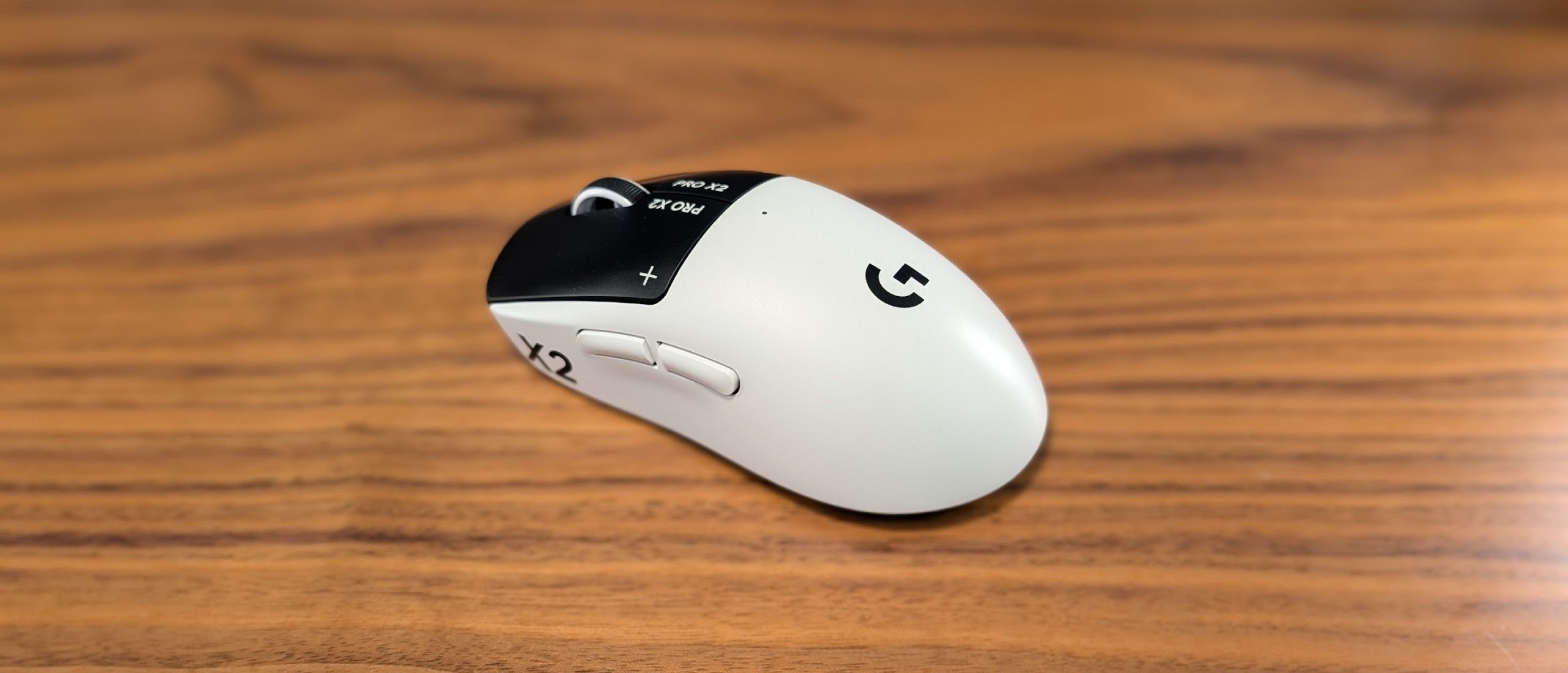
The X2 comes with the latest version of Logitech’s Hero 2 sensor. Like its outer appearance, there, tracking is far more on the iterative side. The only thing to change is the maximum DPI, which jumped from 32,000 to 44,000 (the numbers race crawls ever upward). It keeps the same 888 inches per second (IPS) max speed, 88G of acceleration, and up to an 8,000 Hz polling rate (1,000 Hz by default) . It’s high-spec and proven excellent many times over — but such minor updates definitely point to the triggers being the real reason to choose this over the Superlight.
In the quest to make mice ever lighter, the Superstrike leaves frills like DPI buttons on the cutting room floor. There’s no Bluetooth, which is expected for a competition-oriented gaming mouse. Its 61 gram weight is airy and only one gram more than the Superlight 2, despite the more advanced tech inside it.
There’s been a slight compromise on battery life, dropping from 95 hours or constant motion to 90 hours. It’s not much, but there’s a big caveat to this that the Superlight 2 and other gaming mice don’t have to contend with. Since each click is now driven by jolts to haptic motors, balancing feedback with battery life is a new consideration. On its default setting of “3,” my test period has me trending toward that 90 hour mark, even including some hours of testing at higher levels.
With a retail price of $180, the Superstrike has a lot to prove. Because of its familiar shape, however, you essentially know what you're getting going in. It’s a very simple, minimalist shape and layout that most people will find comfortable right away. Depending on your preference of video game genre, you might find it a little too basic.
That’s because the Superstrike, like the Superlight series, is mainly designed around competitive shooters. It intentionally trades extra buttons for a streamlined design that delivers only what you’ll need but at the highest quality and performance Logitech has to offer. At 61 grams, it’s meant to feel like an extension of your arm — to get out of the way, in other words and any inputs you don’t “need” are left for other mice.
When it comes to physical performance, it lacks nothing compared to the Superlight 2. The grip is the same — fingertip, claw, or hybrid between the two. A palm grip isn’t ideal due to its low height and slim size. Its weight and high-performance sensor also make it perfect for twitch shooting and quick snaps, both of which lend themselves to a nimble grip.
It’s comfortable to hold. Out of the box, there’s no texturing or rubberized finishes to support control. It seems a little slick, but the shell has small contours on either side to promote a steady grip. There are also grip tapes included in the box as an optional add-on. I didn’t find the mouse difficult to hold without them, but the grip tapes add a significant amount of control that I preferred right away.
Tracking is, expectedly, excellent. Logitech's Hero sensor is a proven commodity, so you won't need to worry about spin outs or jittery reticles. Its maximum DPI is outside of what I personally find easy or even reasonable to use but, for the sake of science, I did try turning it all the way to the max and lowering my in-game sensitivity, which worked fine.
The important thing to know, however, is that tracking accuracy is pixel perfect throughout the range. If you're like most gamers, and you keep a sensitivity somewhere between 800 and 2000 DPI, you'll find that it doesn't get much better than what the Superstrike has to offer.
The new haptic technology is interesting and effective at mimicking mechanical mouse clicks. Like I mentioned above, it's not one-to-one and you can pretty quickly tell the difference between a traditional sharp mechanical click and the rounded bump of the haptic motor. Despite lacking some sharpness, there's enough power to the haptics that the tactility is exceptionally good. Being able to dial it in through Logitech's G-Hub software is all the better and guarantees you'll be able to find a feedback level that matches your preference.
The competitive edge the X2 offers comes from the inductive switches driving those haptics. With the ability to raise and lower the actuation point, you’re able to customize whether clicks send faster or slower, depending on your needs. In gaming, raising the actuation point to its highest turns each click into a hair trigger, similar to Hall Effect switches and trigger-locked custom controllers.
Logitech quotes up to 30ms of improvement. As a gamer turning 40 this year, I’ve noticed my own reaction time slowing down from what it once was. The 30ms of improvement doesn’t seem like much on paper, but it in practice, holds the potential to turn back time and help level the playing field against younger players. Or, if you’re among the whippersnappers dominating my BF6 lobbies, your advantage can stretch even further.
“Up to 30ms” is a pretty concrete claim, so I put it to the test using AimLabs. AimLabs is an aim-training program available on Steam and made up of benchmarks to improve your skills. One of those tests focuses explicitly on reaction time: as soon as you see a colored sphere, you click. No aiming, nothing else other than pure reaction time.
Through more than four dozen trials, I averaged out my current response time with my prior daily driver, the Razer Basilisk Mobile, my response time with the Superstrike on stock settings (actuation in the middle of the press), and my response time with the highest actuation point possible. I also tested to see if there was any difference between 1,000 Hz and 8,000 Hz polling rates for my speed.
Between the two mice, my reaction time remained almost exactly the same. With the Basilisk, I averaged 247ms across ten runs. The Superstrike on stock settings averaged 243ms — well within the margin of error. Raising the actuation point to its highest level dropped that to 218ms. Not quite 30, but enough to feel when you’re in the middle of a match. Polling rate didn’t make any difference whatsoever.
I admit that I was skeptical about even being able to perceive 30ms of improvement, but I could and easily. It’s subtle, but the Superstrike definitely felt snappier. The marketing is true.
Did this new tech make me a better player? Kind of. For someone like me, it helps level the playing field. But, like always, a mouse is just a tool and is not a replacement for skill. That 25ms of improvement may have let me fire the first shot more often, but if the other player has better aim, they still might net the win.
The inductive triggers also make Rapid Trigger (SOCD) possible for the first time on a mouse. It works identically to gaming keyboards with the feature. It’s easy to see how it could be configured to improve ADS speed, even if only slightly. We don't know yet whether competitive games will ban this feature like they did with gaming keyboards.
For productivity and non-competitive games, these benefits are less impactful — but they still matter. I have a tendency to misclick from time to time, especially if I’m multitasking. When I’m getting work done or browsing the web, I lower the actuation point almost all the way. Clicks need more weight, so those mistaken clicks have all but disappeared. If you’re a fan of macros or binding lots of different actions to your mouse hand, you'll probably find the Superstrike limited, however.
Like most other Logitech G peripherals, the Superstrike is configured using Logitech's G Hub software. This suite is polished, straightforward, and clearly designed for ease of use. You don’t need to be familiar with G Hub to dive right in and start personalizing the mouse.
Loading it up for the first time, I was prompted to update the mouse to the latest firmware version before it would be fully accessible. The process was fast and frustration free, then I was greeted with a graphic of the mouse, as well as my current battery level.
Clicking into the mouse applet reveals several tabs on the left for configuring DPI, polling rate, and a handful of other parameters. There’s also a neat feature that allows you to sensitivity-match the Superstrike with whatever your last mouse was, saving you the troubleshooting of trying to manually match sensitivities. You can also configure the scroll wheel to avoid accidentally bumping it and changing weapons mid fight.
The new H.I.T.S. system has its own dedicated tab. There, you can set the actuation point and feedback level so it feels and responds just as you would like. There’s also a rapid trigger where you can map the actuation and reset behavior to make the buttons even more responsive.
Overall, I find Logitech G Hub to be simple and straightforward. The advanced functions are well explained and there’s frankly more functionality built in that I personally find myself taking advantage of due to the button count. It’s great for newcomers, though, and does a good job of making the H.I.T.S. system quick and easy to engage with.
With mice being such staple peripherals, real innovation is rare. These are peripherals that have been “figured out” for years now, which is what makes the Logitech G Pro X2 Superstrike so refreshing. It’s simultaneously simple and minimalist while also being one of the most technologically advanced and forward thinking out there. And best of all, the innovation works: It’s objectively faster than a normal gaming mouse.
There’s no way around how expensive the X2 is, and if 30ms of improvement doesn’t sound worth it to you, the Logitech G Pro X Superlight 2 is worth a look (and is significantly cheaper). If you need more inputs and you don’t mind trading some weight to get there, the Razer Basilisk V3 Pro 35K is also a solid alternative.
Even though this won’t automatically make you a better player, the H.I.T.S system feels like an important advancement in gaming mice. I expect we’ll see more mice with customizable triggers in the future. For now, however, this is your only option for this kind of performance. If you don’t care about extra buttons and you want to mechanically reclaim some reaction time, it’s well worth considering.
Chris is a regular contributor for Tom\u2019s Hardware, covering mechanical keyboards, peripherals, and content creation gear. ","collapsible":{"enabled":true,"maxHeight":250,"readMoreText":"Read more","readLessText":"Read less"}}), "https://slice.vanilla.futurecdn.net/13-4-18/js/authorBio.js"); } else { console.error('%c FTE ','background: #9306F9; color: #ffffff','no lazy slice hydration function available'); } Christopher Coke Social Links Navigation Contributor Chris is a regular contributor for Tom’s Hardware, covering mechanical keyboards, peripherals, and content creation gear.
Key considerations
- Investor positioning can change fast
- Volatility remains possible near catalysts
- Macro rates and liquidity can dominate flows
Reference reading
- https://www.tomshardware.com/peripherals/gaming-mice/SPONSORED_LINK_URL
- https://www.tomshardware.com/peripherals/gaming-mice/logitech-g-pro-x2-superstrike-review#main
- https://www.tomshardware.com
- Starlink Mobile teases ‘5G speeds from space with 100x the data density’ — V2 satellites are being sent into orbit to power the upgrade
- The Nightmare Returns in the Cloud: GeForce NOW Unleashes Capcom’s ‘Resident Evil Requiem’
- Drones attack several AWS Middle East region data centers amid Iran war, leading to outages — service health been disrupted after power cut due to fire risk
- Apple's new MacBook Air gets M5 and doubles starting storage — base price increases to $1,099
- Leading Inference Providers Cut AI Costs by up to 10x With Open Source Models on NVIDIA Blackwell
Informational only. No financial advice. Do your own research.