
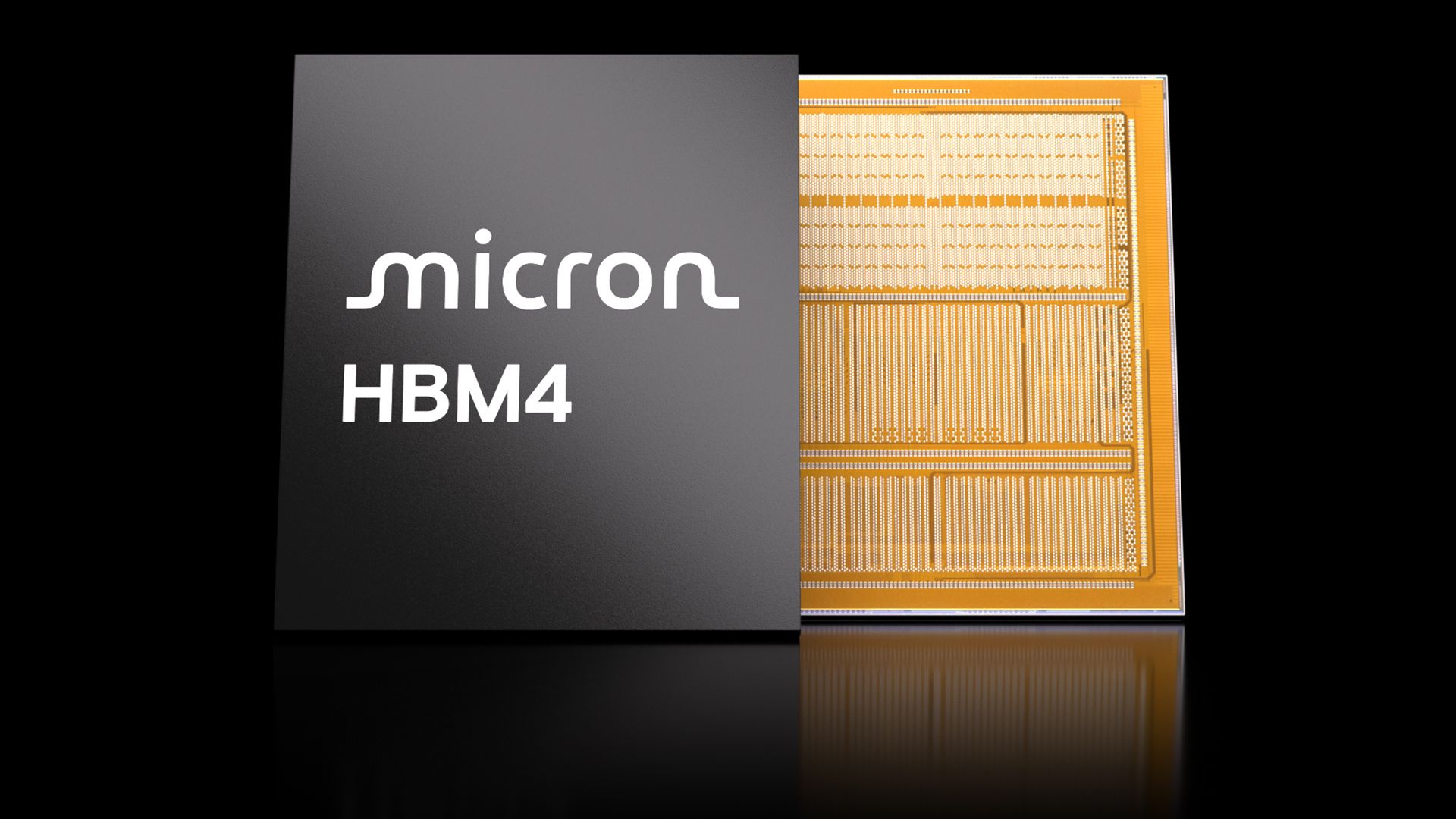
HBM has shifted from a niche technology used in a handful of HPC accelerators into a foundational element of modern AI hardware. Unlike conventional DDR or GDDR memory, HBM stacks multiple DRAM dies vertically and connects them through an ultra-wide interface, delivering orders of magnitude more bandwidth per watt.
Current HBM3E stacks already provide several terabytes per second of bandwidth, feeding GPUs such as Nvidia’s H200 and AMD’s MI300X without becoming a performance bottleneck. Next-gen HBM4 pushes this further by doubling the interface width to 2048 bits and supporting taller stacks with higher-density dies. In doing so, HBM4-class memory enables larger models, faster training, and more efficient inference without relying solely on brute-force compute scaling.
This, unfortunately, has also turned HBM into a choke point. AI accelerators cannot ship without it, and the ability to produce advanced HBM at scale now directly limits how many high-end GPUs can reach the market. As a result, memory suppliers have found themselves graduating from being interchangeable commodity vendors to fully-fledged semiconductor industry behemoths whose roadmaps influence the entire AI hardware ecosystem.
That explains why governments are increasingly willing to subsidize HBM development, and Taiwan’s Ministry of Economic Affairs has been explicit that memory is the missing pillar in its semiconductor ecosystem. The island already dominates advanced logic manufacturing and chip design, but has historically relied on foreign suppliers for cutting-edge memory technology. Supporting Micron’s HBM R&D is a way to anchor that capability locally.
Micron is the smallest of the three major HBM suppliers by volume, behind SK hynix and Samsung, but it has rapidly closed the tech gap over the past two product generations. Micron’s HBM3E has already been qualified by major accelerator vendors, and the company has publicly stated that its HBM capacity for 2026 is fully booked. The company recently made headlines when it axed its Crucial consumer business to enable the company to focus more on producing HBM and storage devices to feed the AI beast.
SK hynix, meanwhile, currently holds a dominant share of the HBM market and has reportedly committed much of its near-term output to Nvidia, while Samsung is investing aggressively to regain momentum, pushing 12-layer HBM3E and preparing for HBM4 transitions. In that environment, Micron’s ability to accelerate development, improve yields, and bring new stacks to volume production earlier than rivals could materially affect market share.
Taiwan also offers Micron more than just money. The subsidy requires R&D to be conducted locally and encourages collaboration with Taiwanese companies, particularly in equipment, materials, and advanced packaging. That’s key because HBM development is not just about DRAM cell design but also involves through-silicon vias, wafer bonding, thermal management, and increasingly complex interposer and advanced packaging technologies.
Micron plans $9.6 billion HBM fab in Japan as AI memory race accelerates
Key considerations
- Investor positioning can change fast
- Volatility remains possible near catalysts
- Macro rates and liquidity can dominate flows
Reference reading
- https://www.tomshardware.com/tech-industry/SPONSORED_LINK_URL
- https://www.tomshardware.com/tech-industry/micron-secures-318-million-taiwanese-subsidy-for-hbm-rd-as-ai-memory-arms-race-intensifies#main
- https://www.tomshardware.com
- Adata XPG Mars 980 Blade 2TB SSD Review: Affordable Luxury
- Microsoft silently kills Windows and Office phone activation and forces online activation with a Microsoft account — Windows users are now herded into an online
- Get a Steelseries Rival 3 Wireless mouse for just $25, or 34% off the regular price — potent rodent is simple and executes flawlessly
- Finnish authorities seize ship and crew after undersea cable cut, pursuing criminal charges — Finnish special forces board ship, detain all 14 crewmembers
- ASRock to enter AIO liquid cooling market with an intriguing pumpless design at CES — full lineup to include more traditional options, some with LCD displays
Informational only. No financial advice. Do your own research.