
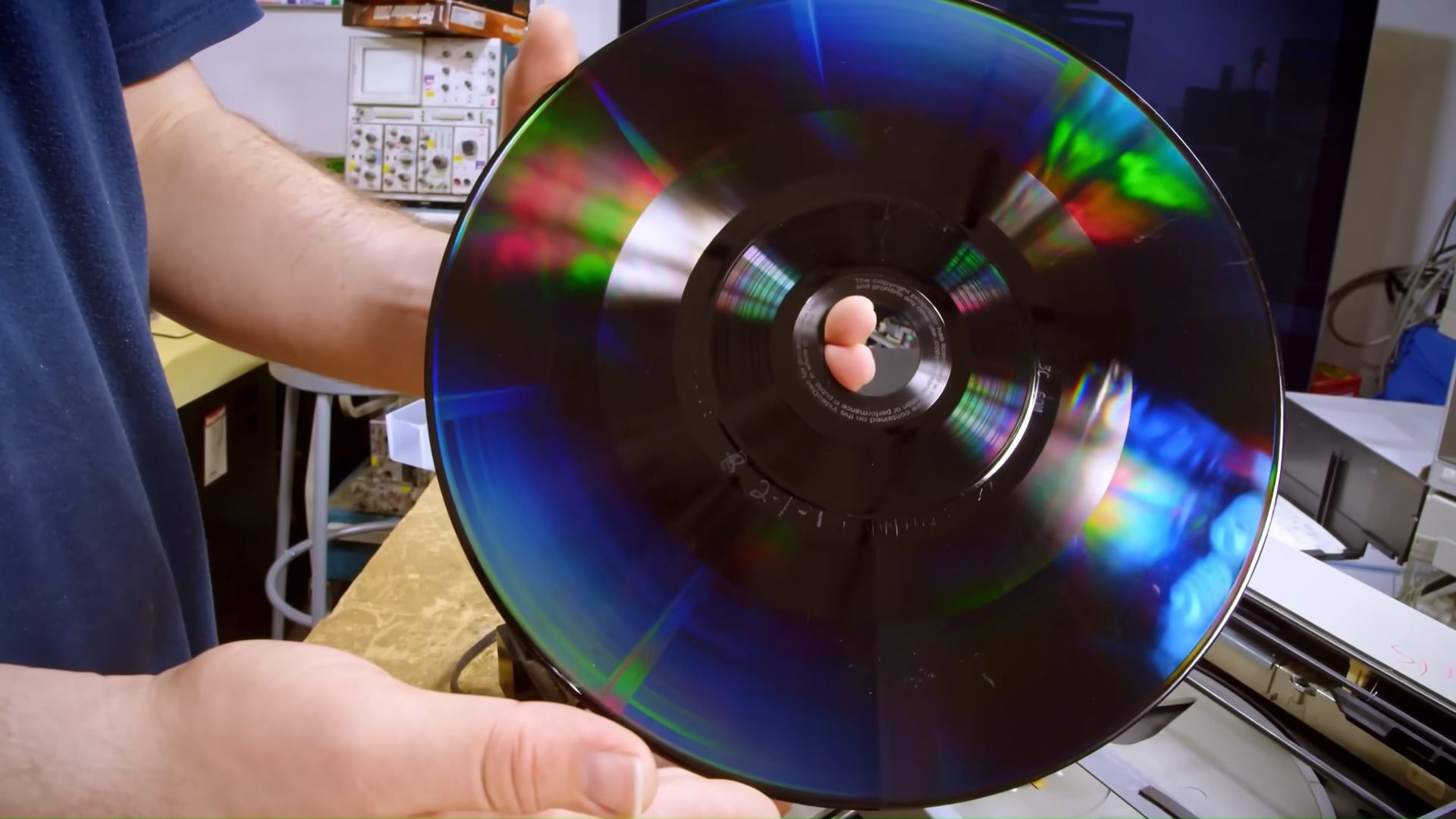
The main event takes place around 25 minutes into the video. A CED disc is (at last) placed under the microscope. After a bit of zooming, focusing, and angling of light sources, TT blurts, “Oh my gosh. We just nailed it. Bang. Right there.”
Again, it is some text, but this time a much clearer representation of the disc content. The CED surface text is almost as clear as a stored video frame on some old film.
After that excitement, the video host moves along to look at a couple of other tech-related artifacts under the microscope. The extras include a surface study of a mixed-mode audio/data CD , and a smartphone screen close-up where the OLED (sub) pixels are clearly visible.
If you reckon the demonstrated desktop digital microscope is a good one, it is the Andonstar AD246S model. We have noticed it is currently 13% off and available for $139 on Amazon .
Follow Tom's Hardware on Google News , or add us as a preferred source , to get our latest news, analysis, & reviews in your feeds.
Mark Tyson is a news editor at Tom's Hardware. He enjoys covering the full breadth of PC tech; from business and semiconductor design to products approaching the edge of reason. ","collapsible":{"enabled":true,"maxHeight":250,"readMoreText":"Read more","readLessText":"Read less"}}), "https://slice.vanilla.futurecdn.net/13-4-18/js/authorBio.js"); } else { console.error('%c FTE ','background: #9306F9; color: #ffffff','no lazy slice hydration function available'); } Mark Tyson Social Links Navigation News Editor Mark Tyson is a news editor at Tom's Hardware. He enjoys covering the full breadth of PC tech; from business and semiconductor design to products approaching the edge of reason.
Skramblr Title is wrong. That's not a LaserDisc, its a CED ( Capacitance Electronic Disc). These are two different things Reply
pockyfiend "Though the media looks quite a lot like a LaserDisc, a CED (Capacitance Electronic Disc) is an unusual video distribution format that existed for a time" You guys said it correctly in the very first paragraph of the article . So then how did you spend the rest of the article, as well as the headline, getting it completely wrong and calling it a "LaserDisc"? Are you just getting lazy and writing these with AI these days? 🤦♂️ This system actually used a needle, like a vinyl record player, rather than a laser, to read analog audio and analog video, unlike a LaserDisc, which was an optical disc that that used a laser like a CD player to read analog OR digital audio along with analog video (yes, optically-recorded NTSC/PAL analog video signals read by laser.) I actually had a Capacitance Electronic Disc player ("RCA VideoDisc" / "SelectaVision") was the brand name) with some titles as a kid, including a bunch of Disney discs and Bakshi's The Hobbit. Recently, cleaning out my parents ' basement, I even found some softcore erotica. Reply
bit_user Loosely related (about LDs, not CEDs): the first time I saw a CAV laserdisc in person, I knew enough about video that I actually understood the significance of being able to see the line and field structure. That blew me away! If you knew where to look, you could figure out whether the disc had closed captioning information just through visual inspection! The other thing that blew my mind about Laserdisc is that it's effectively an analog medium! It still works by either the presence or absence of pits, but their spacing in the time domain isn't discrete. This encodes a composite video signal, which is pretty insane, because it means you then need to de-jitter the signal enough that the chroma & luma can be separated. Most video recording formats use a different chroma modulation schema that's much less susceptible to jitter. Reply
Kevlarrgh This intrigues me. The description implies that the signal is read linearly in a spiral path, so how does a coherent FRAME appear optically with successive frame lines on neighboring "tracks"? Is this a pure coincidence where a single track holds all the scan lines +1 in that, or every part of the disc? Also, how does the needle track closely and rapidly enough without touching or marring the disc at video bandwidth? Reply
bit_user wakuwaku said: Btw, CEDs are vinyl, they are not vinyl-like. It is made from vinyl so it is vinyl. The name vinyl comes from the material the disc is made from. According to Wikipedia: "The first CED prototype discs were multi-layered, consisting of a vinyl substrate, nickel conductive layer, glow-discharge insulating layer and silicone lubricant top layer. Failure to fully solve the stylus/disc wear and manufacturing complexity forced RCA to seek simpler construction of the disc. The final disc was crafted using PVC blended with carbon to make the disc conductive. To preserve stylus and groove life, a thin layer (up to 50 nm thick) of silicone (polysiloxane) or methyl alkyl siloxane was applied to the disc as a lubricant." So, I think it's not accurate either to say it's vinyl or entirely vinyl-like. Perhaps you could describe "PVC blended with carbon" as "vinyl-like", but that overlooks the coating. wakuwaku said: Simple and Easy English! "Everything should be made as simple as possible, but not simpler." — Albert Einstein Reply
bit_user Kevlarrgh said: This intrigues me. The description implies that the signal is read linearly in a spiral path, Yes, like a conventional record. Kevlarrgh said: so how does a coherent FRAME appear optically with successive frame lines on neighboring "tracks"? That happens when you have some scrolling text. If scrolling at an appropriate speed, the same scanline, over successive frames, shows progressively more of the text. Put together, you see a scan-out of the full text. At least, that's how I understood it. That's why the sample images are showing credits. It would also work when the camera pans down. I think the same thing would probably work with CAV laser discs. Kevlarrgh said: Also, how does the needle track closely and rapidly enough without touching or marring the disc at video bandwidth? My understanding is that it does touch the disk, but that the groove is merely serving the purpose of guiding the head. Unlike in audio records, head detects the depth of the groove through variation in capacitance (i.e. the deeper the groove, the lower the capacitance). Because there's not a needle that's vibrating at video frequencies (i.e. several MHz), you don't have mechanical wear-out of the signal portion. Reply
80251 A really interesting read. Now do an article on DAC! Reply
Key considerations
- Investor positioning can change fast
- Volatility remains possible near catalysts
- Macro rates and liquidity can dominate flows
Reference reading
- https://www.tomshardware.com/pc-components/storage/SPONSORED_LINK_URL
- https://www.tomshardware.com/pc-components/storage/microscopes-can-clearly-see-the-video-on-the-surface-of-a-laserdisc-discovers-techtuber-a-12-inch-vinyl-like-disc-that-stores-sd-analog-video#main
- https://www.tomshardware.com
- Fiber internet provider says it can detect leaking water pipes using existing infrastructure, prevented loss of 2 million liters a day over three months — Light
- March Into the Cloud With 15 New Games Coming to GeForce NOW
- The Nightmare Returns in the Cloud: GeForce NOW Unleashes Capcom’s ‘Resident Evil Requiem’
- How to protect yourself from bad external SSDs during the PC hardware apocalypse – newer drives will definitely cost more, and some may offer up shockingly poor
- Survey Reveals AI Advances in Telecom: Networks and Automation in Driver’s Seat as Return on Investment Climbs
Informational only. No financial advice. Do your own research.