
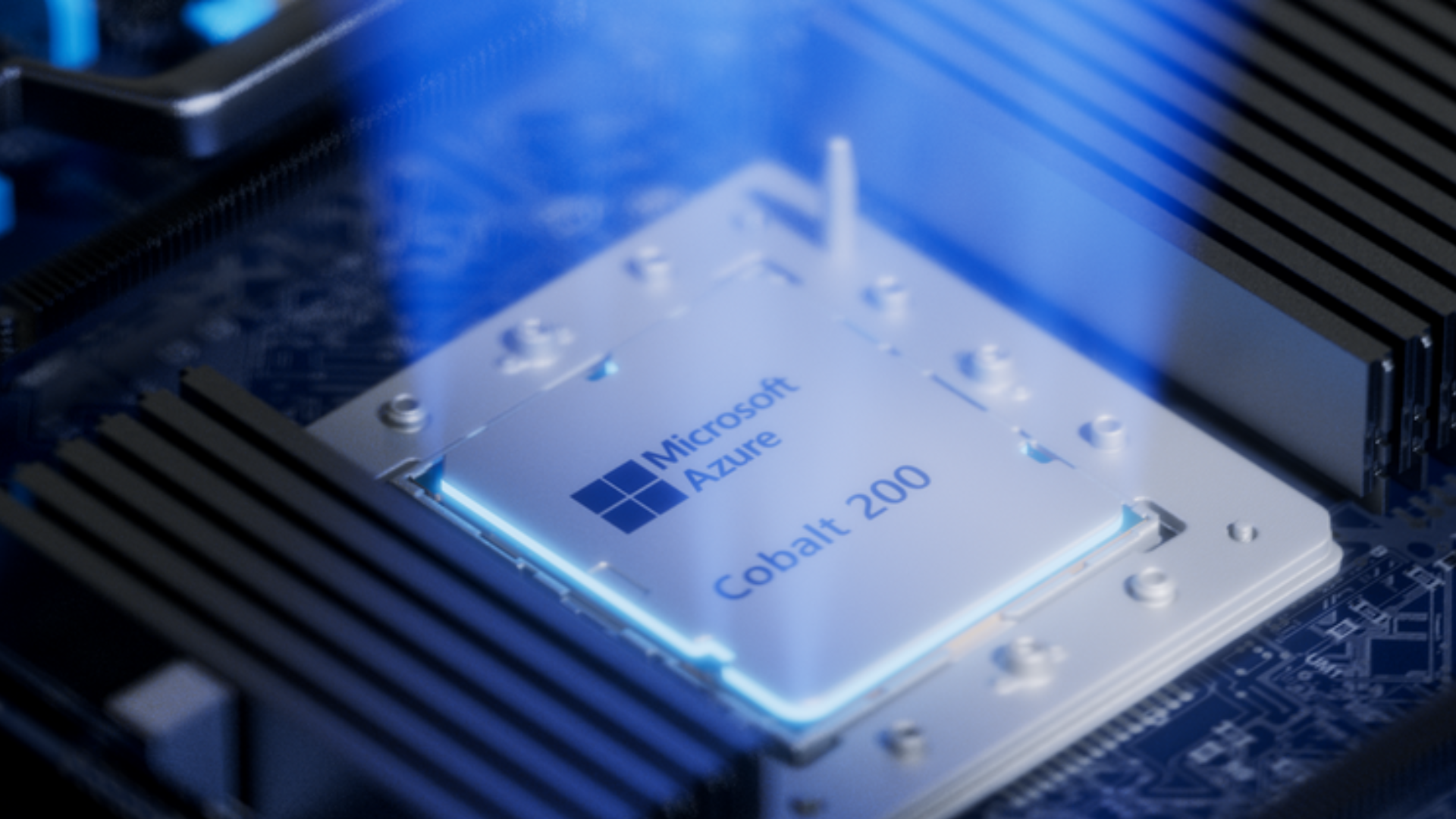
One of the clearer differences between Cobalt 200 and the previous generation is in how the company has moved certain common data-center tasks into hardware. Compression and cryptography engines are now part of the SoC. These blocks sit alongside the CPU cores and offload encryption and decryption that previously consumed a noticeable share of compute time on database and analytics workloads. Microsoft has highlighted SQL Server as an early beneficiary of these offloads, with I/O encryption handled directly on the silicon.
Thermals and power remain in focus with Cobalt 200, too. Microsoft says the chip delivers more than 50% higher performance than its predecessor while maintaining its status as the most power-efficient platform in Azure. Each core supports dynamic voltage and frequency scaling, allowing the processor to adjust power use in response to workload demands.
Combined with the 3nm process and the inclusion of dedicated hardware accelerators for tasks like compression and encryption, the architecture is built to maximize throughput without requiring all cores to operate at peak frequency simultaneously. While Microsoft has not published detailed thermal or TDP specifications, the company positions Cobalt 200 as a significant performance upgrade.
Cobalt 200 is delivered as part of a broader hardware stack that brings together Microsoft’s own CPUs, networking, and storage offload engines, and a new hardware security module. Each server node pairs the processor with Azure Boost, the DPU that handles software-defined networking and remote storage. This offload moves packet processing and I/O scheduling entirely out of the CPU, allowing the chip to reserve its cores for application and service workloads.
The cloud CPU market is moving quickly. Amazon has its Graviton line for general compute and the Trainium and Inferentia families for training and inference. Google continues to expand its TPU offerings with high-bandwidth pods tuned for transformers. NVIDIA’s H100 and H200 GPUs remain the dominant accelerators for large-model training, and AMD is pushing MI300 in the HPC and AI segments.
Microsoft’s Cobalt 200 sits in a different part of this spectrum. It’s not an accelerator and is not meant to compete with the H200 or Trainium2 clusters. Its job is to deliver high sustained throughput on the services that form the foundation of Azure’s cloud business, such as web front ends, microservices, transactional databases, streaming ingestion, and the fast-growing category of CPU-bound AI inference. In these categories, core count, cache size, and memory bandwidth matter more than anything else.
A good parallel is Amazon’s Graviton3 , which significantly improved AWS’s price-performance for web and database workloads. The difference is that Microsoft has pushed further into customization. The 132-core layout and 3nm node give it a larger execution footprint than Graviton3’s 64 cores on 5nm, while the compression and crypto blocks target specific Azure workloads such as SQL Server, Cosmos DB, and large-scale telemetry processing. Arm’s own data from the CSS V3 subsystem indicates performance-per-socket gains of up to 50% over N2-based designs, a figure that aligns with Microsoft’s internal benchmark results.
RAM Benchmark Hierarchy 2025: DDR5, DDR4 for AMD, Intel CPUs
Key considerations
- Investor positioning can change fast
- Volatility remains possible near catalysts
- Macro rates and liquidity can dominate flows
Reference reading
- https://www.tomshardware.com/tech-industry/semiconductors/SPONSORED_LINK_URL
- https://www.tomshardware.com/tech-industry/semiconductors/microsoft-unveils-azure-cobalt-200-cpu#main
- https://www.tomshardware.com
- Dell and HP disable hardware H.265 decoding on select PCs due to rising royalty costs — companies could save big on HEVC royalties, but at the expense of users
- Save $250 on Samsung's spacious and speedy 8TB SSD — 9100 Pro drops to all-time low of 9 cents per GB
- One Giant Leap for AI Physics: NVIDIA Apollo Unveiled as Open Model Family for Scientific Simulation
- AWS, Google, Microsoft and OCI Boost AI Inference Performance for Cloud Customers With NVIDIA Dynamo
- Gigabyte's 32-inch Aorus 4K gaming monitor now just $749.99 at Amazon and Best Buy — 240 Hz speed demon hits all-time low pricing for Black Friday
Informational only. No financial advice. Do your own research.