
When you purchase through links on our site, we may earn an affiliate commission. Here’s how it works .
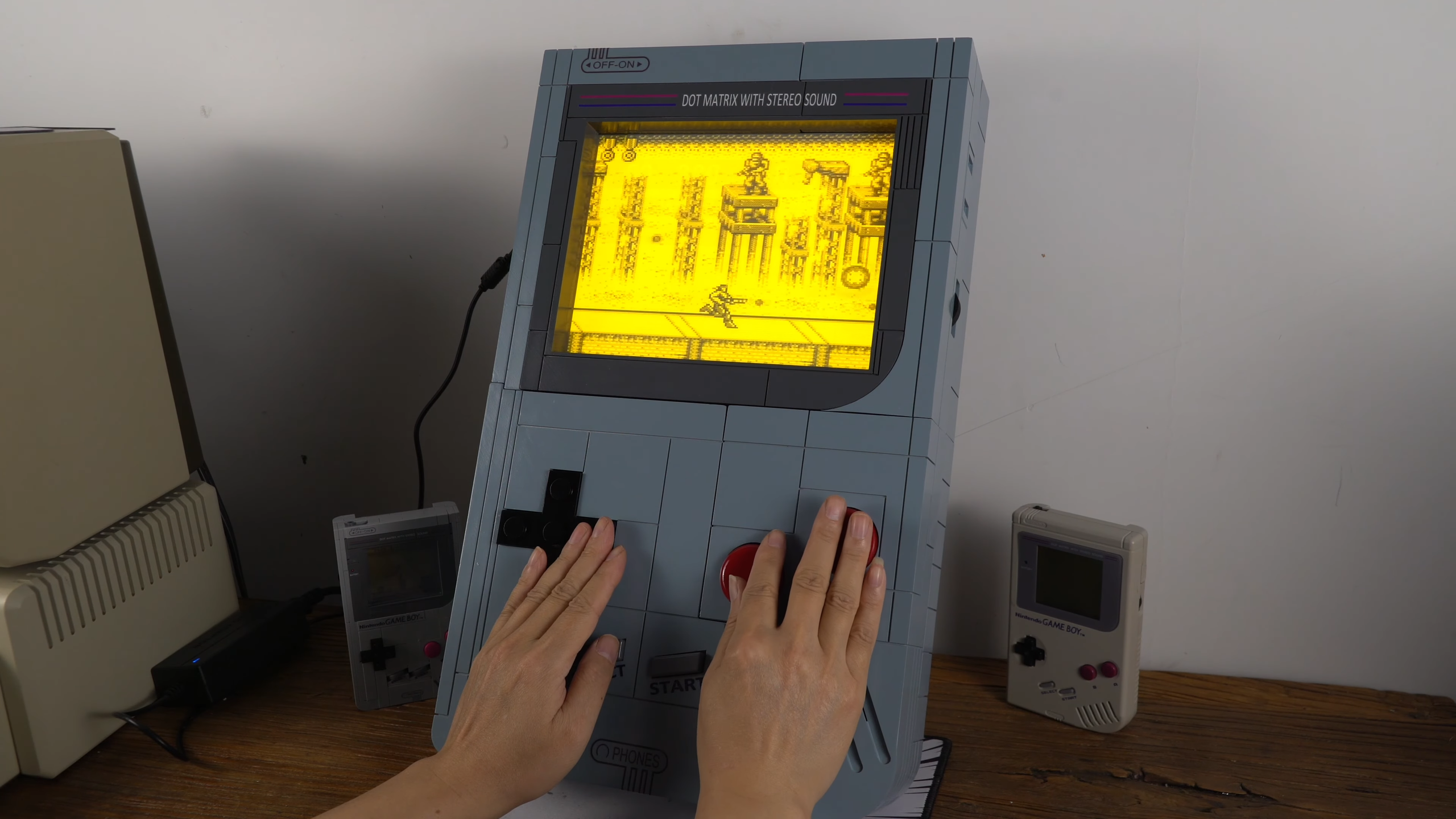
(Image credit: LCLDIY) Share Share by: Copy link Facebook X Whatsapp Reddit Flipboard Share this article Join the conversation Follow us Add us as a preferred source on Google The Lego Game Boy launched earlier this year to rave reviews, but it's just a showpiece that doesn't actually play games. Someone eventually built a working modded version of it, but even then, the screen was too small for LCLDIY , a modder hailing from China. He decided to make a giant Lego Game Boy using an electroluminescent display instead, to avoid the "annoying pixelation" that would otherwise come with simply scaling up an older screen.
Watch On The star of the show — the EL display — is not cheap, as outlined on the Hackaday.io page . Moreover, it's hard to make it work with modern systems because it was never designed to accept that kind of signal. It doesn't even support relatively recent outputs like VGA, so everything had to be tweaked from the ground up, starting with how the display communicates with a "GPU."
Lego Game Boy turns into an actual Game Boy that can play real catridges, modder packs in a whole custom PCB
Modders recreate the original Xbox prototype with solid block of metal and original hardware
This scratch-built, period-correct Portable Commodore 64 is a love letter to an alternate Commodore history
Before that, though, let's understand why the modder even chose an electroluminescent display. See, in many ways, it's the predecessor to OLED, which today is the closest thing we have to CRT. Both displays have pixels that emit their own light, feature near-instant response times, and an infinite contrast ratio due to the lack of a backlight.
OLED, however, scans progressively, whereas CRT was interlaced and had a soft glow due to phosphor persistence. OLED can simulate that look through shaders, and it's often necessary for older games to look era-accurate on an otherwise unforgiving modern display tech. That beautiful glow effect, though, can be achieved with electroluminescent screens, too.
Like CRT, EL displays produce a soft, blended pixel look on even large panels, but they do so through phosphor persistence rather than true interlacing. Unlike CRTs, EL displays don't require bulky cathode ray tubes; they are essentially a matrix of phosphors. But those layers are instead controlled through selective voltage, lighting up pixels and naturally masking low-res pixelation.
This is where the OLED connection comes full circle — they're also controlled by electronic pulses; it's just that the pixels are organically self-lit rather than relying on phosphors. Display TED Talk aside, this is why an electroluminescent panel made sense, as it preserved that romanticized glowing look without requiring heavy cathode tubes or jumping straight to OLED and mimicking the entire aesthetic.
Get Tom's Hardware's best news and in-depth reviews, straight to your inbox.
Key considerations
- Investor positioning can change fast
- Volatility remains possible near catalysts
- Macro rates and liquidity can dominate flows
Reference reading
- https://www.tomshardware.com/video-games/retro-gaming/SPONSORED_LINK_URL
- https://www.tomshardware.com/video-games/retro-gaming/modder-builds-giant-game-boy-featuring-a-dreamy-electroluminescent-screen-driven-by-custom-graphics-adapter-diy-retro-console-is-fully-functional-with-working-buttons#main
- https://www.tomshardware.com
- Opt-In NVIDIA Software Enables Data Center Fleet Management
- Deck the Vaults: ‘Fallout: New Vegas’ Joins the Cloud This Holiday Season
- Into the Omniverse: OpenUSD and NVIDIA Halos Accelerate Safety for Robotaxis, Physical AI Systems
- Windows 11 rockets SSD performance to new heights with hacked native NVMe driver — up to 85% higher random workload performance in some tests
- 1,000 computers taken offline in Romanian water management authority hack — ransomware takes Bitlocker-encrypted systems down
Informational only. No financial advice. Do your own research.