
One thing to know about USB ports is that the colors aren’t consistent. That being said, USB 3.2 Gen 2 (10 Gbps) ports are usually red, USB 3.2 Gen 1 (5 Gbps) blue, and USB 2.0 (480 Mbps) ports black. But again, that’s not always the case — especially when board makers add features like sleep-charge to some ports, or ASRock’s gaming-focused yellow Lightning ports.
Also note that if you plan to install a dedicated graphics card, you likely won’t use the onboard video ports (Type-C in the image above, but often HDMI or DisplayPort). If that’s your aim, look for a board with fewer (or no) video ports to make room for more USB or other ports.
If you’re overwhelmed by all the features and details above, you’ll be relieved to hear that, when it comes to motherboard size, your options are pretty simple. The vast majority of today’s consumer motherboards come in one of four sizes: E-ATX, ATX, Micro-ATX, and Mini-ITX.
ATX is the de facto standard, and offers the second-most space for features and expansion. Mini-ITX allows for compact PCs that still have space for a single graphics card, while Micro-ATX falls between the two in size and expansion.
You may also encounter E-ATX motherboards, which are larger than ATX and are primarily used in high-end or workstation-class systems or flagship-class consumer boards. Other sizes are available, but chances are you’ll opt for one of the three sizes illustrated above.
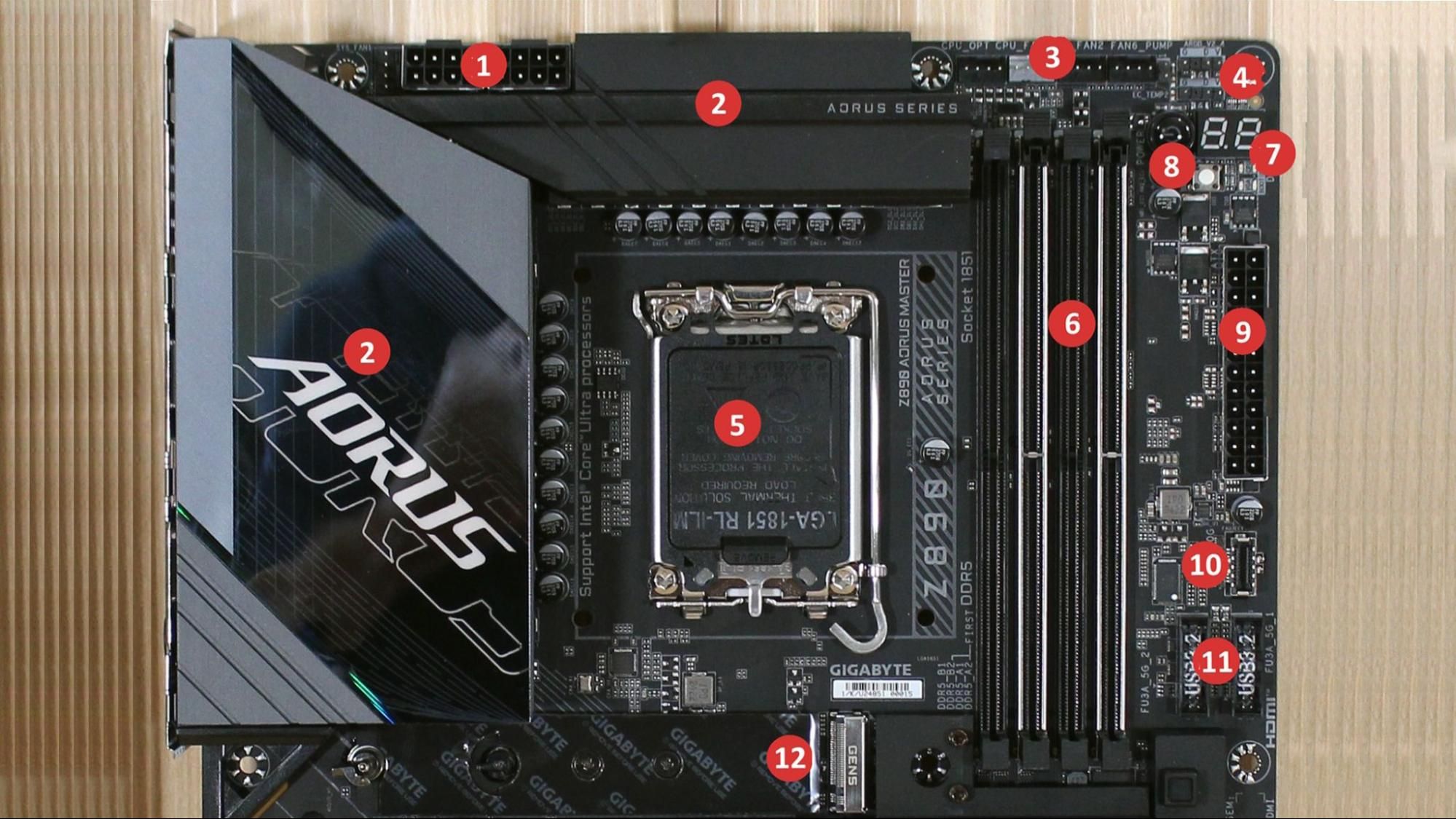
Also worth mentioning are the new “PZ” or “BTF”-style motherboards, where the major connectors are all on the back side of the motherboard. Although they still use the standard dimensions mentioned above, connections such as EPS, ATX, USB, SATA, and more are on the back of the motherboard, allowing for a clean look and easier wire management. Just be sure your case supports the rear-facing motherboards.
Another key board consideration is, of course, what CPU you need it to support. For all you need to know about choosing a processor, you can head to our CPU buying guide . But once you’ve settled on a CPU, you often still have chipset options which dictate things like how many high-speed components you can install, or how many super-fast USB ports are supported.
Since the chipset is arguably the main component that’s permanently attached to the motherboard (as opposed to removable CPU or RAM), we’ll list the primary features of each current-generation chipset below, to help you choose. But chipsets can be incredibly complex, enough so that a story could be written about each one. Along those lines, you can peruse the finer details of Intel’s latest mainstream H370 and B370 chipsets and boards in our Cheap Coffee Lake feature . For feature details and comparisons of those and other current chipsets, you can check the charts below.
*STD = Standard/Integrated **OPT = Optional
Key considerations
- Investor positioning can change fast
- Volatility remains possible near catalysts
- Macro rates and liquidity can dominate flows
Reference reading
- https://www.tomshardware.com/pc-components/motherboards/SPONSORED_LINK_URL
- https://www.tomshardware.com/pc-components/motherboards/modern-motherboard-features-explained-connectors-headers-ports-and-chipsets-decoded#main
- https://www.tomshardware.com
- Gigabyte Aorus FO27Q5P 27-inch 500 Hz QD-OLED gaming monitor review: Superb in every respect
- Bank of America sued over not paying workers for PC boot up time in proposed class action lawsuit
- Jensen Huang confirms there are no plans to ship Blackwell GPUs to China right now, chipmaker at Beijing's mercy — Nvidia CEO says shipments haven't been approv
- NVIDIA Founder and CEO Jensen Huang and Chief Scientist Bill Dally Awarded Prestigious Queen Elizabeth Prize for Engineering
- NVIDIA Open Sources Aerial Software to Accelerate AI-Native 6G
Informational only. No financial advice. Do your own research.