
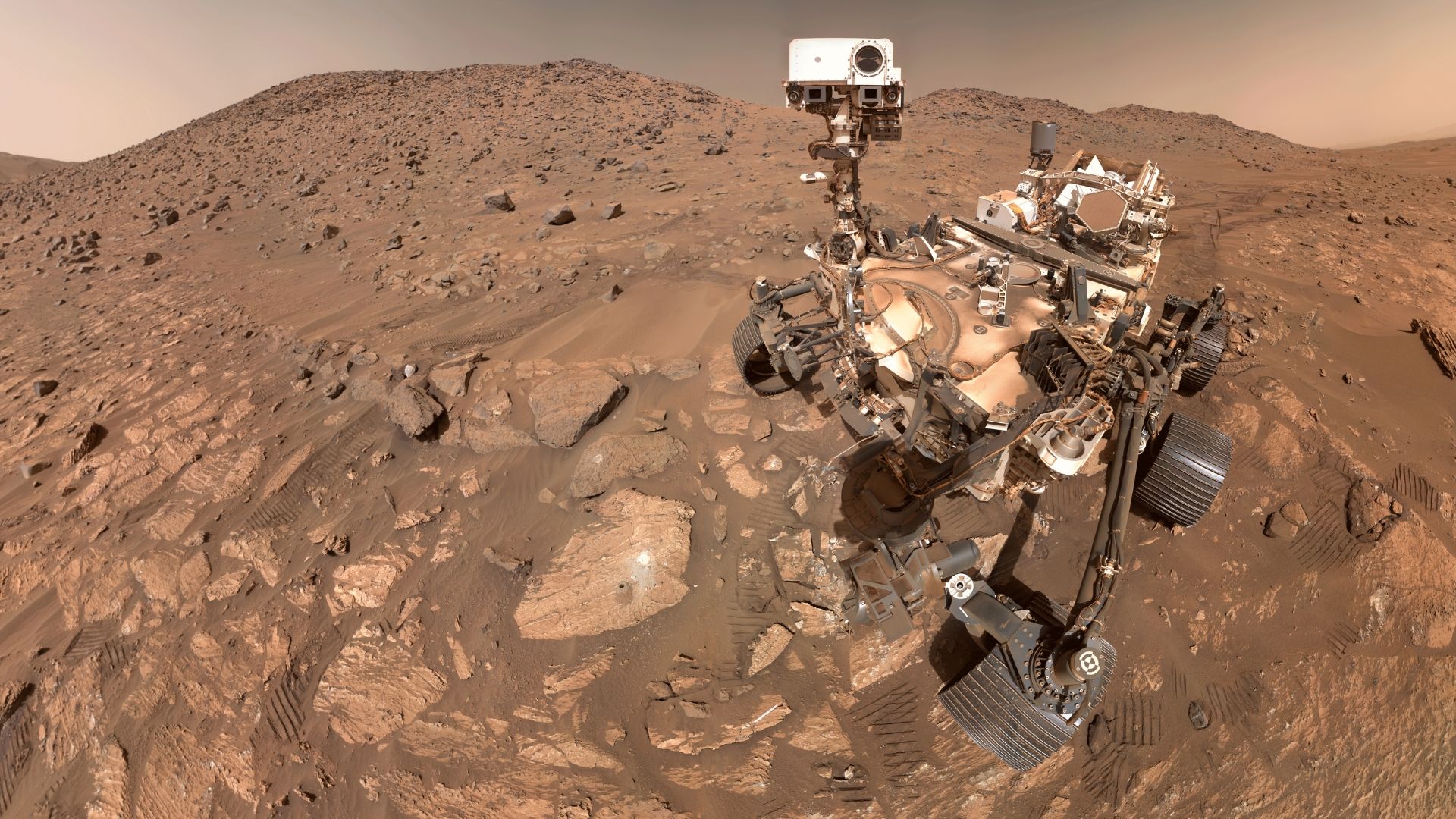
The "ancient" Snapdragon 801 chip for mid-range smartphones is still powerful enough to give the rover accurate directions.
When you purchase through links on our site, we may earn an affiliate commission. Here’s how it works .
The space agency fixed this with an ingenious method involving the use of its panoramic cameras, satellite information of the surface of the red planet, and an unused chip from the rover. Perseverance's Helicopter Base Station is equipped with a Qualcomm Snapdragon 801 SoC, which it previously used to communicate with the rover. But since the chopper was retired in 2024, the chip has remained idle and unused. So, NASA engineers decided to repurpose it to help Perseverance find where it is to an accuracy of about 10 inches.
What the rover would do is to take panoramic photos of its surroundings. It would then feed the data to the SoC and convert it into a bird’s eye view of its surroundings, after which it would compare that with satellite terrain maps taken from orbiting spacecraft. By matching the converted 360-degree photo with overhead images from the satellite, it can then pinpoint its exact location on the planet’s surface. NASA calls this technology Mars Global Localization, and it serves as a substitute for GPS without requiring a constellation of 24 satellites.
After nearly fifty years, Voyager 1 spacecraft approaches one light-day milestone — 25.9 billion km distance from Earth ensures one day of latency for commands
Qualcomm Snapdragon X Elite's latest Linux benchmarks show it performs like five-year-old Intel Tiger Lake chips
UK company shoots a 1000-degree furnace into space to study off-world chip manufacturing
“This is kind of like giving the rover GPS. Now it can determine its own location on Mars,” said Vandi Verma of the NASA Jet Propulsion Laboratory. “It means the rover will be able to drive for much longer distances autonomously, so we’ll explore more of the planet and get more science. And it could be used by almost any other rover traveling fast and far.”
Although this isn’t the first time that NASA engineers worked at planetary distances, it still remains an astounding feat to be able to successfully reprogram a spacecraft while being hundreds of millions of miles away from it. This is exactly what the space agency achieved when its Voyager 1 spacecraft, which launched in 1977, encountered an error in deep space. When its memory module finally failed after traveling for over 45 years , the engineers were able to devise a way to bypass the errant chip and continue operating the spacecraft. And, as of late 2025, it has now reached one light-day — meaning it takes 24 hours to send commands to the probe, and another 24 hours to receive a response — making it the farthest man-made object from Earth.
Follow Tom's Hardware on Google News , or add us as a preferred source , to get our latest news, analysis, & reviews in your feeds.
Get Tom's Hardware's best news and in-depth reviews, straight to your inbox.
Key considerations
- Investor positioning can change fast
- Volatility remains possible near catalysts
- Macro rates and liquidity can dominate flows
Reference reading
- https://www.tomshardware.com/tech-industry/SPONSORED_LINK_URL
- https://www.tomshardware.com/tech-industry/nasa-engineers-reprogram-the-perseverance-rover-for-autonomous-navigation-from-140-million-miles-away-repurposes-its-ancient-unused-qualcomm-801-soc-accurate-to-within-10-inches#main
- https://www.tomshardware.com
- Save $649 by buying 64GB of DDR5-6000 G.Skill RAM with an Nvidia RTX 5070 GPU — Newegg will even throw in a free Cooler Master CPU cooler to sweeten the deal
- OpenAI couldn’t finance its data centers, so it took control of the hardware instead — company's chip design aspirations lag behind Google and Amazon
- Everything Will Be Represented in a Virtual Twin, NVIDIA CEO Jensen Huang Says at 3DEXPERIENCE World
- Save $349 on a 9850X3D, bundled with 32GB of RAM and a motherboard at Newegg — RAM effectively $150 when paired with X870E Aorus and AMD's fastest gaming chip
- ATAboy bridges old IDE drives to the 21st century with Open Source USB host bridge — powered by a Raspberry Pi RP2350 and with custom "Award" BIOS menu
Informational only. No financial advice. Do your own research.