
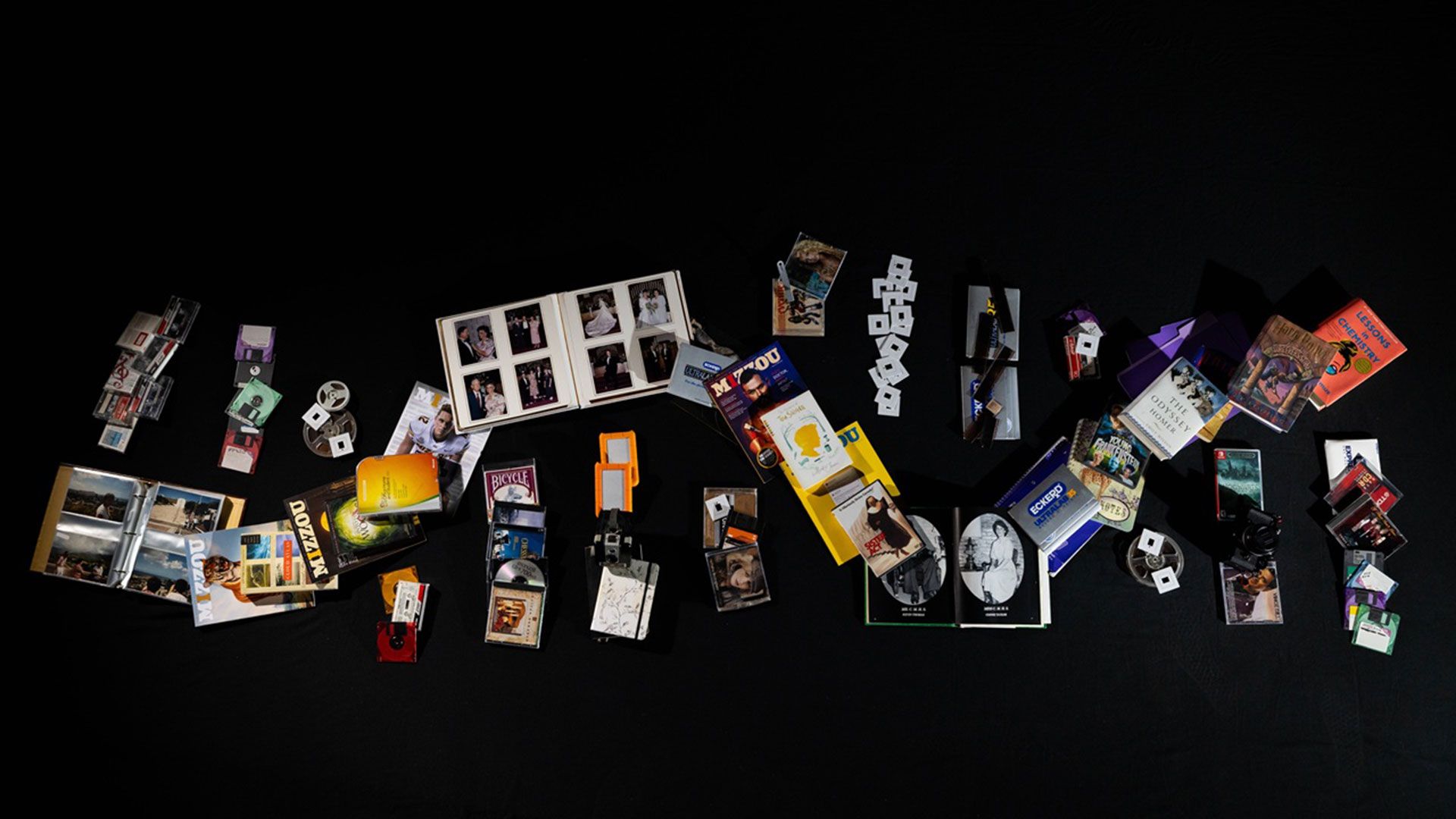
“DNA is incredible — it stores life’s blueprint in a tiny, stable package,” Li-Qun ‘Andrew’ Gu, a professor of chemical and biomedical engineering at Mizzou’s College of Engineering, gushes. “We wanted to see if we could store and rewrite information at the molecular level faster, simpler, and more efficiently than ever before.”
We know of the potential of DNA from prior published works, news from other academic institutions such as MIT , and details from the University of Washington’s well-publicized collaborations with Microsoft , among many others . So, what makes Mizzou’s advances stand out from the crowd? It is touted to be an irresistible mix of simplicity, speed, and rewritability.
'World's first scalable DNA data storage offering' announced offering a staggering ‘60PB in 60 cubic inches,’ enough to hold 660,000 4K movies
Microsoft's Project Silica write-once storage could store terabytes of data for over 10,000 years
Key to ultra-dense next-gen data storage could be a new magnetic state found in twisted 2D materials
Gu’s team claims to have developed a method to store, erase, and overwrite DNA data repeatedly. Indeed, this would make the Mizzou DNA HDD attractive and practical – with its “extraordinary storage density and longevity,” due to the nature of DNA.
Mizzou doesn’t divulge details of the writing methodology in its blog post, but we unearthed the associated research paper, which says it uses "frameshift encoding" to write data. This technique is an emerging approach among several groups looking at rewritable DNA storage.
The Mizzou blog briefly explains its DNA reading method, though. The team has designed “a compact electronic device paired with a molecular-scale detector called a nanopore sensor,” it is explained. This read head, since we are using HDD terminology, senses the subtle electrical changes as DNA passes through its field, and electronics/software converts the DNA’s A, C, G, and T sequences into binary.
The academics assert that their project, which leverages the university’s experts in fields such as physics, biology, data, and materials sciences, marks a “key milestone in making DNA a long-term replacement for some of today’s energy-hungry storage technologies.” That’s pretty bold for a project that admittedly has a “long-term” hope to shrink its DNA HDD to USB thumb-drive size. Moreover, we haven’t even seen the non-miniaturized prototypes or demos yet. We’ll stay tuned, but think it will be a while before we see any DNA-data thumb drives on Amazon …
Get Tom's Hardware's best news and in-depth reviews, straight to your inbox.
Key considerations
- Investor positioning can change fast
- Volatility remains possible near catalysts
- Macro rates and liquidity can dominate flows
Reference reading
- https://www.tomshardware.com/pc-components/storage/SPONSORED_LINK_URL
- https://www.tomshardware.com/pc-components/storage/new-dna-hdd-can-be-erased-and-overwritten-repeatedly-university-of-missouri-researchers-aiming-for-next-gen-thumb-drive-sized-storage#main
- https://www.tomshardware.com
- Microsoft adds Shader Execution Reordering (SER) in latest DirectX SDK for more efficient ray tracing — Intel Arc B-series GPUs show 90% performance uplift
- Lenovo's Legion Go Fold-able gaming handheld concept has four screen modes, also works as a small laptop — POLED display unfolds from 7.7 to 11.6 inches
- Starlink Mobile teases ‘5G speeds from space with 100x the data density’ — V2 satellites are being sent into orbit to power the upgrade
- Two suspects arrested over theft of $1.5 million in Bitcoin stolen from police custody in outrageous blunder — Korean cops left virtual assets stored with a thi
- DRAM bots reportedly being deployed to hoover up memory chips and components — one operation ran 10 million web scraping requests, hitting DDR5 RAM product page
Informational only. No financial advice. Do your own research.